

You're probably looking at a strip, a bottle, or a meter because something in the tank, the laundry room, or the pet area doesn't smell right, and you want a number before you guess. That's exactly where an ammonia test kit earns its keep, because it turns an invisible nitrogen compound into a reading you can act on. The catch is that the number only makes sense if you know what form it measures, what the sample came from, and what temperature and pH were doing at the time.
A quick example helps. A parent checks a fish tank after feeding, a pet owner checks a kennel area after a deep clean, or a hobbyist tests water after moving a filter, and the same word, ammonia, suddenly means different things. In one setup, the number is mainly about total nitrogen in the water. In another, it's really about whether the more toxic fraction is likely to rise as conditions change.
That's why the first question isn't “What color is it?” It's “What form am I reading, and what does this sample represent in real life?” If you keep that question in mind, the rest of the kit becomes much easier to trust. For a related aquarium setup reference, see the 10 gallon fish tank setup guide.
What an Ammonia Test Kit Measures
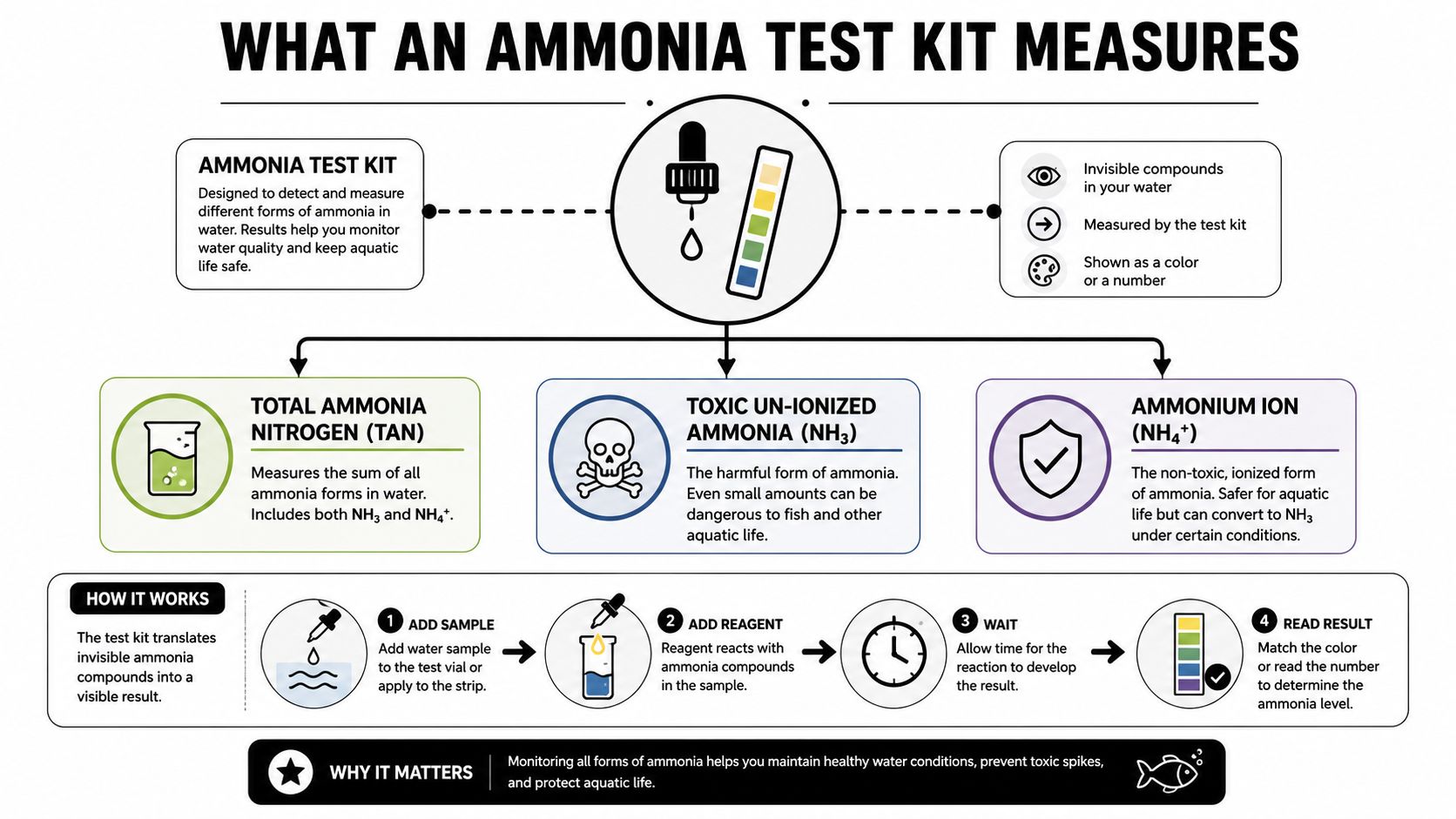
A strip can look clean and still deserve a second look. That is the part many first-time users miss, because an ammonia test kit is not reading smell, slime, or general grime. It is converting a chemical state into a color or a number, and that number depends on what form of ammonia is present in the sample.
In water testing, the terms total ammonia nitrogen (TAN), NH3-N, and NH4+ often appear together, but they do not mean the same thing. TAN is the broad total, NH3 is the unionized form that raises concern more quickly, and NH4+ is the ionized form that is generally less toxic.
TAN is the broad reading, not the whole risk picture
TAN includes both unionized ammonia and ammonium, so it gives you the wider pool of ammonia-related nitrogen. That wider view is useful, but it can also mislead you if you treat it like a direct toxicity score. The part that creates the biggest concern is NH3, while NH4+ is the less toxic ionized form.
The chemistry behind many kits is old, and that helps explain why the format is so standardized. Modern kits still commonly rely on Nesslerization or indophenol blue color methods, and the Berthelot reaction for ammonium detection was first reported in 1859 (PMC review of ammonium test-kit chemistry). That history is one reason the same basic approach shows up in aquariums, wastewater checks, household testing, and field work.
Why the same number can mean different things
A reading from a fish tank can look acceptable at one pH and risky at another. A reading from a grooming wash area can speak more to sanitation and runoff control than to fish safety. The kit gives you a translation, not a verdict.
Practical rule: treat the number as a starting point, then ask what kind of sample you tested and what conditions were present around it.
Temperature and pH shape what that number means, and the sample matrix matters too. A tank with warm water and a high pH can push more of the total into the toxic form, while a different environment, such as a kennel rinse area or a household cleaning setup, may change how the chemistry behaves before the color even settles. That is why the same reading can feel reassuring in one place and urgent in another.
Portable ammonia testing became useful outside the lab for the same reason. Public-health and toxicology literature notes that ammonia testing moved from older laboratory methods into practical field use, and field hygiene research later documented ammonia dosimeter development as part of occupational monitoring (ATSDR toxicology profile). The field kit did not replace chemistry, it made chemistry usable where decisions get made. For a related aquarium setup reference, see the 10 gallon fish tank setup guide.
How Strip, Liquid, and Electronic Sensors Work
A test kit can look like a small plastic tool on the shelf, but the three main formats work in different ways. If you understand the mechanism, you can tell why one format feels quick and another gives you more confidence when the color sits near the edge of the chart.
Strip kits react on the pad
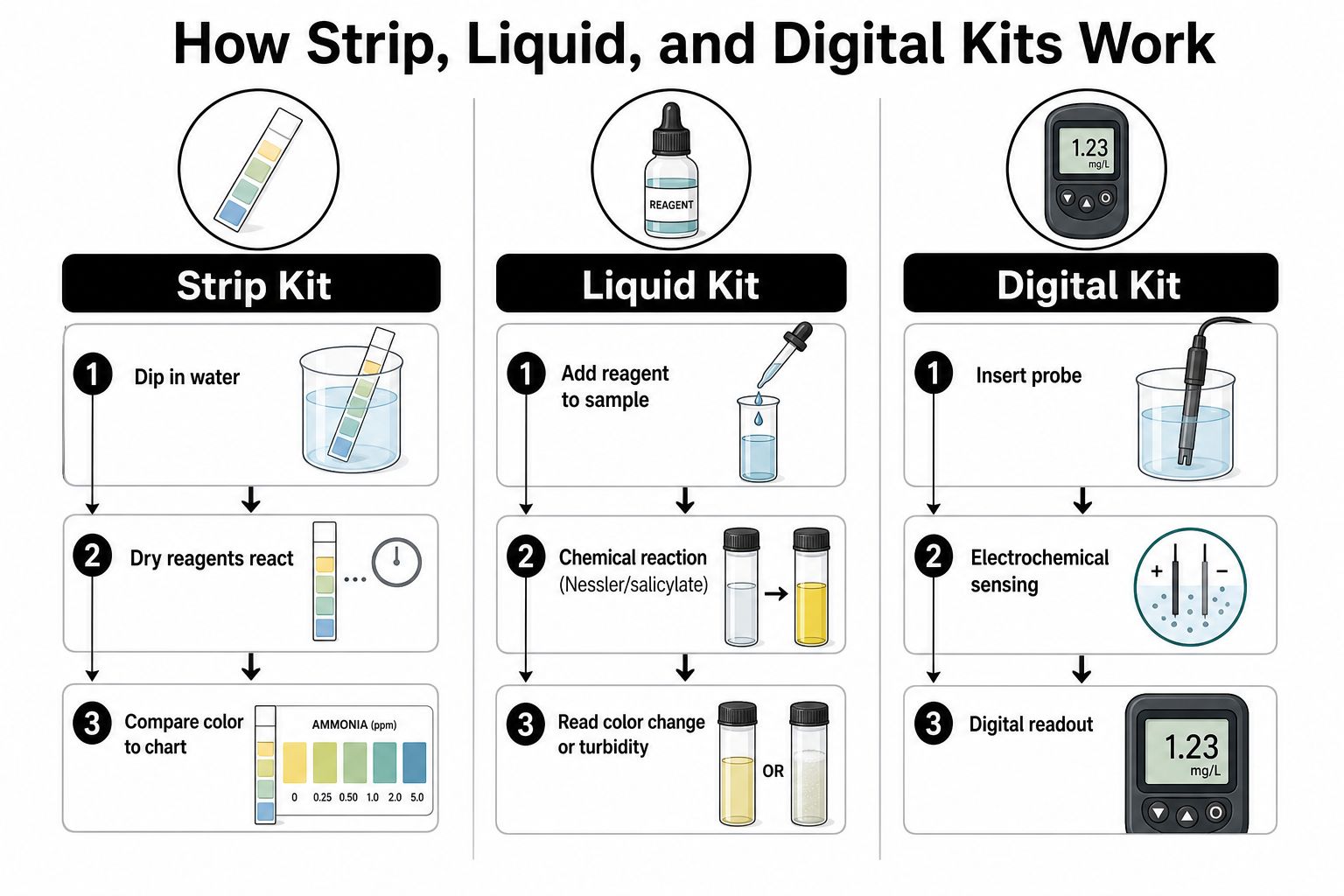
A strip kit uses dry reagents fixed to a pad. You dip it, wait the stated time, and compare the resulting color to a chart. The chemistry is compact, which is why strips are easy to store and quick to use in a pinch.
That convenience has a price. Strip results depend heavily on timing, light, and how carefully you handle the pad, so the reading can shift even when the water itself has not changed. In plain terms, strips work best as a fast screen, not as the last word on a borderline sample.
Liquid kits build the color in a vial
Liquid reagent kits add one or more reagents to a measured sample. The chemical reaction then produces a color change, or sometimes turbidity, that you compare against a standard. In the ammonia world, Nessler and salicylate chemistry are the classic routes, and modern products still center on those approaches (PMC evaluation of water ammonium test kits).
That extra step gives you more control over sample volume and reading conditions. It also makes liquid kits a better fit for people who need a steadier comparison than a strip can provide, especially when the number sits close to a decision threshold. For a closer look at the kind of sample handling that affects results, see this guide to an aquarium sand vacuum.
Electronic sensors turn chemistry into a meter reading
Electronic meters and probes do not remove chemistry from the process, they move it into the sensor. The device reads a response and translates it into a displayed value. In practice, that can make repeated checks easier, especially if you are tracking the same space over time.
This matters in more places than a fish tank. A grooming wash area, a household cleaning setup, or a small business space can all involve water, residue, temperature shifts, and surfaces that change what the number really means. The meter still gives you a reading, but the surrounding conditions decide how much trust to place in it.
A useful way to sort the three formats is simple. Strips give speed, liquid kits give more deliberate comparison, and sensors are built for repeated measurements where consistency matters more than convenience alone.
Comparing Strips, Liquid Reagents, and Electronic Sensors
A side-by-side view helps more than marketing copy does. The best ammonia test kit for your use case depends on whether you need a quick screen, a more careful reading, or something that can support repeated monitoring.
| Format | Typical range | Best for | Main trade-off |
|---|---|---|---|
| Strip | Narrow, kit-specific | Fast screening and checking for sudden change | More vulnerable to lighting and handling error |
| Liquid reagent | Kit-specific, often better for low-level color comparison | Hobbyists, small businesses, and users who want more confidence | Slower than strips and requires careful measuring |
| Electronic sensor | Application-specific | Repeated checks and ongoing monitoring | Higher setup discipline and more method dependence |
Strip kits win on speed, which is why they're common in everyday checks. They're useful when you want to know if something changed after feeding, cleaning, or a ventilation shift. They're less useful when the result sits near the edge of what the color chart can resolve.
Liquid kits sit in the middle. They're slower, but they usually give the user a cleaner reading workflow and a better chance at distinguishing between close colors. That's why many aquarists and small operators prefer them when the decision matters more than the convenience.
Electronic sensors are the most specialized of the three. They're the right fit when you need repeated measurements and want to avoid constant color matching. They're not a shortcut around method choice, though, because the sample type and calibration still matter.
If your decision is about whether to act now, a strip may be enough. If your decision is about diagnosing a pattern, a liquid or sensor method is safer.
For a more confined aquatic cleanup context, the aquarium sand vacuum resource is a useful companion read, because residue control and testing often go hand in hand.
Running a Test the Right Way
The biggest testing mistake is assuming the strip or bottle is the hard part. The hard part is sample handling. A clean workflow usually matters more than brand name, especially when the reading is near a boundary.
A simple strip routine
- Collect a representative sample. Pull water from the same place you care about, not from a stirred-up corner or a freshly topped-off spot.
- Dip for the stated time. Keep the strip level and don't over-soak it.
- Wait exactly as directed. Reading too early or too late can shift the color.
- Compare in good light. Natural daylight is usually the easiest way to reduce color confusion.
A simple liquid routine
- Use clean glassware. Old residue can distort the result.
- Measure the sample carefully. Vial volume matters because the chemistry is calibrated to a specific amount.
- Add the reagent in the stated order. Some kits are forgiving, some aren't.
- Read the result at the specified time. Don't guess if the color is still developing.
Cloudiness, smudged pads, and color drift usually point to handling errors before they point to a bad kit. If the sample was warm, dirty, or cross-contaminated from a previous test, repeat it with fresh glassware and a fresh sample. A single messy reading is a clue, not a verdict.
Reading the Number and What Safe Really Means
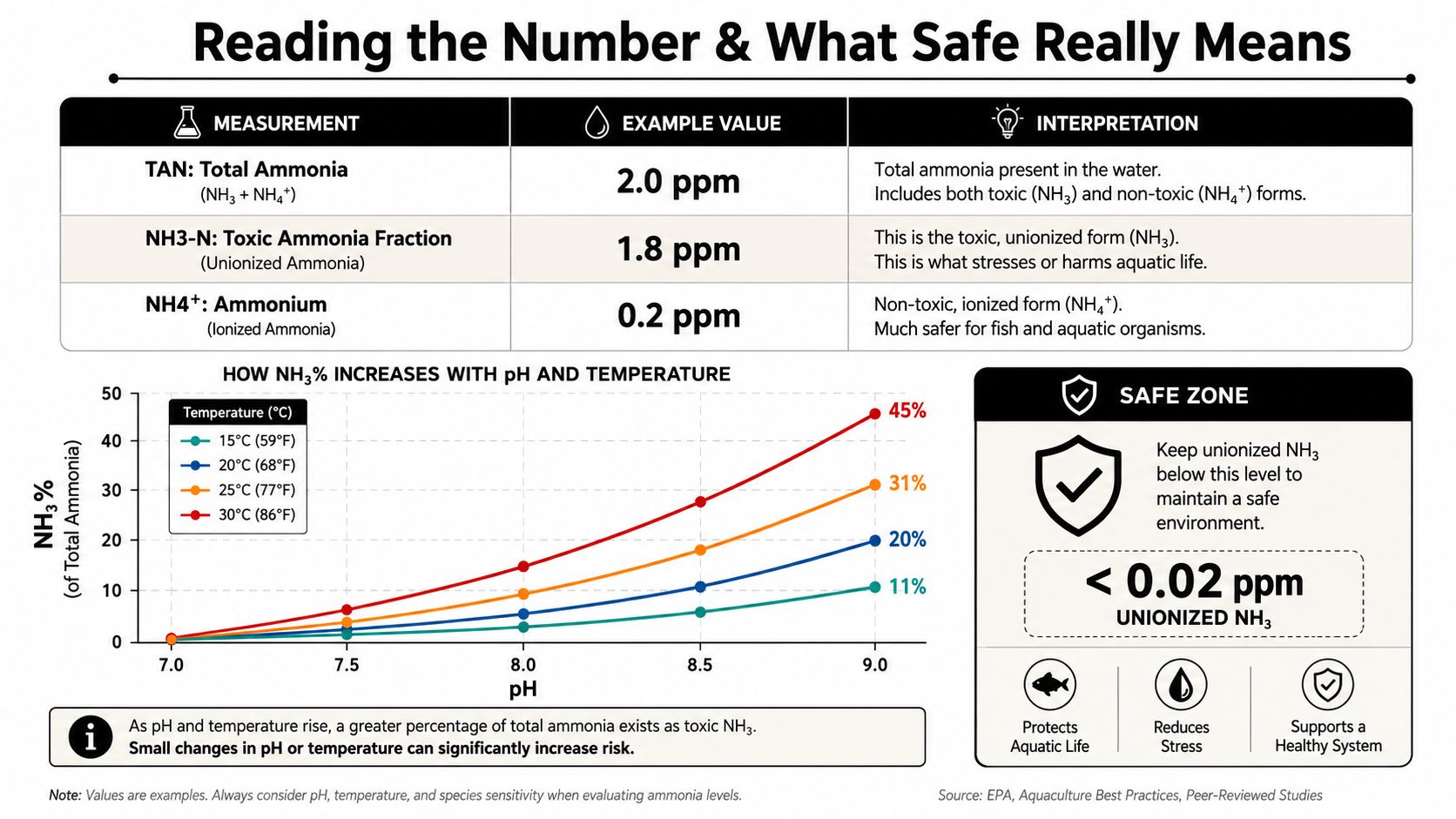
A number on its own can create a false sense of safety. TAN, NH3-N, and NH4+ sound close, but they are different measurements and they do not carry the same risk. The part that matters most is the toxic fraction of unionized ammonia (NH3), and that fraction rises as pH and temperature rise.
Why a “safe” TAN reading can still be a problem
Some consumer kits report TAN instead of free ammonia alone, so the same reading can hide very different levels of risk depending on the water. A kit may show a single total-ammonia value while the toxic share shifts with the sample's conditions. That is why a TAN number does not tell you how much of the total is the more harmful NH3.
A simple example makes the point clearer. If you get 1 ppm TAN in warm water with a higher pH, the toxic fraction can be far more concerning than the number looks at first glance. A groomer checking rinse water in a busy salon, or an owner checking a small tank beside a kennel or pet area, has to read the number together with the conditions around it. Temperature and pH are part of the result, not separate side notes.
Reference points by market
For aquarium work, published guidance for planted tanks treats 0 ppm NH3 as the most suitable condition, with total ammonia below 0.25 ppm described as safe in that context. The same guidance says levels above 0.5 ppm can become harmful to fish and invertebrates. The API aquarium guidance also explains how to interpret ammonia testing in context, which helps separate a plain total-ammonia reading from the part that causes harm (API aquarium ammonia guidance).
For environmental water monitoring, the EPA describes ammonia measurement as either a probe or a colorimeter, with the result compared against standards to convert absorbance into concentration (EPA ammonia measurement overview). That is the same basic idea as a hobby kit, but the surrounding sample conditions still matter. Cleaner water, darker water, and water with more organic load can all change how easy the result is to read.
Clinical testing uses a different frame entirely. FDA documentation for a human plasma ammonia assay gives an analytical range of 4 to 1700 µg/dL and a plasma reference interval of 31 to 123 µg/dL (18 to 72 µmol/L) (FDA plasma ammonia assay summary). That does not make it a household test. It shows how sharply the intended use changes the meaning of the result, the sample matrix, and the level at which a reading becomes a concern.
Troubleshooting Misreads and False Results
A bad reading does not always mean the kit failed. More often, the sample, the method, or the lighting changed what the result looked like. With ammonia, that matters because a pale color can shift enough to fool your eye before you realize it.
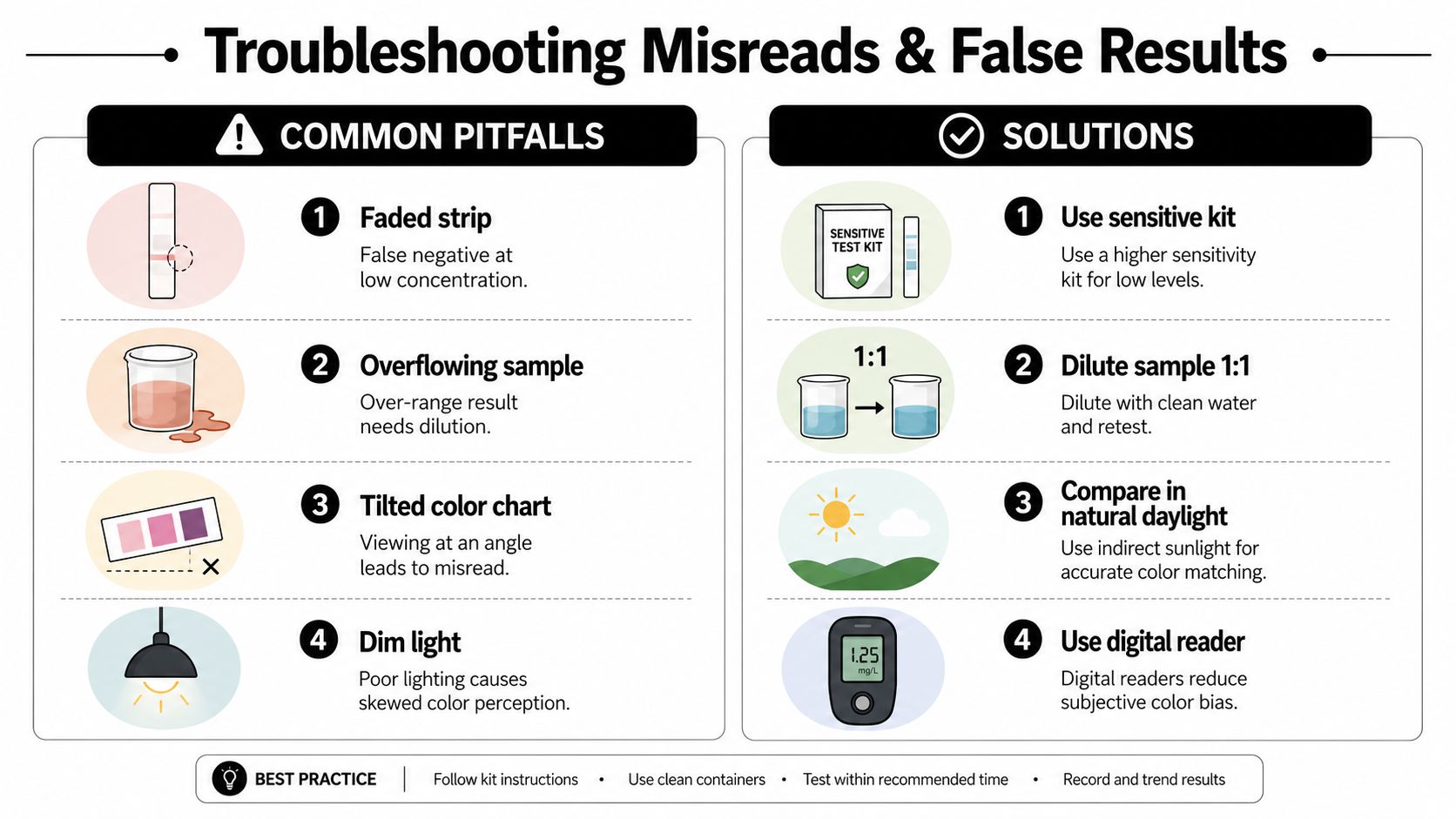
The four misreads people run into most often
- Faded strip pad: A low concentration can fall below what a strip shows clearly, so a strip may miss a trace level that a liquid or enzymatic assay would catch.
- Over-range sample: A sample that is too concentrated may need dilution before it fits back into the kit's readable window.
- Tilted color comparison: Reading the chart from the wrong angle changes how the eye sees the hue.
- Dim or mixed light: Poor lighting can make two close colors look the same.
Sample makeup matters as much as the kit. Urine, wastewater, and water with a high organic load can interfere with a simple hobby strip in ways a cleaner sample will not. Abcam's ammonia assay protocol discusses duplicate runs, multiple dilutions, and plate readers for quantitative work, which is a useful reminder that careful handling matters as much as the reagent itself (Abcam ammonia assay protocol.pdf)).
When to upgrade the method
A strip is a quick check, not a cure-all. If you need trace detection, or if you need results that line up across several samples, a liquid or enzymatic method is usually the better choice.
The chemistry behind those methods is more controlled. Sigma-Aldrich's ammonia assay uses L-glutamate dehydrogenase with absorbance at 340 nm, a linear range of 0.2–15 µg/mL, reagents for 100 assays, and storage at 2–8 °C (Sigma-Aldrich ammonia assay documentation).
Rapid enzymatic formats can still be fast. The Megazyme assay documentation.pdf) describes absorbance at 340 nm, a linear range of 0.2 to 7 µg per assay, a 0.07 mg/L detection limit, and about 5 minutes reaction time. Those numbers show why a tighter workflow gives cleaner results, especially when the sample is dark, crowded with dissolved material, or hard to read by eye.
Ammonia Monitoring for Grooming Studios and Pet Homes
In a grooming studio, ammonia usually shows up as odor, poor ventilation, damp flooring, or cleaning that is not keeping up with the load. In a pet home, the same compound can build in litter areas, bathing spaces, or anywhere urine, rinse water, and organic residue sit too long.
A disciplined workflow makes the reading useful. A premium grooming environment limits the number of animals on site, keeps sanitation routines clear, and treats airflow as part of the service standard rather than an afterthought. In El Paso, dry air and warm conditions can make smells feel sharper and linger longer, so consistency matters even more for El Paso dog grooming and premium pet grooming standards.
Where testing fits into real operations
A test kit helps answer whether the problem is mostly odor, moisture, or true ammonia buildup. If a space smells stronger after a change in cleaning product, after a busy bath day, or after poor ventilation, a reading gives you a fact base instead of a guess. If the number stays high, the next step is not to mask it with fragrance, it is to improve cleanup, airflow, and source control.
For household pet care, the same logic applies. A single higher reading in a wash area or around an enclosure can point to a sanitation gap, a drainage problem, or a product mismatch. For reference on smaller aquatic maintenance spaces, the 1 gallon tank page shows how compact setups still demand methodical upkeep.
Good monitoring does not punish you for a messy day. It tells you where the mess is coming from.
Veteran-owned shops often stand out because they can set their own pace and standards. A studio that works from its own playbook can choose the slower, cleaner, more deliberate process instead of rushing through volume like a chain. That difference is practical, not just branding, because fewer shortcuts usually mean fewer odor problems and better pet comfort.
Your Weekly Ammonia Check and When to Escalate
A weekly check keeps ammonia from becoming a surprise. Start with the places that collect residue, the tank, wash area, kennel floor, litter-adjacent zones, and any spot where rinse water lingers. Use a strip for a fast screen, then confirm with a liquid or enzymatic kit if the number looks borderline or the smell doesn't match the reading.
A simple checklist
- Test after routine cleaning: Look for sudden changes after switching soap, disinfectant, or rinse habits.
- Test after heavy use days: More dogs, more washing, and more moisture can change the air and water load.
- Test near problem spots: Focus on drains, mats, corners, and standing-water areas.
- Repeat questionable results: If the reading doesn't fit what you see or smell, rerun it with fresh sample and better light.
Escalate when readings stay non-zero in pet areas, when a spike follows a cleaning change, or when the same space keeps smelling wrong even after a thorough wash. In animals, lingering contamination can be a health issue, so talk to a veterinarian if the environment and the pet's symptoms seem linked. If the problem is structural, persistent, or tied to runoff, call a remediation professional.
One practical next step is to make the test part of the same rhythm you already use for grooming, feeding, or cleanup. That keeps ammonia from becoming an emergency and turns it into a manageable maintenance check.
Glo More Grooming brings that same disciplined mindset to premium pet grooming in El Paso, with one-on-one care, clear standards, and a calm process that puts comfort first. If you want grooming that respects your pet, your schedule, and your home's cleanliness, visit Glo More Grooming and reserve your appointment today.