
Most beginner advice about a 1 gallon tank gets the core issue backward. Small tanks aren't easier because they hold less water. They're harder because they forgive less. A missed top-off, a little extra food, a room that warms up in the afternoon, or a rushed water change can turn a tiny volume of water unstable fast.
That old 1 inch of fish per gallon rule sounds simple, but it breaks down badly in a micro setup. The rule was established over 30 years ago and later refined to account for mass. For a 1 gallon tank, that means it could only safely hold about 1 gram of fish, roughly one small guppy, which makes it functionally inadequate for most species, as noted in this aquarist discussion of stocking by fish mass.
A humane 1 gallon tank is possible only if you treat it like expert-mode aquarium keeping. That means disciplined workflow, premium care standards, and a willingness to value animal welfare over the usual “cute desktop tank” aesthetic. If you want a low-effort starter aquarium, this isn't it. If you still want to try, the only honest path is precision.
The Unspoken Truth About 1 Gallon Tanks
A 1 gallon tank is not a beginner tank. It's a tiny, unstable life-support box.
Beginners usually assume a smaller aquarium means less work. In practice, the opposite is true. The smaller the water volume, the less buffering capacity you have against waste, temperature swings, evaporation, and chemistry changes. In a larger aquarium, a minor mistake often stays minor. In a micro tank, the same mistake can become a crisis by the end of the day.
Why the old rule fails
The biggest myth is that fish length tells you what fits. It doesn't. Waste production, oxygen demand, and the effect an animal has on water quality are tied much more closely to body mass and total bioload than to a simplistic length rule.
That's why the revised guidance matters. A 1 gallon tank only safely supports about 1 gram of fish, which is why most fish are poor candidates from the start. Even if a fish physically fits inside the glass, that doesn't mean the system can support its needs in a humane way.
Practical rule: If your plan for a 1 gallon tank starts with fish, stop and rethink the plan.
What responsible ownership looks like
Ethical aquarists don't ask only, “Can this animal survive here?” They ask, “Can this setup stay stable enough for that animal to live without chronic stress?” That's a very different standard.
The hard truth is useful. It helps you avoid a cycle of impulse buying, emergency fixes, and preventable losses. A 1 gallon tank can work as a carefully managed micro-ecosystem. It usually fails as a casual fish tank.
Essential Equipment for Micro-Aquarium Stability
The tank itself is the least important part of the system. Stability comes from the gear around it.
A lot of small kits include the bare minimum. That might be enough to hold water. It usually isn't enough to keep that water stable. In a micro aquarium, every piece of equipment needs to support a disciplined routine. Think less “starter kit” and more “compact life-support system.”
The non-negotiable gear
Heater with dependable control
A small tank changes temperature quickly, so consistent heating matters. Skip the mindset that room temperature is close enough. It often isn't.Low-flow sponge filter or similarly gentle biofiltration
You need a place for beneficial bacteria to live. In a tiny tank, aggressive flow can toss small inhabitants around, so gentle filtration works better than flashy current.Liquid test kit
Test strips are convenient, but a 1 gallon tank punishes vague information. You need to track ammonia, nitrite, nitrate, and pH with care because the dangerous problems are invisible.Dedicated thermometer
Don't trust your hand. Water that feels fine to you can still be drifting in a range that stresses invertebrates.Airline tubing for slow water changes
In a micro tank, precision matters. Airline tubing lets you remove and replace water gradually instead of pouring and hoping.A small siphon or careful debris-removal tool
Uneaten food and trapped detritus have outsized effects in tiny water volumes. Maintenance has to be gentle and targeted. A tool like an aquarium sand vacuum for nano tank cleanup can help with controlled waste removal if used carefully.
What matters more than appearance
The best 1 gallon tank setups often look understated. They favor planted cover, gentle circulation, and easy access for testing and maintenance. The prettiest all-in-one desktop tank can still be a poor system if it overheats, has weak biofiltration, or makes routine care awkward.
This is also where disciplined workflow matters. Premium animal care comes from repeatable habits. Keep your tools in one place. Use one feeding utensil. Mark your maintenance water. Don't improvise every time.
Later in this guide, that same mentality will sound familiar to pet owners who appreciate structured care in other parts of animal keeping too. It's the same reason people value a well-run service business with clear standards, calm handling, and reliable routines over a chaotic chain experience.
A visual walkthrough helps if you've never cycled a tank before:
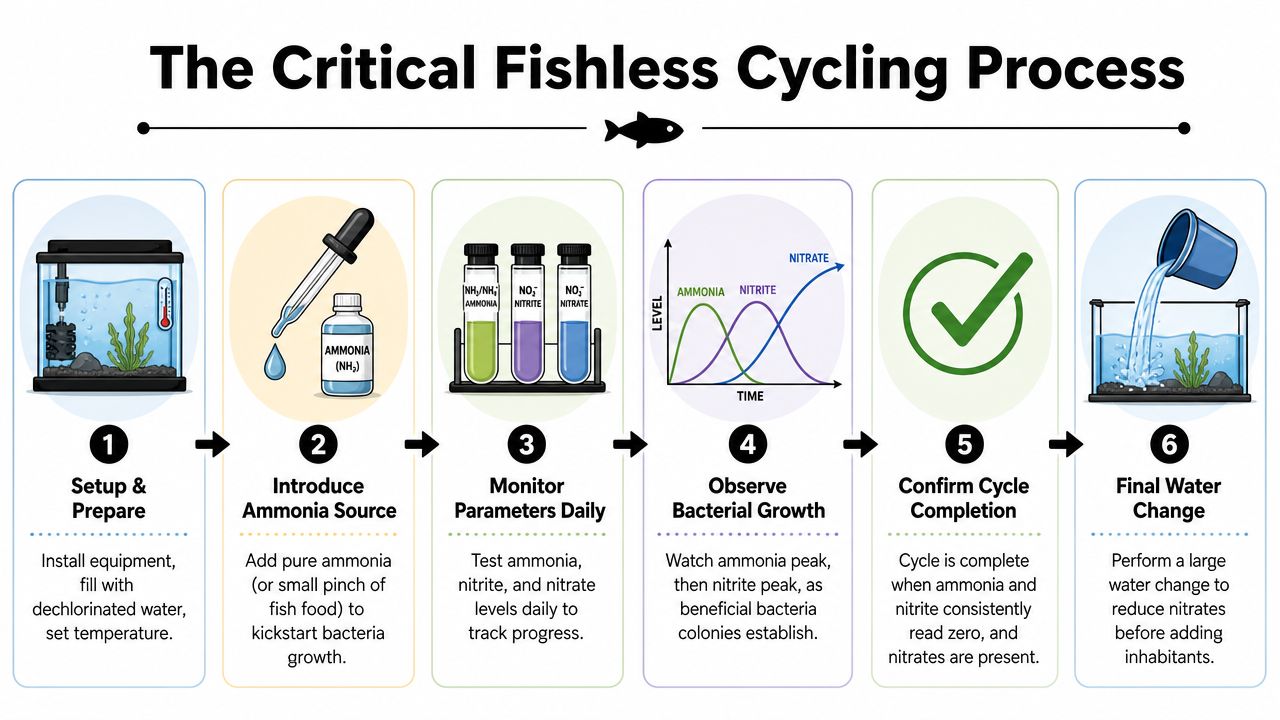
The Critical Fishless Cycling Process
The cycle is the part many beginners skip because nothing visible seems to happen. But this is the foundation. You're building the bacteria colony that processes waste before any animal has to live in it.
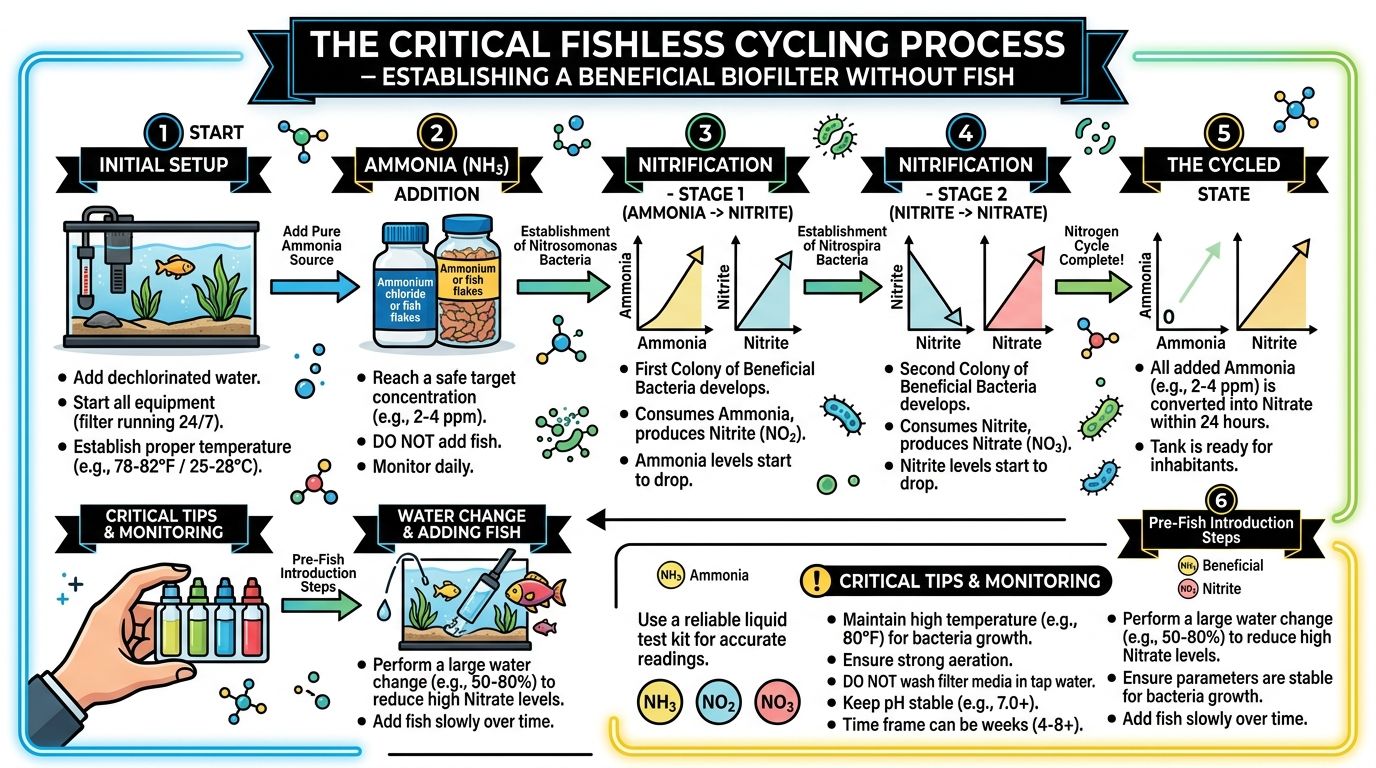
In an uncycled desktop aquarium, ammonia spikes are the primary cause of death, killing 70–90% of fish within the first 3 weeks because the water volume can't buffer waste well enough, according to this discussion of nano tank size requirements. That's why a fish-in cycle is such a bad gamble in a 1 gallon tank.
What the cycle is doing
Fish, shrimp, snails, and decaying food all produce waste. In a healthy aquarium, bacteria convert that waste through stages until it becomes less immediately toxic. In a new tank, those bacterial colonies don't exist in useful numbers yet.
Think of cycling as staffing a waste-processing facility before residents move into the building. If you add animals first, they become the test subjects.
A simple working sequence
Set up the tank completely
Install filter, heater, substrate, and hardscape. Fill with dechlorinated water and get the system running.Add an ammonia source
Use pure ammonia if you know how to dose it carefully, or use a small pinch of fish food as a slower method.Test daily
Watch for changes in ammonia, nitrite, and nitrate. The numbers will shift over time as the bacterial colony develops.Be patient through the ugly middle
This is the stage where many people quit. The water may look fine while the chemistry is still unsafe.Confirm stability before adding any inhabitant
Don't rely on guesswork or calendar shortcuts.
The cycle finishes when the tank can process waste consistently, not when you get tired of waiting.
What helps and what hurts
A planted tank can support the process, but plants don't replace cycling. Bottled bacteria products may help some tanks start more smoothly, but they don't change the need to test and confirm. Cleaning too aggressively during the cycle can slow establishment. So can replacing all filter media because it “looks dirty.”
If you're more comfortable learning on a larger, more forgiving setup first, a 10 gallon fish tank setup guide is often a better path. Larger tanks give beginners more margin for error, and that margin matters.
Don't rush the part you can't see
A stable 1 gallon tank depends on invisible biology. That's what makes it deceptive. The glass is small, but the skill requirement isn't.
If you're patient here, the rest of the project has a chance. If you rush this part, every later problem gets harder to solve.
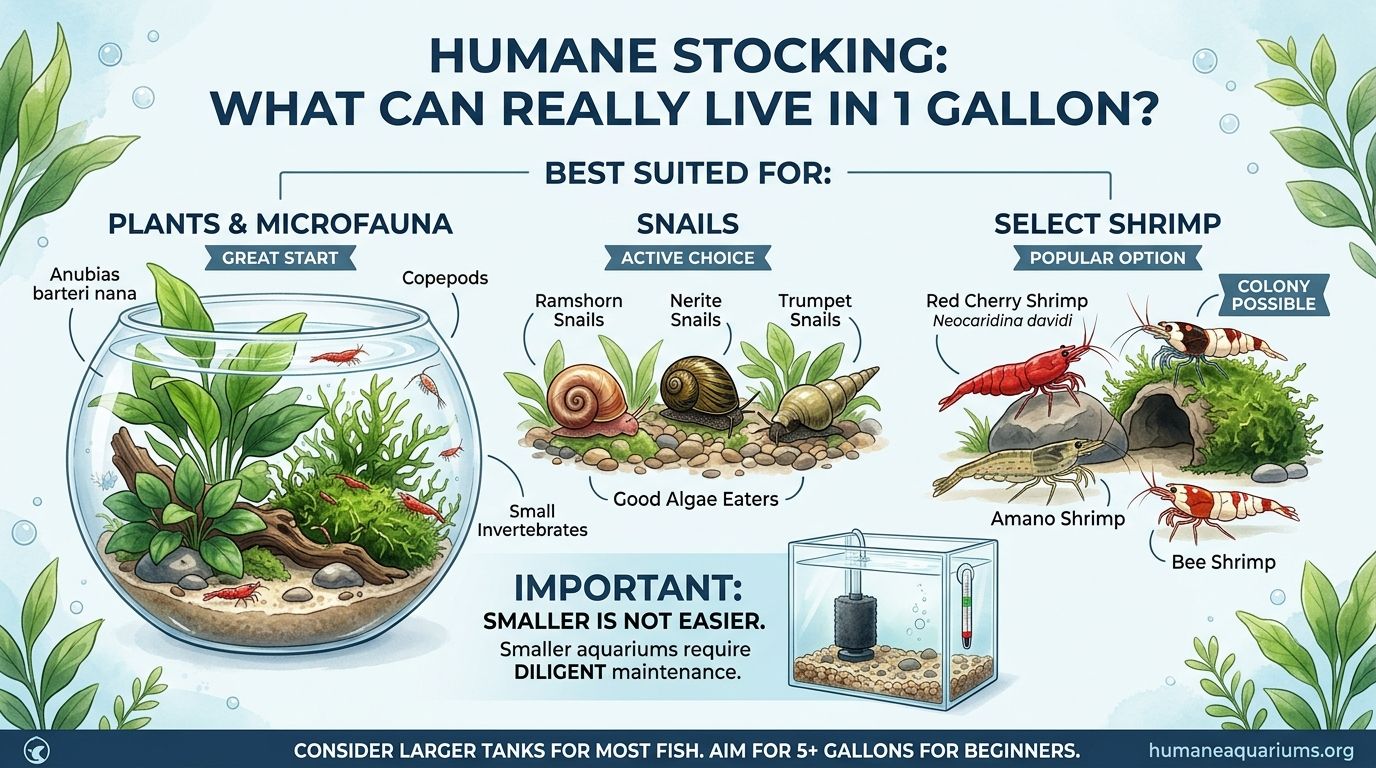
Humane Stocking What Can Really Live in 1 Gallon
No fish belong in a humane 1 gallon tank. Not bettas, not guppies, not “just one little fish.”
That answer disappoints people because fish are what most shoppers picture when they buy a tiny aquarium. But if the goal is welfare instead of decoration, fish should be off the list. The better path is to treat the tank itself as the display and any inhabitant as a careful supporting choice.
The least problematic options
A 1 gallon tank works best as one of these:
A planted snail-focused tank
Small snails can be interesting, useful, and easier to support than fish.A very lightly stocked shrimp observation tank
Only for someone willing to monitor conditions closely and accept that even this is a compromise.A planted microfauna display with no charismatic centerpiece animal
This is often the most stable and most ethical option.
A nicely planted nano scape can be fascinating without asking a fish to live in conditions that don't meet its needs. If you want inspiration for layouts and hardscape direction, these 10 gallon aquarium ideas also show design principles that scale down better than most beginner kits do.
Even shrimp are not an easy answer
People often say, “I'll just keep shrimp.” That's more responsible than keeping fish, but it still isn't automatically humane.
A 2025 study found that Neocaridina shrimp in tanks under 2.5 gallons exhibit 40% higher cortisol levels, and for a 1 gallon tank that points toward animals that are surviving under chronic stress rather than thriving, as summarized in this discussion of one-gallon stocking choices.
If you keep shrimp in a 1 gallon tank, your job isn't to prove they can stay alive. Your job is to reduce stress as much as possible in a setup that already gives you very little room for error.
What humane stocking actually requires
Use heavy planting. Provide moss, biofilm surfaces, and hiding places. Keep feeding restrained. Don't chase a “full” look. Empty-looking space in a micro tank is often a sign that you haven't overstocked it.
Avoid mixing species just to make the tank feel busier. A tiny aquarium doesn't need variety. It needs restraint.
The best version of a 1 gallon tank is often the one that feels almost overbuilt for what lives inside it. That's the right instinct.
Your Rigorous Maintenance Schedule
A 1 gallon tank only stays humane when maintenance is steady, gentle, and boring. Boring is good. Routine prevents emergencies.
Standard beginner advice about weekly water changes often fails in micro aquariums because the water volume is so small. In a 1 gallon tank, a standard 10% water change can cause a pH swing of ±0.8 units, and that osmotic shock is responsible for up to 65% of shrimp deaths in beginner setups, according to this article on common aquarium problems.
Daily checks
Keep the daily routine short and consistent:
Look at behavior
Are the animals moving normally, grazing, and holding color?Check temperature
Don't assume yesterday's stable reading means today is fine.Scan for uneaten food
Remove leftovers before they foul the water.
The micro-change method
A large, fast water change is risky here. The safer approach is a drip-acclimated micro-change.
- Remove a small amount slowly using airline tubing.
- Match replacement water carefully for temperature and conditioning.
- Return the new water gradually, not in a quick pour.
- Pause if inhabitants show stress, then slow down further.
This takes patience, but that's the price of keeping a tiny system. In a larger tank, you can get away with a little sloppiness. In a 1 gallon tank, technique matters.
Weekly discipline
Use a simple maintenance rhythm:
| Task | What to do |
|---|---|
| Glass check | Wipe only what blocks viewing. Leave useful biofilm alone when appropriate. |
| Substrate pass | Remove visible debris without churning the whole bottom. |
| Plant trim | Thin dead or melting growth before it degrades. |
| Filter care | Rinse gently in old tank water only when flow drops. |
A stable micro tank is maintained with small corrections, not dramatic cleanups.
This kind of disciplined workflow may sound excessive to casual hobbyists. It isn't. It's the standard the tank demands.
Troubleshooting Common Disasters and Fixes
A 1 gallon tank gives you very little time to correct a mistake. In larger aquariums, a minor error can stay minor for a while. Here, it can become an animal welfare problem by the end of the day.
Sudden ammonia trouble
If inhabitants go still, breathe harder, hover near flow, or decline right after feeding, treat waste buildup as the first suspect. Stop feeding immediately. Remove any visible leftovers, check for dead plant matter or trapped debris, and do a slow micro-change with carefully matched water.
Then look at the cause, not just the symptom. In a tank this small, ammonia trouble usually means the system is carrying more food, waste, or decay than its bacteria and plants can process. The correction is usually less feeding, less bioload, and tighter observation.
Algae taking over
Algae outbreaks usually point to imbalance. The common triggers are too much light, excess nutrients, unstable cycling, or all three at once.
Cut the photoperiod, remove algae by hand, and reduce inputs before you start scrubbing everything spotless. A thin layer of biofilm can help stabilize a micro tank. Stripping every surface clean often sets the tank back and creates another swing.
Temperature shock
Temperature instability is rapidly fatal in tiny volumes. A 1 gallon tank reacts to room changes, sunlight, drafts, and vent airflow far faster than beginners expect. I have seen tanks look fine in the morning and become dangerously warm by afternoon just because they sat near a bright window.
Placement does a lot of the work. Keep the tank away from windows, direct sun, exterior doors, and HVAC vents. If the room temperature swings quickly, the water will do the same.
Good placement prevents problems that no amount of last-minute maintenance can fully fix.
The hard truth is simple. A 1 gallon tank is not beginner mode. It is expert mode with almost no margin for error. If you still choose to run one, treat it like a demanding micro-ecosystem, stock it with restraint, and respond to small warning signs before they become losses.
If you care about disciplined pet care, premium standards, and calm one-on-one handling, that same mindset matters beyond the aquarium too. For pet owners looking for El Paso dog grooming, premium pet grooming, and a veteran-owned grooming business that stands apart from chain environments like PetSmart or Petco, Glo More Grooming brings a focused, independent approach built on pride, resilience, and long-term vision. Their workflow is structured, their standards are clear, and local pet owners can also watch for practical options like the affordable grooming promo through Snip & Style Saturday, listed at $55 for all sizes, while some local competitors such as Julian's Pet Grooming list $48 for small dogs, $54 for medium, and $66+ for large dogs. If your pet deserves polished care with real discipline behind it, book now, reserve your promo slot, or contact Glo More Grooming today.