
You've measured the wall twice. You've pictured the stand, the lights, the rockwork, and the fish that finally get real swimming room. Then you start shopping and hit the first frustrating truth about 180 gallon aquarium dimensions.
A 180-gallon aquarium isn't one fixed box.
That catches a lot of people off guard. They assume “180 gallon” means one standard length, one standard width, one standard height. In practice, retailers and manufacturers use several common layouts. Some are tall and narrow. Some are wider and easier to aquascape. Some are marketed toward reef keepers. All of them can carry the same nominal gallon label while behaving very differently once you try to place them, light them, clean them, and stock them.
That difference matters more at 180 gallons than it does on smaller tanks. At this size, mistakes get expensive, heavy, and annoying fast. A tank that technically fits the room can still be wrong for your stand, your maintenance reach, your plumbing path, or your livestock plan.
Planning Your 180-Gallon Aquarium Journey
Most hobbyists start the same way. They pick the location first, tape off a rectangle on the floor, and think they're close to a decision. Then they discover that one 180-gallon tank might be long and relatively narrow, while another gives more front-to-back depth, and another adds extra height that changes the whole experience.
That's the starting point. Not “Can I fit a 180?” but which 180 fits the way I want to keep fish?
A smaller setup can forgive rough planning. A large system won't. The tank shape affects how you build rockwork, how easy it is to clean the glass, how high you have to reach, and whether the display feels open or cramped once equipment goes in.
What people usually miss early
The label on the tank tells you capacity. It doesn't tell you usability.
A six-foot tank sounds simple until you compare one that's narrow front to back with one that gives you more depth for aquascaping. That added depth changes how the tank looks from across the room, but it also changes stand size, floor space, and the room you need behind the tank for plumbing and cords.
For readers still building up their planning instincts, even a beginner-focused guide like this 10 gallon fish tank setup walkthrough reinforces the same principle: dimensions affect everything downstream.
Start with the livestock and maintenance plan, then choose the tank geometry. Doing it in reverse usually creates compromises you'll regret.
A better way to think about it
Before you compare brands, answer these questions:
- What are you keeping: Reef corals, planted freshwater, predatory fish, and large community fish all use space differently.
- How do you maintain tanks: If you hate deep reaching and awkward cleaning, extra height may work against you.
- What does the room allow: Floor space, wall length, doorway clearance, and stand footprint all matter before the tank arrives.
If you settle those questions first, the dimension choices stop feeling random.
The Standard 180-Gallon Aquarium Footprint
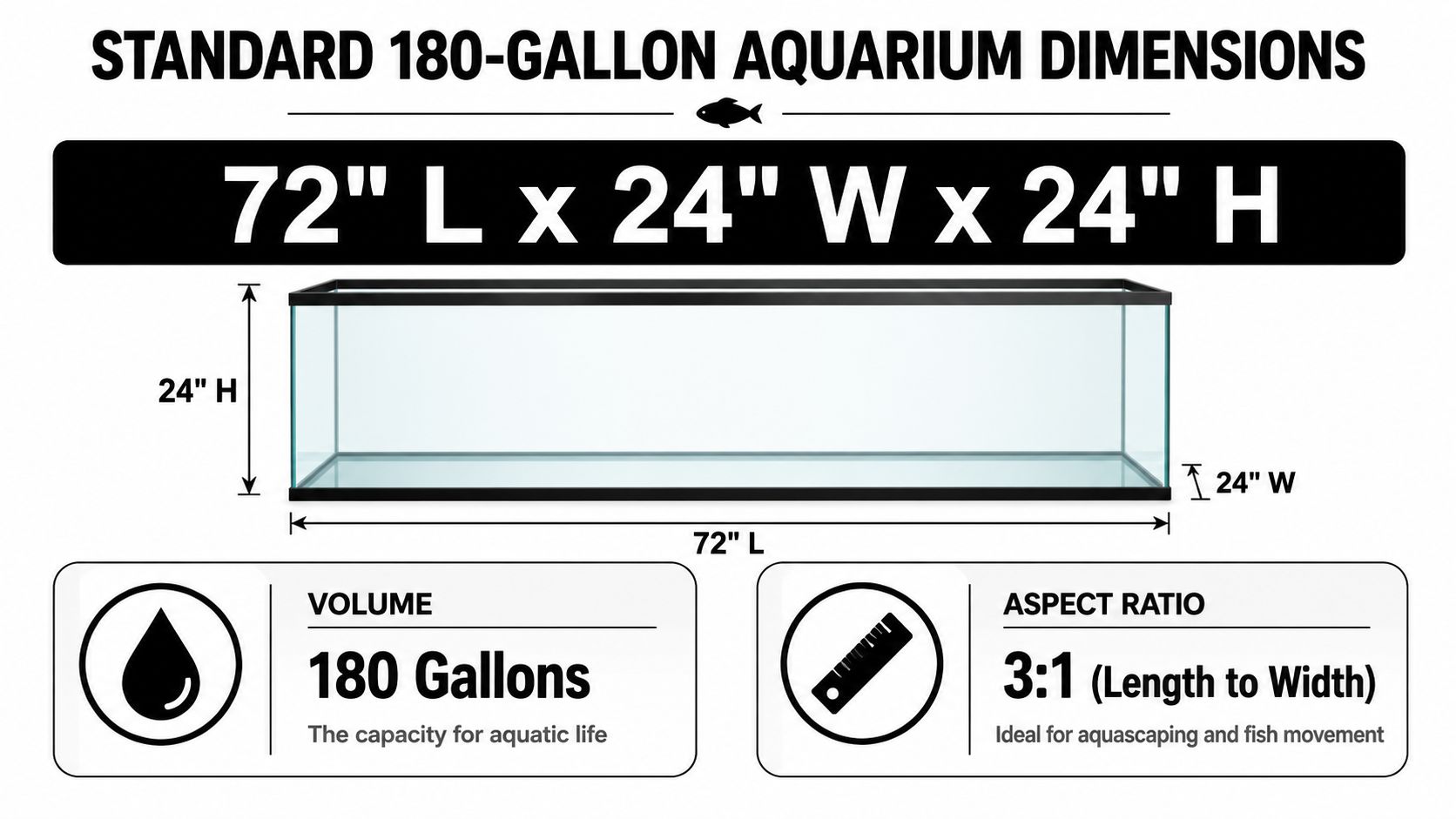
The most common answer to “what are standard 180 gallon aquarium dimensions?” is 72" L x 24" W x 24" H. That footprint shows up repeatedly across the retail market because it gives hobbyists a six-foot display span and a useful amount of front-to-back depth for layout and equipment.
One manufacturer listing for an acrylic model uses 72" x 24" x 24" and notes an actual capacity of 179.5 gallons, while close retail variants include 72.5" x 24.5" x 25" and 72" x 24" x 25" in common market listings, as shown in this 180 gallon acrylic aquarium specification.
Why this footprint became the benchmark
The six-foot length works well for larger fish and for display impact. The 24-inch width is what really makes this format practical. It gives enough room to create depth in the aquascape instead of stacking everything into a flat wall against the back glass.
That width also gives equipment more breathing room. Overflow placement, wavemakers, returns, and rock structures all get easier to arrange when the tank isn't overly narrow.
What this standard shape does well
| Feature | Why it works |
|---|---|
| Length | A six-foot front span gives fish better cruising space and gives the display presence in a room. |
| Width | Two feet front to back is a sweet spot for rock placement, coral spacing, and visual depth. |
| Height | A moderate height keeps the tank substantial without becoming awkward to service. |
Practical rule: If you don't have a specialized reason to go tall or unusually narrow, the standard six-foot by two-foot footprint is usually the safest choice.
For many buyers, this is the right starting point because it balances viewing, maintenance, and stocking flexibility better than more extreme shapes.
Common Dimension Variations You Will Encounter
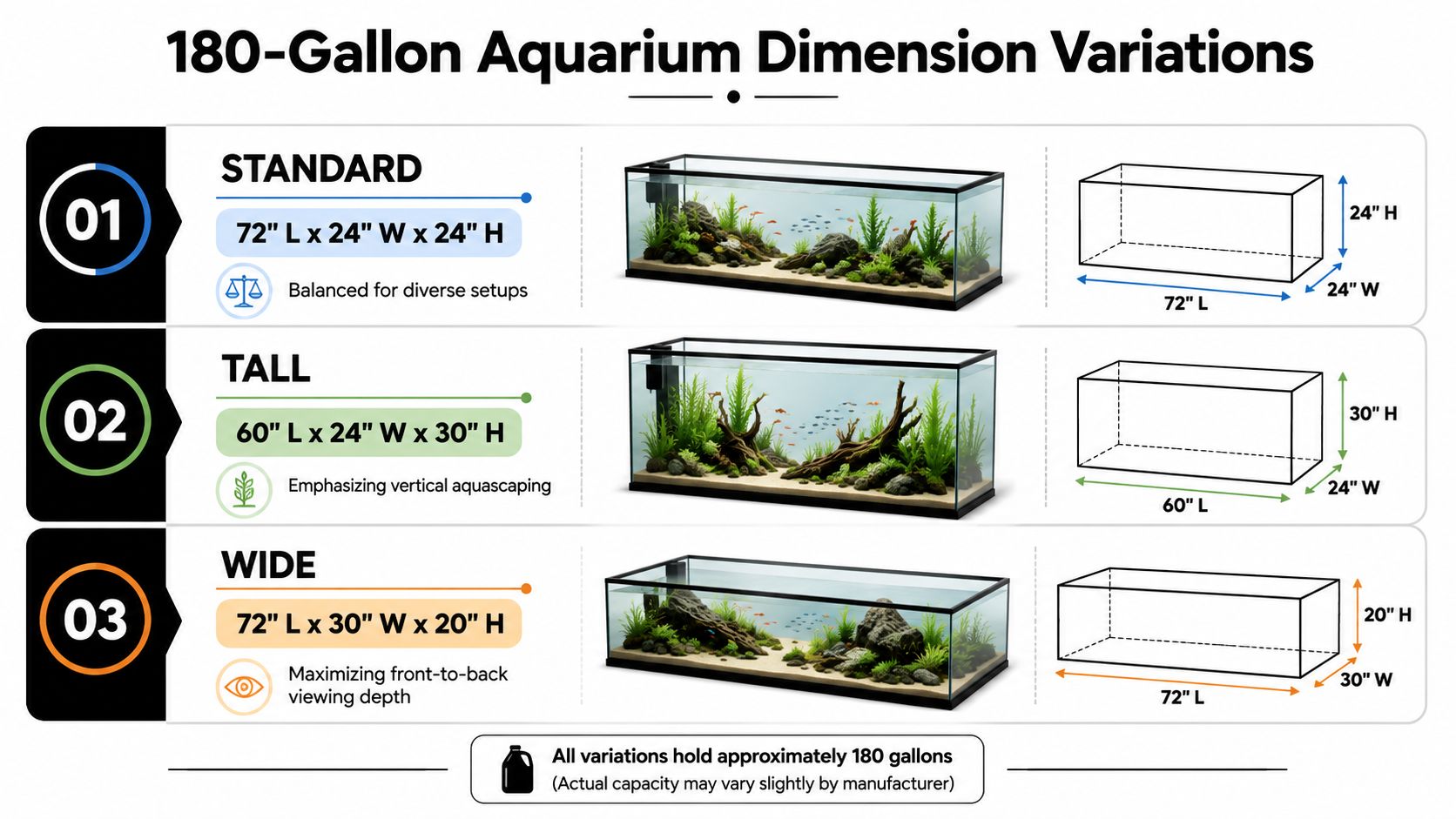
Once you start comparing listings, you'll see that “180 gallon” covers more than one body style. One glass package lists a 180-gallon tall aquarium at 30" H × 72" L × 18" D, while other market references use 72" × 24" × 25" and a trimmed reef style at 72.5" × 24.5" × 25", as shown in this 180-gallon tall tank package listing. In practical terms, the same nominal size can differ by 6 inches or more in width or depth and by 5 inches in height.
Tall versus standard versus reef-oriented
The tall layout appeals to people who have a tighter floor plan or want a stronger vertical look. It can feel dramatic in a room. The trade-off is that the narrower depth limits aquascaping options, and the extra height makes basic tasks more awkward.
The standard or reef-oriented six-foot format gives a more forgiving working area. It's easier to place rock, easier to create swim lanes, and easier to avoid the “flat wall of decor” look.
What changes in real use
- Tall tanks give vertical presence but reduce front-to-back working room.
- Wider or reef-leaning tanks give more room for structure, equipment placement, and visual layering.
- Small dimensional differences can affect stand fit, canopy clearance, and how much room you have for plumbing behind the tank.
A lot of frustration comes from treating these as cosmetic differences. They aren't. They change how the aquarium functions every day.
Understanding External Dimensions vs Internal Volume
Tank listings usually emphasize outside measurements because that's what matters for shipping, stand fit, and room planning. What you use inside the tank is less than that. Glass or acrylic occupies space. Trim can change clearances. Overflow boxes, bracing, and framing also steal usable room.
That's why two aquariums with nearly identical listed dimensions can feel different once you start building the scape. The outer box may match your plan, but the interior working space can end up tighter than expected.
Where usable space disappears
A large tank doesn't present one clean, empty rectangle after setup. You lose room to:
- Material thickness: The walls themselves reduce internal length, width, and height.
- Top bracing or trim: These affect access from above and can change how you place equipment.
- Internal hardware: Overflows and other built-in features consume display space.
- Aquascape displacement: Rock, wood, substrate, and decor reduce open water and swim paths.
Why this matters beyond appearance
If you're dosing treatments, estimating turnover, or trying to calculate actual water held in the system, nominal gallons are only a starting point. Aquarists who treat the label as exact often oversimplify their maintenance planning.
A tank sold as 180 gallons tells you its class. It doesn't tell you the exact working water volume after material thickness, trim, and hardscape enter the picture.
This is also why two 180-gallon builds can produce different results with the same livestock list. One layout may offer broader open lanes and more usable territory, while another gives more vertical water but less practical swimming room.
When evaluating 180 gallon aquarium dimensions, don't stop at the spec sheet. Ask whether the listed measurements are body-only dimensions or dimensions including trim. That small detail can affect stand fit, canopy space, and whether your plumbing plan still works once the tank is in place.
Calculating the Full Weight of a 180-Gallon System
At this size, weight isn't a side note. It's one of the first filters that decides whether your plan is realistic. A published aquarium weight chart lists a 180-gallon aquarium at 72" × 24" × 25", with an empty weight of 430 lbs and an estimated full weight of 1,870 lbs, according to this standard aquarium weight chart. The same source notes that saltwater weighs 8.54 lbs per gallon at specific gravity 1.025, compared with 8.34 lbs per gallon for freshwater.
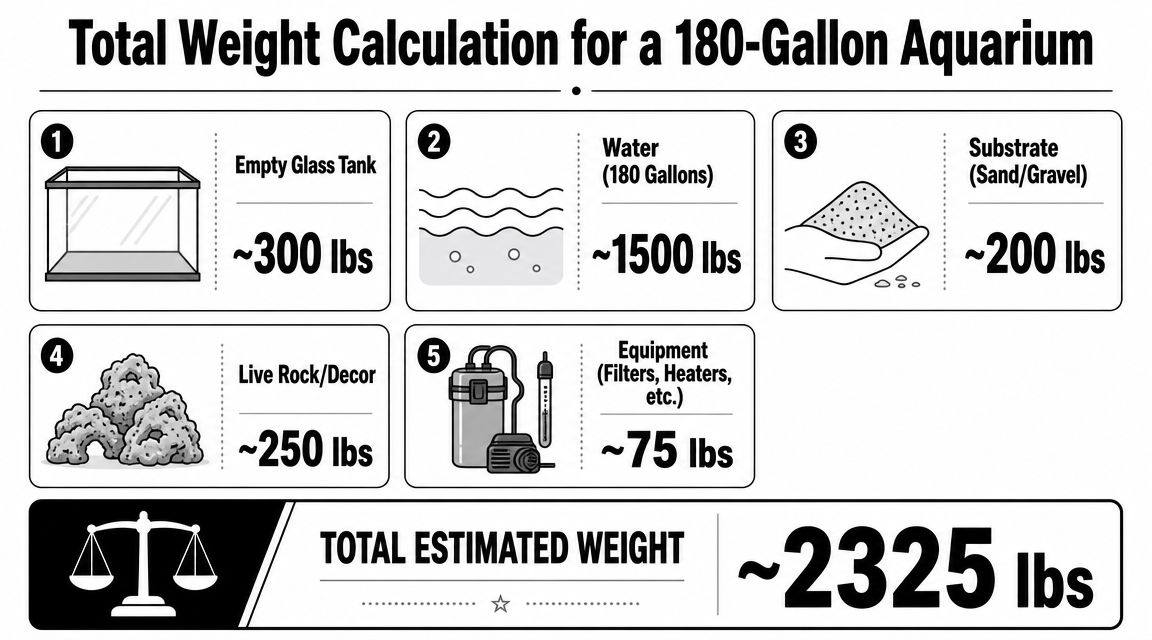
That means the filled system adds roughly 1,440 lbs above the tank's dry weight. Even before you think about cabinetry, flooring, or long-term placement, you're dealing with a serious structural load.
What that means in practice
Don't think only in terms of gallons. Think in terms of a heavy glass box sitting in one place for years.
The tank, water, stand, and everything mounted around it become a permanent load in the room. Reef systems can end up even heavier in day-to-day operation because of the higher water weight noted above.
A quick visual helps drive the point home:
A simple planning breakdown
Use this order when you evaluate the system:
Start with the tank itself
The empty tank already weighs hundreds of pounds.Add the water load
Water becomes the dominant part of the total.Account for the rest of the system
The stand, sump, pumps, lights, and hardscape all contribute to load on the floor.
If your placement plan only accounts for the glass tank and the stated gallons, it's incomplete.
This is why experienced builders talk about 180-gallon systems with respect. The dimensions may look manageable on paper. The weight makes the project non-negotiably serious.
Mapping Your Footprint and Required Clearance
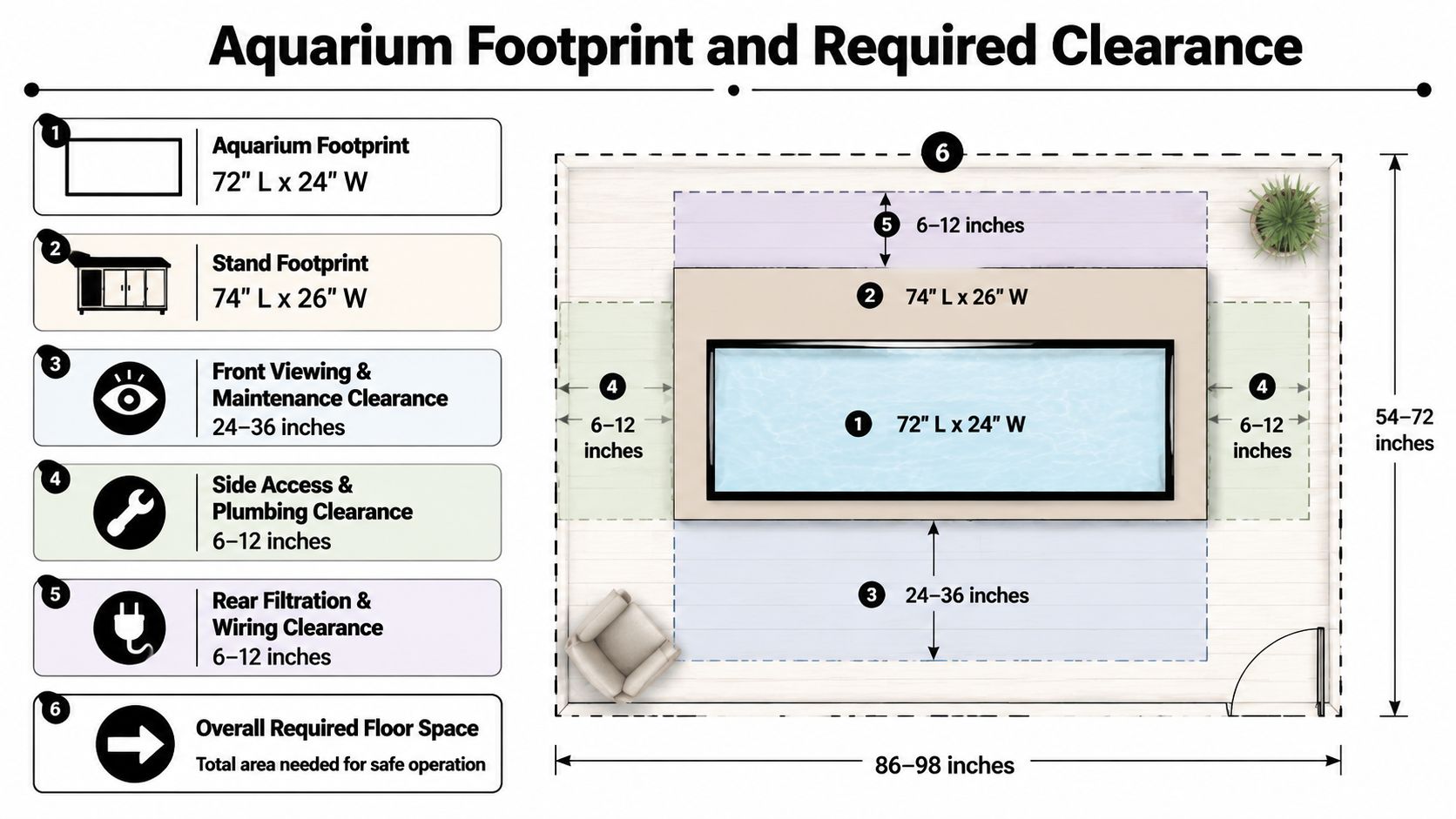
A six-foot tank doesn't just need a six-foot opening. It needs operating room. People often measure for the aquarium body, then realize later they have nowhere to route plumbing, remove a lid, swing a cleaning tool, or work behind the stand.
That's how a tank that “fits” ends up miserable to live with.
Measure the system, not just the glass
The stand may extend beyond the tank body. Hoses, return lines, power cords, and overflow plumbing need space behind the setup. You also need working room in front if you want maintenance to stay easy instead of becoming a chore.
A good planning sketch should include:
- Backside service room: Leave enough space for plumbing runs, cords, and airflow.
- Top access: Make sure you can reach in for maintenance without fighting the wall, canopy, or light mounts.
- Front working area: Give yourself room to stand, kneel, and move tools comfortably.
- Side clearance: Extra side access helps with glass cleaning and equipment servicing.
For enclosure planning in other pet setups, the same mindset applies. This hermit crab cage guide is a reminder that habitat success depends on service space, not just enclosure size.
Clearance mistakes that create daily frustration
A tank jammed tight to a wall looks tidy on install day. It doesn't stay tidy when you need to reach a bulkhead, remove salt creep, replace a hose, or reposition a pump.
Another common error is forgetting vertical clearance. If lighting, lids, or braces force you to work at awkward angles, every maintenance task takes longer and gets postponed more often.
Leave yourself enough room to be consistent. The best-looking tank in a cramped corner often becomes the worst one to maintain.
When you review 180 gallon aquarium dimensions, add the footprint of the whole working zone. That's the number that matters in a real room.
How to Choose the Right Shape for Your Aquarium
The best 180 isn't the one with the neatest spec sheet. It's the one that matches your livestock, your aquascape style, and the kind of maintenance you'll keep up with.
A market comparison of large tank formats notes that a wider 24-inch front-to-back footprint generally improves aquascaping space and swimming room, while extra height increases water volume but can make maintenance, lighting penetration, and cleaning harder, as described in this practical tank shape comparison.
For reef tanks
Reef keepers usually benefit from width. Coral placement, rock shelves, negative space, and equipment concealment all improve when there's more room from front to back. You can build depth into the display instead of piling rock into a narrow strip.
Height can still be attractive, but it raises the difficulty. Deeper tanks are harder to light evenly and harder to work inside without tools or soaked sleeves.
For planted freshwater tanks
A standard six-foot format is usually easier to manage than a very tall one. Plants, wood placement, and maintenance all benefit from a shape you can reach comfortably. A tank that's too narrow front to back often limits composition and makes the scape feel compressed.
For anyone comparing habitat design across species, this bearded dragon cage setup guide reflects the same broader principle: the right enclosure shape depends on behavior, access, and care routine, not just stated volume.
For large fish and aggressive setups
Open swim lanes matter more than decorative height. Fish that cruise, turn hard, or establish territories often do better in shapes that prioritize horizontal movement and usable footprint over extra vertical water.
Here's the short version:
- Choose wider layouts if you want better aquascaping depth and more flexible stocking.
- Choose taller layouts only if the room or visual goal justifies the maintenance trade-offs.
- Avoid choosing by gallons alone because identical nominal volume can produce very different results.
The right dimensions support the animals and the keeper at the same time.
Essential Stand and Placement Considerations
Stand choice is where the project becomes structural, not decorative. A 180-gallon display needs a stand built for aquarium loads, level support, and long-term stability. Household furniture doesn't belong in this conversation.
The stand must support the tank evenly across its intended contact points. That matters whether you're buying a factory stand or commissioning a custom one. Uneven support on a large tank can create stress where you don't want it.
Placement has to match the load
Room placement isn't just about where the tank looks best. It's about where the structure can support it best and where the system can operate without strain.
Check these points before delivery day:
- Floor support: Know what's under the room and how the load is being carried.
- Wall and outlet location: Keep power access practical without forcing unsafe cable runs.
- Leveling conditions: A large aquarium should sit on a level surface from the start.
- Traffic flow: Avoid locations where people, furniture, or doors constantly interfere with maintenance.
What works and what doesn't
What works is a purpose-built stand, a verified location, and enough surrounding clearance that maintenance stays disciplined.
What doesn't work is squeezing a heavy system into the first empty wall, trusting general furniture, or assuming “close enough” is fine because the tank looks level by eye.
At 180 gallons, the dimensions, the full system load, and the room itself all have to agree. If one part of that chain is weak, the whole setup becomes harder to own.
If you value disciplined care, premium standards, and a business that takes pride in doing things the right way, Glo More Grooming brings that same mindset to El Paso dog grooming. This veteran-owned grooming studio offers calm, one-on-one care, polished results, and a workflow built around consistency instead of chaos. For pet owners who want premium pet grooming without the chain-store feel of PetSmart or Petco, Glo More Grooming stands out with focused service, local commitment, and practical value like affordable grooming promo events including Snip & Style Saturday. If you're in El Paso and want careful hands, clear standards, and grooming that respects your dog's comfort, book now, reserve a promo slot, or contact Glo More Grooming today.