

You've got the dates circled, the airline tabs open, and one big question sitting in the middle of the room. How do you get your pet on a plane safely without turning the whole trip into chaos?
That moment hits hard for a lot of El Paso families. Military moves, job relocations, family emergencies, seasonal travel, and cross-country transitions all bring the same pressure. Your dog isn't a suitcase. Your cat isn't an afterthought. When the plan involves pet transportation by air, every detail matters.
The good news is that air travel for pets can be handled well when the process is disciplined. Historical data from US Department of Transportation documents and Air Cargo World magazine shows that less than 0.01% of pets flying as cargo experience any incident, and from 2015 through 2020, carriers reported 197 incidents out of more than 2.7 million animals transported, or about 0.007%. Those figures come from the verified transportation data summarized above. The lesson is simple. Flying a pet isn't casual, but it also isn't reckless when the preparation is right.
For owners in West Texas, that preparation has to be practical. El Paso heat, dry air, tight travel windows, and airline rule changes don't leave much room for improvising. The same disciplined workflow that defines premium pet grooming also applies here. Clean coat. Correct crate. Current paperwork. Calm handling. No shortcuts.
That's also where a veteran-owned grooming mindset matters. Strong pet care operations aren't built on guesswork. They're built on standards, repetition, and calm execution under pressure. If you're comparing your options for El Paso dog grooming, pre-travel support, or an affordable grooming promo before a flight, the right provider should help you think beyond appearance and focus on readiness.
Your Pet Travel Mission Starts Here
A lot of pet owners first think about air travel at the worst possible time. The lease is ending. Orders came through. A family member needs help in another state. You're already coordinating movers, hotels, records, and deadlines, and then it hits you that your pet needs a flight plan too.
That's usually when anxiety takes over. Owners worry about cargo holds, heat, paperwork, crate rules, and whether their pet can handle the trip. Those concerns are valid, but panic doesn't help. A checklist does.
Why calm planning works
Pet transportation by air is safest when people stop treating it like a last-minute add-on. The strongest outcomes come from structure. Book the right route. Confirm the airline's pet rules. Get a true fitness-to-fly evaluation. Use the right kennel. Prepare the coat, nails, and hydration plan before travel day.
Practical rule: If a flight plan feels rushed, assume something important is missing and slow down long enough to verify it.
That mindset matters in El Paso, where weather can change your options fast. A route that looks fine on paper can become a poor choice if ground temperatures spike, if a connection is too long, or if your pet already struggles with stress in new environments.
What owners often get wrong
The biggest mistake isn't usually love or effort. It's assuming all pets travel the same way. They don't.
A compact, calm dog may qualify for in-cabin travel. A larger dog may need to fly in a pressurized cargo compartment under a different process. A senior pet with hidden health concerns may need a ground alternative instead. Good decisions come from matching the plan to the animal in front of you, not from forcing the pet into the owner's preferred itinerary.
Another mistake is focusing only on the airport side of the process. In practice, travel readiness starts much earlier. A matted coat traps heat. Overgrown nails make crate footing harder. Poor crate acclimation creates unnecessary stress. Premium standards in grooming and handling support safer transport, especially for owners who want more than chain-level care from a quick service desk.
For El Paso families, resilience and preparation go together. That's true whether you're booking El Paso dog grooming before a move, using an affordable grooming promo like a monthly Snip & Style Saturday to get your dog travel-ready, or trying to protect your pet from avoidable stress.
Understanding Your Pet's Flight Options
Not every pet flies the same way, and choosing the wrong category creates problems before you ever get to check-in. Most owners are deciding between three paths. In-cabin, checked travel, or manifest cargo. Each has a different experience for the pet and a different level of owner control.
In-cabin for small pets
In-cabin travel is the closest thing to first-class for a pet. Your dog or cat stays with you in an approved carrier that fits under the seat, subject to airline rules.
This option works best for small pets that stay calm in tight spaces and can tolerate airport activity, foot traffic, and cabin noise. It's usually the least stressful option for the owner because the pet remains nearby, but it's not automatically the least stressful for every animal. Some pets panic with strangers constantly moving around them.
A few practical checks matter here:
- Confirm size fit early: Don't assume your pet qualifies because they're “small.” The carrier must meet the airline's under-seat requirements.
- Test quiet confinement: A pet that tolerates a crate at home for short periods may still struggle in a loud terminal.
- Practice the full routine: Carry the bag, drive to a busy place, wait, and sit still. That rehearsal tells you more than a pet sleeping in the living room crate.
Owners who want a deeper walkthrough can review how to fly with a dog safely and calmly.
Checked travel on your flight
Some airlines allow pets to travel as checked animals on the same itinerary as the owner. The pet rides in the aircraft's designated animal area rather than in the passenger cabin.
This can work well for medium or larger dogs when the route, weather, and airline procedures line up. It also means the owner and pet generally move through the trip together, even if they aren't physically side by side.
The trade-off is control. Once the pet is checked, handling shifts to airline staff. That makes crate compliance, labels, hydration planning, and timing mandatory.
A good flight option is the one your pet can complete safely, not the one that sounds most convenient when you're booking.
Manifest cargo for large pets or special routes
Manifest cargo sounds intimidating to many owners, but for some pets it's the correct and safest channel. Larger dogs, some international routes, and certain airline programs require this process.
Cargo transport is more structured than many people expect. It's designed for animals that can't travel in cabin and need formal handling. The key issue isn't whether the label says cargo. The key issue is whether the airline, route, crate, and pet are a sound match.
Here's a simple comparison:
| Option | Best for | Main advantage | Main trade-off |
|---|---|---|---|
| In-cabin | Small pets | Owner stays close | Tight space, limited eligibility |
| Checked | Pets on same itinerary | Shared routing with owner | Less direct oversight after check-in |
| Cargo | Large pets or restricted routes | Formal animal handling process | Requires more coordination |
For non-dog species, owners need to be even more careful. Airline treatment of rabbits, birds, and other animals can vary widely, so broad internet advice often falls apart when you try to book a real trip.
Navigating Airline and USDA Regulations
Paperwork problems ruin more trips than bad intentions do. The airline counter is the worst place to discover that a certificate is out of date, a route is under a temperature restriction, or your carrier doesn't match the booking category. Pet transportation by air runs on documentation, timing, and exact compliance.
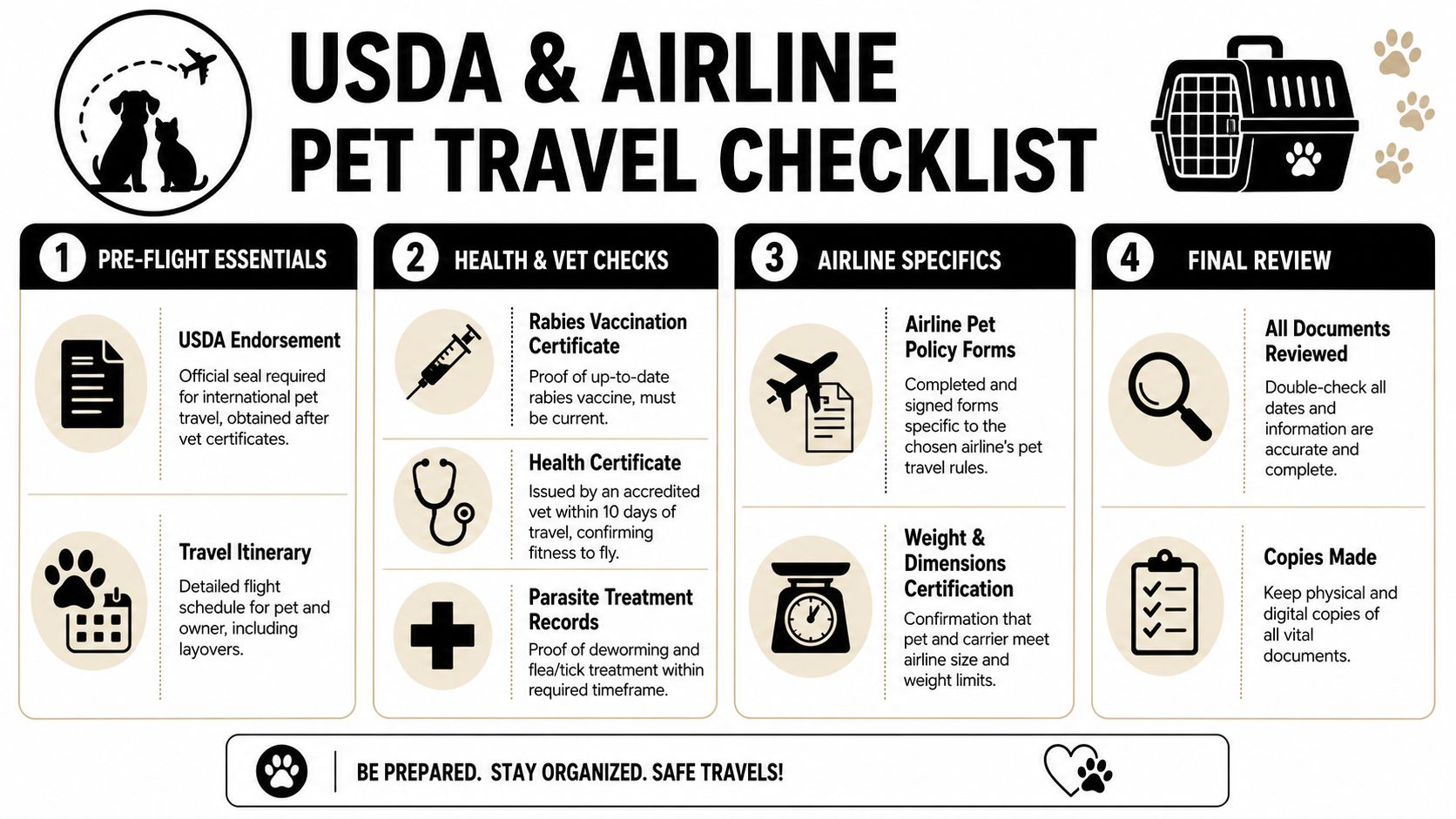
The first rule to lock in is timing. American Airlines states that a health certificate must be issued within 10 days of the first flight in the itinerary, and if the temperature anywhere on the itinerary exceeds 85°F (29.4°C), pets can't be checked even with a vet letter. You can review that directly in American Airlines pet travel requirements.
Why the rules are strict
These requirements aren't red tape for its own sake. A recent veterinary review from the AVMA notes that veterinarians must perform a deliberate physical examination to identify risk factors that reduce an animal's resilience to travel stressors. That matters because flight stress isn't just about motion. It includes handling changes, environmental shifts, temperature exposure, and pressure changes that can affect one pet very differently from another.
In practical terms, that means a pet can look fine at home and still be a poor flight candidate if the exam raises concerns. Owners should ask the veterinarian for a direct travel-readiness opinion, not just a signature.
What to have ready before check-in
A disciplined workflow keeps the file clean. At minimum, owners should gather and verify:
- Current health certificate: Check the issue date against the first flight date, not just the departure week.
- Vaccination records: Keep complete copies that are legible and easy to access.
- Airline-specific forms: Many carriers use their own acceptance documents, acknowledgments, or check-in procedures.
- Itinerary details: Include connections, destination information, and contact numbers.
- Backup copies: Carry printed copies and keep digital versions on your phone.
For support with coordinated logistics beyond grooming, route planning, and pet readiness, review professional pet transportation services in El Paso.
The paperwork side is easier to understand when you see it laid out visually.
What El Paso owners should watch closely
Heat is the local issue that changes plans fast. If your route includes a hot departure city, layover city, or arrival city, the trip can be blocked even when the weather at your home seems manageable. That's why serious planning happens around the full itinerary, not just the first airport.
Three habits reduce last-minute failures:
- Book early-day flights when possible. Ground temperatures are often more manageable earlier.
- Call the airline directly after booking. Don't rely only on what the website implied.
- Reconfirm every date on every document. Owners often catch mistakes only when they read line by line.
The Art and Science of the Perfect Travel Crate
The travel crate isn't just packaging. It's safety equipment. If the crate is too small, poorly ventilated, weak at the seams, or awkward for the pet's body, the trip starts with a disadvantage.
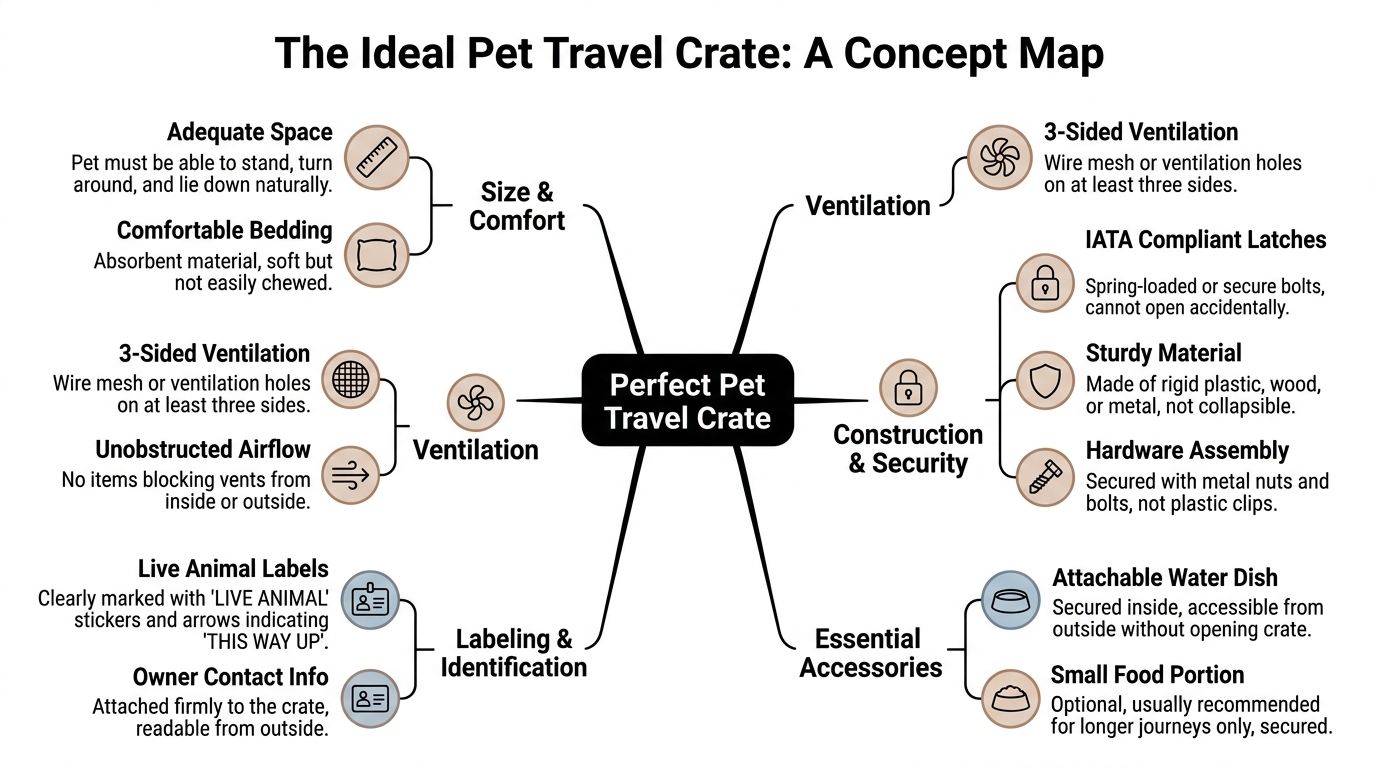
IATA sizing standards are precise for a reason. According to the IATA Live Animal Regulations, the container length must equal the animal's nose-to-tail length (A) plus one-half the height from the ground to the elbow joint (B), the width must be exactly twice the shoulder width (C), and the height must accommodate the animal's standing height (D). If the crate doesn't meet those benchmarks, the pet can experience acute stress and hyperthermia.
Size is not guesswork
Owners often buy a crate by breed label. That's a mistake. “Large dog crate” doesn't mean airline-ready, and breed assumptions fail fast with dogs that are tall, long-bodied, broad-chested, or between sizes.
Use the actual body measurements. Then test the fit in real life. Your pet should be able to stand naturally, turn without contorting, and settle into a resting position without curling into the walls.
For a detailed breakdown, use this dog crate sizing guide for air travel.
Ventilation and build quality matter
A proper crate also needs real airflow and solid construction. The crate should feel secure when lifted, latched, and moved. Flimsy hardware, warped plastic, and cheap clips create failure points under stress.
Look for these features:
- Rigid shell construction: Avoid collapsible carriers for any route that requires a hard-sided kennel.
- Secure door and fasteners: Airline staff should be able to inspect the setup without questioning its integrity.
- Absorbent bedding: Keep it practical. Soft enough for comfort, not bulky enough to block positioning.
- Accessible water dish: It should be attachable and usable without opening the crate.
The best crate feels boring. No wobble, no guesswork, no decorative extras that interfere with safety.
Grooming affects crate comfort
This is where many generic travel guides fall short. The dog entering the crate matters as much as the crate itself.
A clean, brushed, mat-free coat helps the pet regulate body temperature more effectively than a packed or dirty coat. Trimmed nails reduce slipping and awkward footing when the crate is moved. Clean paw pads and sanitary prep also reduce discomfort during long waits or delays. That's one reason owners seeking premium pet grooming before travel often get a better result than those waiting until after the move.
Chains like PetSmart or Petco may be convenient for basic volume service, but travel prep often benefits from slower handling, one-on-one attention, and a more disciplined eye for details that affect transport comfort.
Your Step by Step Pre Flight Preparation Checklist
Strong trips are built on timing. If you try to prepare a pet for flying in the final few days, you'll miss something. This checklist works best when you treat travel readiness like a sequence instead of a scramble.
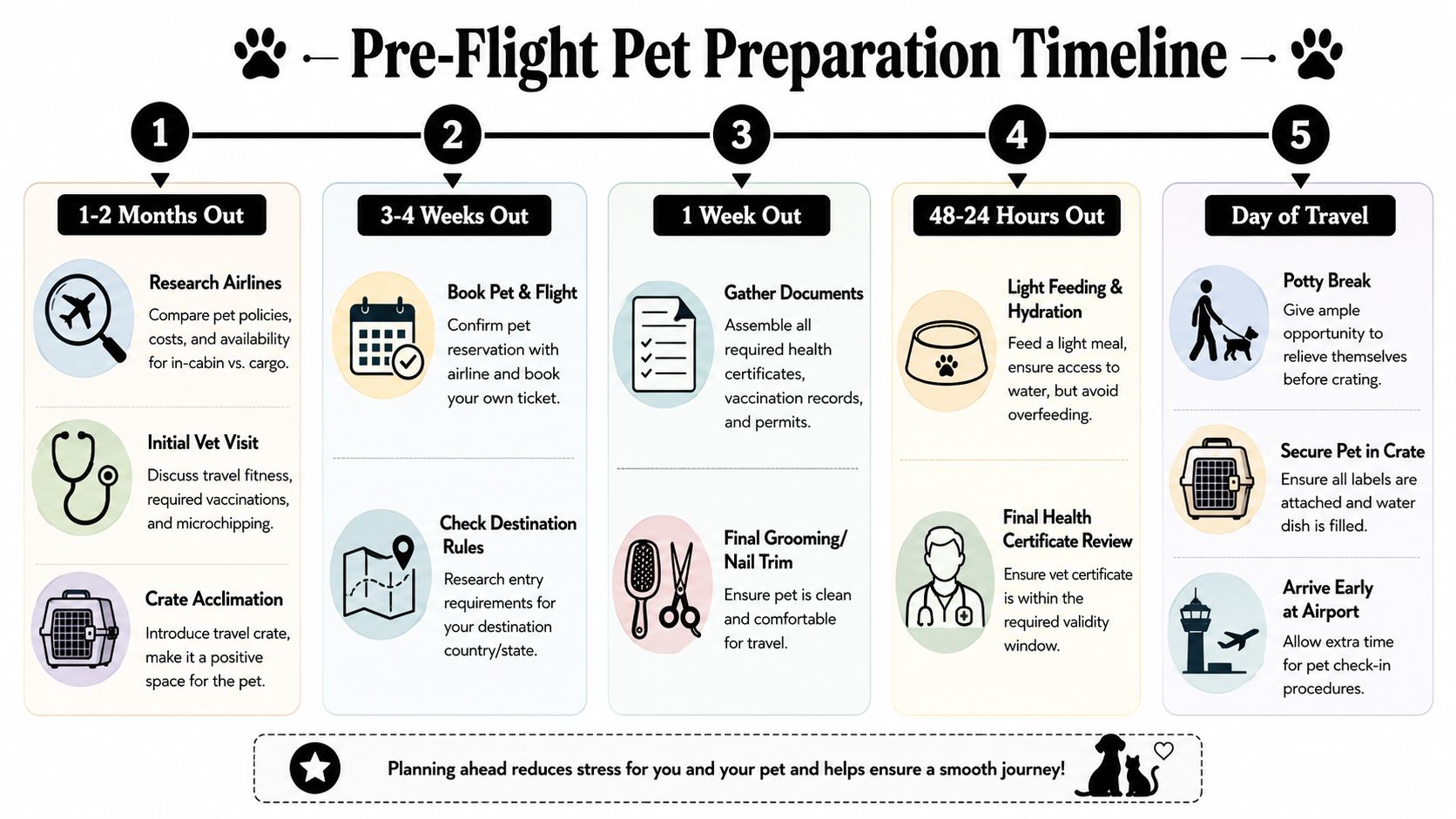
One to two months before departure
Start with the route, not the crate.
Research airlines, compare pet categories, and identify whether your pet is a realistic candidate for in-cabin, checked, or cargo travel. If your dog is anxious, elderly, heat-sensitive, or reactive in unfamiliar settings, note that now. The route has to fit the pet.
Then buy the crate early enough to make it familiar. Feed meals near it. Toss treats inside. Let the pet enter and exit freely. Short, calm sessions beat forcing long confinement.
Use this phase for the first veterinary conversation too. Ask specific questions about travel resilience, stress triggers, and whether there are hidden concerns that need more evaluation.
Three to four weeks before departure
Make the bookings official and tighten the plan.
At this stage:
- Reserve the pet with the airline: Pet space can be limited even when human seats are available.
- Review destination requirements: State, island, or international rules may require more than the airline does.
- Test crate routines outside the house: Put the crate in the car. Sit in a parking lot. Recreate waiting periods.
- Check grooming condition: If your pet has undercoat buildup, matting, heavy shedding, or overgrown nails, don't leave that until the end.
For many owners, this is the best window to schedule El Paso dog grooming with a provider that understands travel prep rather than just cosmetic trimming.
One week before departure
This is the document and conditioning week.
Gather the records, confirm names and dates match, and print duplicates. Replace worn ID tags. Attach emergency contact information to the crate in a waterproof sleeve. Make sure the bedding is clean and the bowls fit correctly.
This is also the ideal time for the final grooming appointment. A proper pre-travel groom should focus on comfort and function:
- Bath and blow dry: A clean coat is easier to manage and monitor.
- Brush-out or de-shed: Remove packed hair that can trap heat.
- Nail trim: Improve footing inside the kennel.
- Ear cleaning and sanitary care: Reduce discomfort during a long day of transit.
A monthly affordable grooming promo like Snip & Style Saturday can be a smart option for owners who want travel readiness without stretching the budget. Good preparation doesn't have to mean careless spending.
If your dog is overdue for grooming before a flight, fix that before you fix cosmetic details around your own suitcase.
Forty-eight to twenty-four hours before departure
Keep the home environment steady. Don't introduce a new food, new supplement, or a dramatic schedule change right before travel.
Run this short pre-flight check:
- Confirm the airline reservation again.
- Review the health certificate validity window.
- Prepare water strategy for travel day.
- Pack leash, wipes, records, and spare labels.
- Check weather across the route.
Feed normally unless your veterinarian gives a different instruction, but avoid heavy meals close to the departure window. Hydration matters. So does preventing stomach upset.
A practical trick many handlers use is freezing water in the crate dish so it melts gradually during the trip instead of spilling immediately during loading.
On travel day
Your job is to bring calm, not extra stimulation.
Take your pet for a proper potty break. Keep your own energy steady. Don't crowd the final hour with emotional fussing, because many animals mirror that tension.
A clean handoff usually looks like this:
| Travel-day task | What to do |
|---|---|
| Potty routine | Give enough time, not a rushed curb stop |
| Crate setup | Secure bedding, labels, bowls, and door check |
| Owner arrival | Get to the airport early enough for pet processing |
| Final handling | Keep leash control firm and voice calm |
For El Paso travel in warm months, protect the pet during the drive to the airport too. Pre-cool the car. Don't leave the dog waiting in a parked vehicle. A good trip can go bad before check-in if the first heat exposure is careless.
When Flying Is Not the Answer and Expert Help Is
Some pets shouldn't fly. That's the truth owners need more often.
A pet may be a poor candidate because of health concerns, severe anxiety, age-related limitations, or a route that creates too much heat exposure and too much handling. When that happens, forcing pet transportation by air just because the calendar says so is the wrong move.
The AVMA notes that veterinarians must conduct a deliberate physical examination to identify risk factors that reduce an animal's resilience to trip stressors. It also alerts owners to less obvious stressors, such as temperature fluctuations and pressure changes. You can read that guidance in the AVMA discussion of pet air travel pitfalls.
When another transport option makes more sense
Ground transport may be better when the route is manageable by car, when your pet does poorly with environmental changes, or when airline restrictions create too many weak points.
Watch for these signs:
- The pet struggles with confinement: Crate panic doesn't magically improve at the airport.
- The route includes risky weather: Heat and long tarmac exposure can make a legal trip a bad trip.
- The exam raises concerns: A veterinarian's caution should carry real weight.
- The species is non-standard for airlines: Rabbits, birds, and other pets often require more direct negotiation with carriers.
Why expert coordination matters
The hardest part of travel planning isn't always the obvious task. It's managing the details that interact with each other. A healthy pet still needs the right route. A correct crate still needs a realistic check-in plan. A valid certificate still needs the right date and destination details.
That's where chains often fall short. National retailers can handle volume grooming, routine baths, and standard appointments. They usually aren't built for white-glove travel coordination, veterinary advocacy, route troubleshooting, or individualized preparation for a flight-sensitive animal.
Independent, veteran-minded care stands apart because it runs on ownership. That means slower intake when needed, direct communication, premium grooming standards, and the kind of disciplined workflow that catches problems before they become airport failures. In a city like El Paso, where pet owners often balance military schedules, work demands, and regional weather realities, that difference matters.
Good support doesn't just clean the dog. It reduces risk before the trip begins.
Ensure a Smooth Landing with Professional Support
A successful flight doesn't end at pickup. The pet still needs decompression, water, bathroom access, and a calm transition into the next space. Don't schedule a packed social day right after arrival. Give the animal time to settle, observe appetite and behavior, and return to routine gradually.
That final stage reflects the same three pillars that shape the entire trip. Preparation, precision, and professional support. When those are in place, pet transportation by air becomes manageable instead of overwhelming.
For El Paso owners, the strongest outcomes usually come from treating grooming and travel prep as one connected process. A calm dog with a clean coat, trimmed nails, and a well-fitted crate starts the day at an advantage. That's why so many families looking for premium pet grooming, trusted El Paso dog grooming, and a more accountable alternative to PetSmart or Petco want one-on-one handling rather than high-volume turnover.
Veteran-owned care brings a different standard to that process. It values order, clear communication, and follow-through. It also respects the emotional side of the job. Owners need reassurance, but they also need someone who won't cut corners.
If your pet may be flying soon, don't wait until the week of departure to get organized. Build the plan early, ask direct questions, and use professionals who think in terms of safety, not speed.
If you want a cleaner, calmer travel process for your dog, contact Glo More Grooming for pre-travel grooming support or concierge coordination. As a veteran-owned grooming studio in El Paso, Glo More Grooming delivers one-on-one care, premium preparation standards, and practical guidance that stands apart from chain grooming. Reserve your appointment, ask about Snip & Style Saturday, and book now before your travel window gets tight.