
Your dog is packed before you are. The leash is by the door, the crate is half assembled, your moving date is locked, and your stomach still drops every time you think about the trip. That reaction is normal. Pet travel gets complicated fast, especially when you're balancing schedules, health paperwork, route planning, and the simple fact that your dog isn't cargo to you.
A lot of owners still treat pet transportation like a fringe service. It isn't. In the United States, IBISWorld estimates 22,134 businesses were operating in the pet transportation services industry in 2025, and the industry reached about $2.2 billion in market size in 2026, according to IBISWorld's pet transportation services industry report. That matters because it tells you this is a real professional category with standards, rules, and serious operators.
The problem is that the market is crowded, uneven, and full of mixed service levels. One provider offers private climate-controlled ground transport. Another just books a flight and forwards paperwork. Another calls itself concierge but leaves you to chase veterinary forms. If you don't know what to ask, you can overpay for weak service or underbuy and create risk for your dog.
In El Paso, that risk gets sharper because heat, long driving distances, and cross-state logistics aren't abstract concerns. They're part of everyday life. Owners here need disciplined planning, not vague reassurance.
Your Pet's Journey Starts Here
A common scenario goes like this. A family gets new orders, a job transfer, or an urgent relocation timeline. The people can grab flights and hotel rooms in a few hours. The dog can't. Suddenly you're sorting out crate fit, custody rules, handoff timing, health documents, and whether your pet should travel by road or air.
That's where many owners freeze. They assume they're overreacting, or they think they should just “figure it out” online. Bad idea. The right move is to treat pet transportation like any other safety-critical service. You verify the provider, build the route, and control the details.
If you want a practical starting point, review this dog travel guide from Glo More Grooming and then compare your own situation against the transport options below. Start with the dog, not the price. An anxious senior dog, a young confident traveler, and a large working breed do not need the same plan.
What changes when you approach travel professionally
A disciplined pet owner asks different questions:
- Who keeps custody: Will your dog stay under one handler's supervision or move through multiple handoffs?
- What does the route demand: Is this a door-to-door interstate drive, a flight with transfers, or a mixed plan?
- How stress-sensitive is your dog: Some dogs tolerate airport noise. Others do far better in a quiet vehicle with routine breaks.
Practical rule: If the provider talks more about convenience than chain of custody, keep looking.
This is also where premium pet care standards matter. Owners who already value clean workflow, one-on-one handling, and predictable routines in premium pet grooming usually understand this fast. Travel should be managed with the same discipline. Tight scheduling, clear sanitation practices, careful documentation, and direct communication aren't luxuries. They're the baseline for safe movement.
Ground vs Air Transport Options
Most owners don't need more choices. They need a clean decision. Pick the transport mode that fits your dog's temperament, your timeline, and the route itself.
Research and Markets found the domestic travel segment held 77.2% of global pet travel services revenue in 2024, with North America accounting for 36.9% of the market, according to its pet travel services market report. That lines up with what smart owners already suspect. A lot of pet transportation services are built around domestic movement, especially road-based travel.
Ground transport
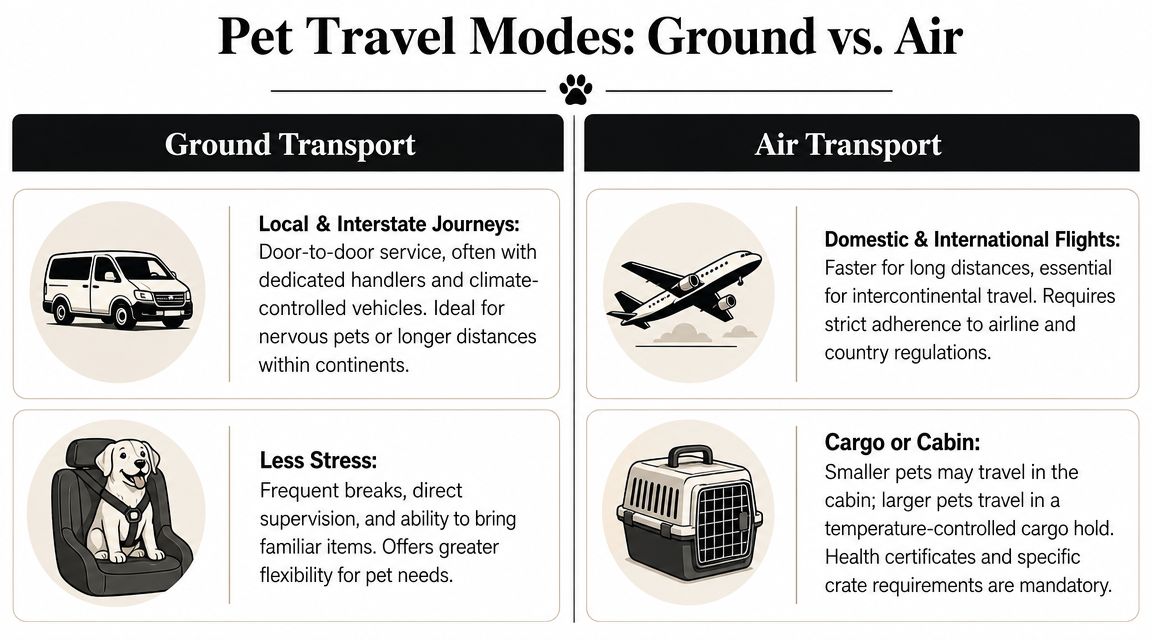
Ground transport is usually the first option I want owners to consider for domestic travel. It offers more control, easier monitoring, and a calmer environment for many dogs.
There are two main versions.
| Mode | Best fit | Main tradeoff |
|---|---|---|
| Private ground | Nervous dogs, seniors, special-needs pets, owners who want direct handling | Higher cost |
| Shared ground | Flexible schedules, social and resilient dogs, budget-conscious owners | Longer transit time and more stops |
Private ground means a more direct route and tighter oversight. Shared ground can work, but it requires stronger screening. Ask how many pets ride together, how often the driver stops, and whether your dog stays in a temperature-controlled vehicle during every leg of the trip.
Ground often wins when the owner's priority is reduced stress, not maximum speed.
Air transport
Air makes sense when distance is too long for practical road travel or when the destination requires it. But “air transport” isn't one thing. Owners confuse several service types and that mistake leads to bad expectations.
Use this simple breakdown:
- Flight nanny: A handler accompanies the pet through the airport process. This is often more personal for smaller pets that qualify for that model.
- Air cargo: This is the formal transport channel used for many larger pets or more complex routes.
- Owner-accompanied cabin travel: This is separate from hiring a transporter and depends on airline rules and pet size.
If you're comparing air options, review this guide on how to fly with a dog before you sign anything. It helps you ask the right operational questions instead of getting distracted by sales language.
Which option fits your dog
I tell owners to choose based on the dog's behavior under stress.
- Choose ground if your dog needs routine breaks, does poorly with noise, or benefits from direct visual supervision.
- Choose air if geography leaves you no practical road option or if speed matters more than route flexibility.
- Choose private service if your dog is elderly, medically sensitive, highly anxious, or not a candidate for multiple handoffs.
A cheap option that doesn't fit your dog isn't a bargain. It's a mistake with a cleaner invoice.
Navigating Pet Travel Regulations and Paperwork
Paperwork is where owners lose control. They assume the provider “handles everything,” then find out that nobody clearly owned the checklist. That's how trips get delayed, denied, or handed off in confusion.
In the United States, if a business takes custody of pets for hire without the owner present, it must register and comply with Animal Welfare Act transportation standards, according to USDA APHIS guidance on transporting animals in commerce. That requirement applies to operators such as airlines, motor carriers, rail carriers, shipping lines, boarding kennels, and hired drivers under the conditions APHIS describes. If the pet stays in the owner's custody, that framework doesn't apply in the same way.
What this means for you
This isn't legal trivia. It affects whether a company can lawfully move your dog, how custody is documented, and how route handoffs should be managed.
A professional workflow should cover:
Identity and itinerary control
Your dog's documents, route, pickup window, and receiving contact should match exactly across all records.Health documentation
Owners should confirm what veterinary paperwork is required for the route and timing involved.Custody records
Every transfer point should be clear. Who picked up the dog, who transported the dog, and who received the dog should never be guesswork.
The paperwork standard I recommend
Don't settle for “we usually take care of that.” That's not a process. That's a shrug.
Use this checklist when you're reviewing a transporter:
- Registration status: Confirm the business is operating under the proper regulatory framework for the service it provides.
- Document ownership: Ask who prepares, reviews, and final-checks the paperwork before travel day.
- Timing discipline: Ask when documents must be completed and what happens if a date slips.
- Exception handling: Ask what the company does if a vet note, route condition, or weather issue changes the plan.
Compliance tells you how a business behaves when details matter. That's why disciplined workflow matters as much in transport as it does in veteran-owned grooming and premium care settings.
For El Paso owners, this is even more important. Long-distance departures often involve interstate planning, and “close enough” paperwork doesn't hold up once your dog is in someone else's custody.
Key Safety and Crate Requirements
If you remember one thing from this guide, remember this. Safety starts long before the vehicle moves or the flight boards. It starts with the crate, the conditioning process, and the provider's handling standards.
A lot of owners focus on departure day. I focus on preparation week. That's where you reduce stress, avoid preventable mistakes, and give your dog the best shot at a calm trip.
Crate fit is not negotiable
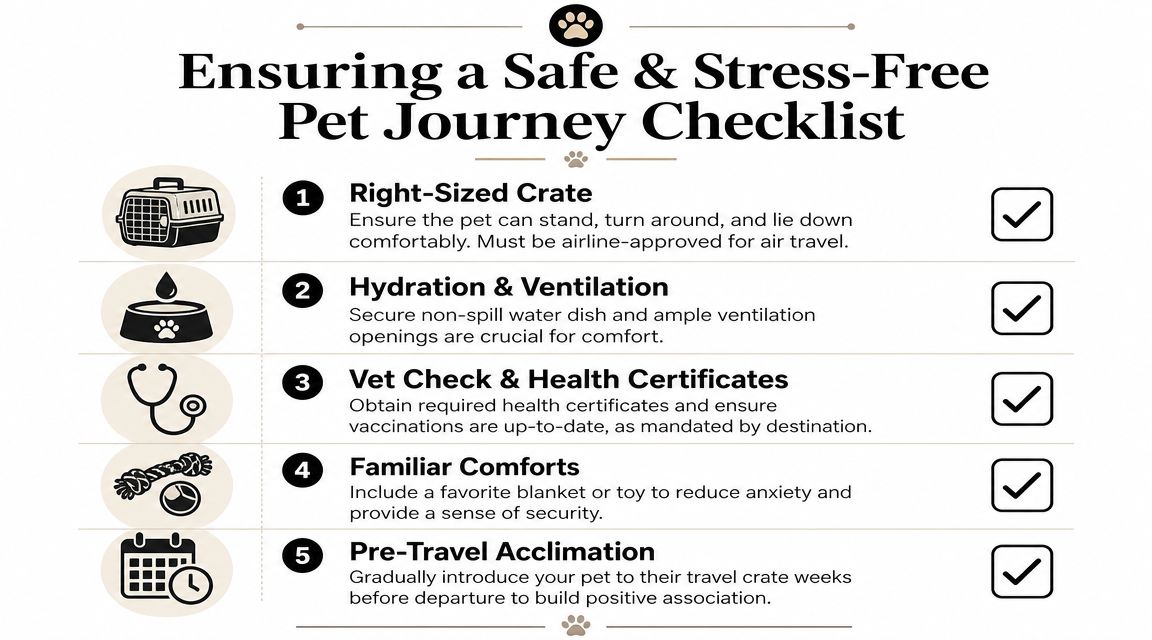
The crate should allow your dog to stand, turn around, and lie down comfortably. Too small creates obvious stress. Too large can reduce stability during movement.
If you're unsure about dimensions, use this dog crate sizing guide before buying a travel kennel. Don't guess from a product photo and don't trust “large breed” labels. Measure your dog.
A sound crate setup includes:
- Secure construction: Doors should close firmly and stay closed through normal handling.
- Proper ventilation: Airflow matters during both road and air transport.
- Stable water setup: The dog needs access to water in a way that doesn't turn the crate into a mess.
- Clear identification: Your contact information and route details should be attached clearly.
Conditioning beats last-minute force
The worst version of crate training is introducing the kennel right before travel and hoping your dog figures it out. That creates panic, not familiarity.
Do this instead:
- Start early: Put the crate out where your dog can investigate it during normal daily life.
- Build positive association: Feed near it, reward calm entry, and let the dog settle inside voluntarily.
- Extend duration gradually: Short calm sessions beat one long stressful session.
- Test travel conditions: Short car rides in the crate can reveal problems before the actual trip.
A dog that accepts the crate as a safe place travels better than a dog that sees it as confinement.
What premium handling looks like
Standards separate serious providers from casual operators. In a region like El Paso, temperature management isn't optional. A provider should be able to explain how the dog is protected during loading, stops, waiting periods, and route changes.
Ask direct questions about:
- Temperature control
- Break routines during road travel
- Medication handling
- Emergency contact protocols
- Whether your dog travels with other animals
- How they respond if the dog shows signs of distress
If the answers are vague, move on. Owners looking for El Paso dog grooming with disciplined care already understand this mindset. The same standard applies in transit. Clean handling, calm routines, and attention to detail are what keep pets safe.
Understanding Pet Transportation Costs
Most pricing frustration comes from one problem. Owners compare quotes that don't include the same service level. One bid includes pickup, supervision, route coordination, and real communication. Another includes transport in the narrowest possible sense. The cheaper number can cost more once delays, add-ons, or weak handling show up.
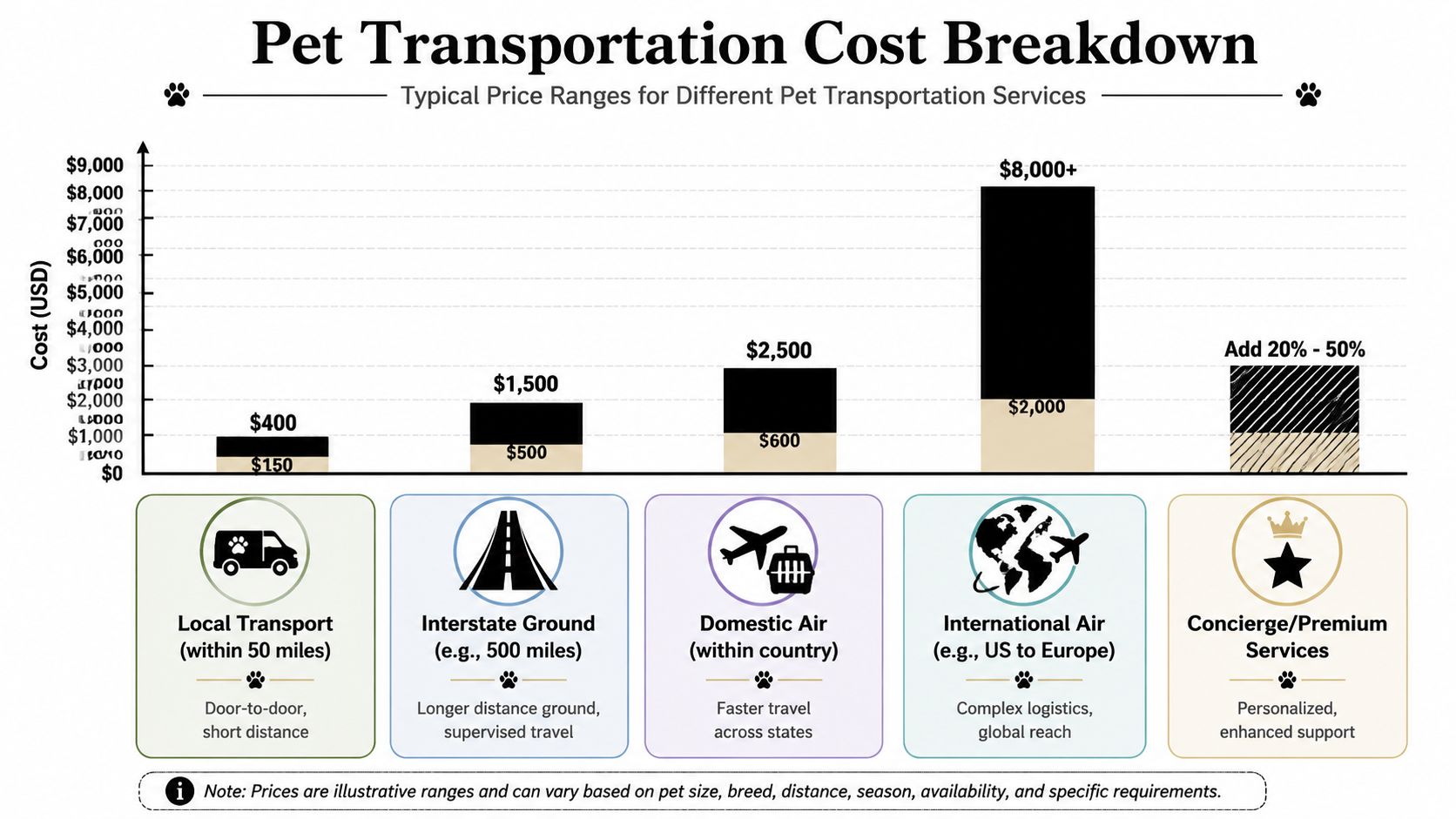
PetWorks gives useful baseline ranges in its published pricing model. It lists local ground transport at about $120 to $300, interstate ground transport at $800 to $1,500, shared ground at $0.75 to $1.25 per mile, private ground at $1.50 to $2.50 per mile, flight nanny services at $400 to $700, and air cargo at $500 to $1,000, with $100 to $200 in extra surcharges for senior, anxious, or special-needs pets, according to PetWorks pricing information for pet transport. Across The Pond Pets similarly notes domestic U.S. transport is typically $800 to $1,500 and international shipping is usually $1,200 to $3,500+, as cited in the verified background.
What actually drives the bill
A quote usually rises or falls based on a few core factors.
| Cost driver | Why it matters |
|---|---|
| Distance | More miles mean more labor, time, fuel, and route management |
| Service level | Shared and private services price differently because supervision differs |
| Pet profile | Senior, anxious, or special-needs pets often require more care |
| Mode of travel | Ground, flight nanny, and air cargo involve different logistics |
That's why premium service costs more. You're not just paying for movement. You're paying for custody discipline, planning, and fewer points of failure.
How to compare quotes without getting fooled
Don't ask, “What's your rate?” Ask, “What does your rate include?”
Use this review method:
- Line-item the service: Pickup, delivery, crate help, paperwork support, communication, and waiting time should be clear.
- Ask about surcharges early: Don't wait until the route is booked to learn that your dog's age, behavior, or needs trigger additional fees.
- Clarify whether the quote is shared or private: Owners often miss this and assume direct travel when the route includes multiple pets.
- Check what happens if plans change: Delays, route changes, and weather can affect the total.
The right question isn't whether a quote is high. It's whether the provider can explain every charge without getting slippery.
If your budget is tight, be honest about it. There's no shame in asking whether a shared route can work safely for your dog. There is a problem if you buy the lowest quote and discover later that your pet is being treated like a scheduling inconvenience.
That same logic applies in everyday care. People who value affordable grooming promo options like Snip & Style Saturday usually still want structure, cleanliness, and respectful handling. Lower price is fine when standards stay intact. Lower standards are not.
How to Evaluate and Choose a Transport Provider
Your dog is scheduled to leave at sunrise, and you still don't know who will be holding the leash at the handoff. That is too late to start asking hard questions.
A transport provider should be easy to verify and hard to shake. If a company gets slippery when you ask about licensing, handling procedures, or emergency response, cross it off your list. Polite sales talk does not protect pets.
MSPCA-Angell advises owners to confirm whether a transporter appears in the USDA Animal Care Public Search Tool as a Class T registrant and to ask about tracking, insurance, emergency procedures, medication handling, temperature-controlled vehicles, break frequency, and whether pets travel with others, according to MSPCA-Angell's guidance on finding a pet transportation service. That advice is useful because it forces a provider to show discipline, not charm.
Questions that expose the real operator
Ask these directly. Then listen for specifics.
Are you properly registered for the service you provide?
A professional should answer clearly and tell you how to verify it.What insurance do you carry, and what does it cover?
You need the scope of coverage, not a vague promise that they are "fully insured."What is your emergency procedure?
Ask who makes decisions, when the owner is contacted, and which veterinary clinic they would use if trouble starts on the road.How do you manage heat, cold, and rest stops?
El Paso owners should press hard on this point. Long routes and extreme temperatures punish sloppy planning fast.Will my pet travel alone or with other animals?
Shared transport is not automatically bad. It does require honest screening, careful scheduling, and controlled handling.
A good provider answers without stalling, guessing, or hiding behind broad language. A weak one talks in circles.
What to look for before you book
Strong operators leave a paper trail and a process trail. You should see both.
- Verifiable credentials: Their status can be checked through the proper channels.
- Written procedures: Pickup, monitoring, feeding, relief breaks, and delivery are documented.
- Consistent communication: They tell you when updates happen and who sends them.
- Pet-specific intake: They ask about temperament, triggers, health history, and daily routine.
- Clean accountability: You know who is responsible from pickup through delivery.
Now the warning signs.
- Vague experience claims: Years in business mean nothing without a clear operating method.
- No written agreement: If details stay verbal, problems multiply at handoff.
- Soft answers on emergencies: Serious carriers rehearse these situations. They do not improvise them.
- Pushy booking pressure: Reliable providers respect careful owners.
Veteran-owned service businesses usually earn trust for a reason. Discipline, chain of custody, and follow-through tend to be built into the culture. Even then, verify every claim. Pride is fine. Proof is better.
For owners who want transport support tied to a higher standard of pet care, Glo More Grooming offers concierge-style coordination for car or air travel as part of its service mix. That matters because the right partner does more than arrange movement. The right partner protects the plan, the pet, and your peace of mind.
The Glo More Grooming Concierge Solution
Your dog is packed, the crate is ready, and the travel date is close. Then one missed document, one late handoff, or one bad timing call turns a clean plan into a stressful mess. Owners who value control do not leave that chain to chance. They put one accountable team over the process.
A real concierge service does more than line up transportation. It coordinates the moving parts that usually break under pressure. That means matching travel plans to the pet, keeping prep on schedule, and making sure the owner is never guessing what happens next. Premium service is not about fluff. It is about disciplined execution.
Why this matters for El Paso owners
El Paso creates its own demands. Heat, long driving windows, cross-state timing, and tight flight coordination all put extra pressure on pet travel plans. Owners here need more than generic booking help. They need a team that respects timing, conditioning, and the understanding that pets do better when the routine around them stays calm and controlled.
That expectation fits the kind of clients Glo More Grooming already serves. People who choose a focused, veteran-owned business usually want clear standards, clean handling, and direct accountability. They are not looking for a call center script. They want people who take ownership.
What concierge support should actually include
You should not have to manage five loose ends while also trying to keep your dog settled. A strong concierge model keeps the trip organized from prep through delivery.
Expect support in these areas:
- Travel planning built around your pet's needs
- Coordination with the selected ground or air transport arrangement
- Scheduling support for veterinary timing and travel prep
- Owner updates that are clear, timely, and useful
- A calm handling standard that protects routine and reduces stress
That last point matters more than owners realize. Dogs respond to disorder fast. Rushed prep, sloppy handoffs, and inconsistent communication create tension before the trip even starts. A disciplined service keeps the process steady, which gives the pet a better travel experience and gives the owner far fewer problems to solve.
Glo More Grooming brings that concierge mindset to local owners who expect polished care and operational discipline in the same package. If you need careful travel coordination, grooming prep before departure, or hands-on support from a veteran-owned team in El Paso, contact Glo More Grooming and ask about current scheduling and service availability.