
You're brushing your dog, running your hand along the ribs or down the neck, and then you feel it. A lump that wasn't there before. Your stomach drops. You start wondering if it's serious, if it hurts, and whether you should rush out the door right now.
That reaction is normal. The good news is that many cysts in dogs are benign, and a calm, disciplined response gives your dog the best chance of getting the right care quickly. In El Paso, where heat, dry air, dust, and skin irritation can all complicate coat and skin health, pet owners need more than panic or internet guessing. They need a steady process, sharp observation, and a care team that pays attention.
A skilled groomer can play a real role in that process. In El Paso dog grooming, the best professionals aren't just focused on tidy feet and clean lines. They're often the first people, outside the family, to notice subtle skin changes under the coat during regular hands-on handling.
Finding a Lump on Your Dog What to Do Next
A common scene goes like this. A dog comes in acting normal, eating well, tail wagging, no obvious distress. Then during a brush-out or bath prep, a small bump turns up under the fur near the shoulder, flank, or leg. The owner hadn't seen it because thick coat can hide a lot.
That first discovery matters, but what happens next matters more. Don't squeeze it. Don't assume it's “just a fatty lump.” Don't let fear make the decision for you.
Start with a calm check
Put your hands on the area again when your dog is relaxed. Notice a few basics:
- Location: Is it near the paw, back, ear, jaw, or belly?
- Surface feel: Does it feel smooth, firm, soft, fixed, or movable?
- Skin changes: Is the skin red, open, crusted, or warm?
- Your dog's reaction: Does your dog pull away, flinch, lick, or ignore it?
Those details help your veterinarian. They also help you avoid the two biggest mistakes owners make. Waiting too long because the dog seems “fine,” or overreacting and trying home treatment before anyone has diagnosed it.
Practical rule: Any new lump deserves attention. It doesn't always mean an emergency, but it always means you should start observing on purpose.
What a disciplined grooming eye can catch
In a rushed, high-volume setting, a small bump can be missed. In a calm, one-dog-focused appointment, hands move slowly through the coat, skin gets seen from multiple angles, and subtle changes stand out sooner. That's one reason regular coat care can support wellness.
If you've found something under your dog's coat and want a grounded overview of what hidden skin changes can look like, this guide on bumps on dogs skin under fur is a useful starting point.
What to do today
Use a simple same-day plan:
- Take a clear photo from above and from the side.
- Note the date you found it.
- Watch for rapid changes in size, redness, or discharge.
- Book a veterinary exam if it's new, irritated, growing, or painful.
A lump is a problem to assess, not a reason to spiral. Good pet care works best when owners, groomers, and veterinarians each do their job with discipline.
Understanding Common Cysts in Dogs
Owners call many round bumps a “sebaceous cyst,” but that label is often too broad. Several cyst types show up in dogs, and they do not all start from the same tissue or carry the same practical concerns.

The cysts owners hear about most often
A cyst is a sac with contents and a lining. That lining matters. If a lesion is only drained and the lining remains, recurrence is more likely.
These are the categories owners commonly hear discussed in the salon or exam room:
| Type | Plain-English picture | What owners often notice |
|---|---|---|
| Sebaceous cyst | Related to an oil gland | A round bump that may stay quiet or become inflamed |
| Follicular cyst | Related to a hair follicle | A lump within the coat-bearing skin, sometimes with irritation nearby |
| Dermoid cyst | Tissue developing in an abnormal location | Often present because of development, not simple blockage |
From a groomer's standpoint, the distinction matters less than the pattern. Is the bump stable, irritated, draining, attached to the skin, or changing between visits? In a one-on-one appointment, those changes are easier to catch because the dog is handled slowly and the coat is parted with intention.
Clean dogs can still get cysts
Owners often assume a cyst means they missed baths, brushing, or grooming. That is usually the wrong conclusion.
Cysts can form from blocked follicles or glands, chronic irritation, scar tissue, or underlying health problems. Some dogs are more prone to them. Good coat care supports skin health and helps us spot trouble earlier, but grooming does not prevent every cyst and it does not correct internal disease.
That is why I treat lump detection as part of professional observation, not a cosmetic side note. A groomer's role is to observe, document, communicate, and maintain standards.
Not every cyst is a skin bump
Some cysts develop in the mouth or deeper tissues, where owners will not find them during a quick pat-down. One example is the dentigerous cyst, which forms around an unerupted tooth.
Research published on PubMed found a strong breed-linked risk pattern for dentigerous cysts in certain short-headed dogs, according to this study on dentigerous cysts in dogs. That matters for owners because a normal-looking coat does not rule out every cyst problem.
Skin conditions can also mimic each other. Areas with crusting, pustules, or irritation may not be cysts at all. This guide on whether dogs can get impetigo shows why surface appearance alone can be misleading.
What owners should take from this
Two points keep people grounded.
- Many cysts are benign
- Many lumps are not cysts
That is the trade-off. Staying calm is appropriate. Guessing is not. Owners should monitor what they can see, and professionals should do their jobs with discipline when something changes.
Diagnosis and Veterinary Treatment Options
You find a lump during belly rubs or while brushing after a dusty El Paso walk. By that evening, it already feels bigger in your mind than it may be on your dog. The right move is a veterinary exam, because appearance and feel alone do not sort a harmless cyst from an abscess, inflamed tissue, or a tumor.
Owners help most by bringing a clean history. Groomers help by documenting what was seen, where it was, and whether it looked different from the last appointment. That kind of record gives the veterinarian a better starting point and saves time.
What to track before the visit
Write down the facts your veterinarian can use:
- When you first noticed the lump
- Whether it has changed in size, shape, color, or firmness
- If your dog licks, rubs, or scratches at it
- Whether it has drained, crusted, opened, or bled
- Any tenderness, odor, or heat around the area
- Any recent clipping, matting, collar friction, or skin irritation nearby
Photos help too. Take them in good light and from the same angle every few days if the appointment is not immediate.
Some skin problems look similar at home and very different under veterinary exam. If the area has pustules, crusting, or surface irritation, owners may be dealing with a lookalike condition rather than a cyst. Our guide on whether dogs can get impetigo explains one of the common mix-ups.
The tests vets use most often
Veterinarians usually start with hands-on examination and then choose the least invasive test that can answer the question. In many cases, that means a fine needle aspiration, often called an FNA. A small needle collects cells or material from the lump, and that sample can show whether the mass behaves more like a cyst, inflammation, infection, or something that needs a closer look.
If the sample does not give a clear answer, the next step may be a biopsy. That provides tissue for a more complete diagnosis. Some lumps are then monitored. Others are treated with medication if infection or inflammation is part of the problem. Some are best removed.
Surgical excision is often the cleanest treatment when a true cyst keeps recurring, becomes irritated, or sits in a spot that gets rubbed and traumatized. Removal matters because draining a cyst does not remove the lining that produced it in the first place.
A lump that has been drained can fill again. Owners often mistake that for a new problem when it is the same one returning.
What works and what falls short
Treatment depends on what the veterinarian finds and how the lump is behaving. There is no single answer that fits every dog.
| Approach | What it does well | Where it falls short |
|---|---|---|
| Monitoring with veterinary guidance | Reasonable for select stable lumps that are not causing trouble | Does not identify every mass with certainty and does not remove it |
| Needle sampling or biopsy | Gives diagnostic information that guides the plan | May still leave the lump in place unless removal is chosen |
| Drainage only | Can relieve pressure or mess for a short time | The lining may remain, and the problem can return |
| Surgical removal | Removes the lesion and allows full tissue review when needed | Requires anesthesia planning, cost discussion, and recovery care |
That trade-off deserves plain talk. Immediate surgery is not always the first step. Waiting without a veterinary assessment is not a plan either.
What owners should expect
A solid vet visit is usually straightforward. The doctor examines the lump, asks how long it has been there, checks whether the surrounding skin is inflamed, and recommends sampling, treatment, monitoring, or removal based on those findings.
My standard as a groomer is simple. I do not diagnose, but I do pay attention, document changes, and tell owners when a lump has crossed the line from “keep an eye on it” to “book the vet.” That partnership works best when each professional stays in their lane and does their job well.
Why Your Groomer Is a Key Health Partner
A groomer shouldn't diagnose cysts. That belongs to the veterinarian. But a skilled groomer absolutely can be a key health partner in spotting trouble early, documenting changes, and encouraging the owner to get proper care.

Why hands-on routine matters
Dogs don't stand in front of a mirror and report a new lump. People find these issues through routine touch. That's where regular grooming becomes more than appearance care.
A groomer working methodically can notice:
- A new bump under dense coat
- Skin thickening near a friction point
- An inflamed area the owner hasn't seen
- A lesion that has changed since the last visit
That kind of comparison over time is powerful. It doesn't replace a medical diagnosis, but it often catches changes before they become larger, angrier, or infected.
Premium versus assembly-line handling
In a chain environment, dogs may rotate through multiple hands with several pets on site at once. That model can clean a dog up, but it often doesn't create the same level of continuity or calm observation.
A premium appointment usually means fewer overlapping dogs, more consistency in who handles the pet, and a controlled pace. That one-on-one structure supports better coat work and sharper skin awareness. It's one reason many owners looking for veteran-owned grooming standards prefer a quieter setup over a conveyor-belt feel.
For a closer look at what that model involves, this page on one-on-one dog grooming shows how controlled workflow supports safer, more attentive care.
A local standard reinforces that expectation. As of January 1, 2021, all dog groomers in El Paso must complete formal training and earn certification to operate, and the ordinance also requires incident reporting protocols and stronger accountability, as reported in KFOX's coverage of the El Paso groomer certification ordinance.
Why local standards matter in El Paso
El Paso pet owners should expect professionalism. Certification, visible handling standards, and documented accountability raise the bar for everyone. That's good for pets. It's also good for owners who are tired of vague answers and rushed drop-offs.
Here's a simple comparison:
| Grooming approach | What the owner often gets |
|---|---|
| High-volume chain model | Speed, rotation, less continuity |
| Disciplined one-on-one model | Consistency, calmer handling, better observation |
This short video captures the wellness side of quality grooming.
A groomer who sees your dog regularly can notice the quiet changes. That's one reason routine appointments support health, not just appearance.
The real role of the groomer
The best groomers stay in their lane and take that lane seriously. They don't diagnose. They observe, document, communicate, and maintain standards.
That approach fits a long-term vision for pet care in El Paso. Better grooming isn't just prettier coats. It's cleaner workflow, calmer pets, clearer owner communication, and another trained set of eyes helping protect the dog.
Safe Home Care and When to Take Action
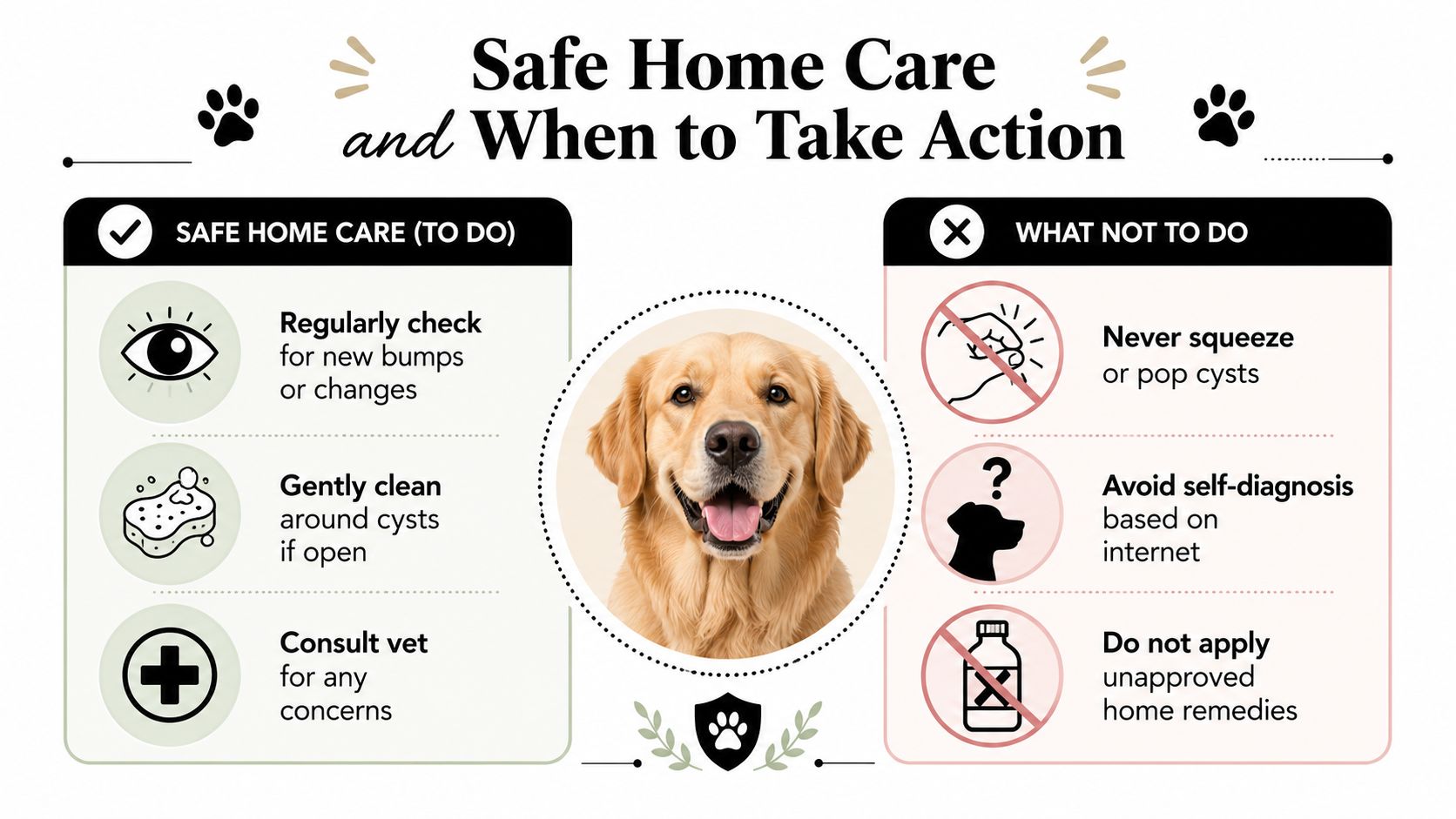
Home care has a place. Home procedures do not. That distinction protects dogs from pain, infection, and delayed treatment.
What you should never do
Veterinary clinical guidance strongly warns against trying to rupture a cyst at home because the released material can trigger an acute inflammatory response, and the body treats it like a foreign invader. That can lead to pain and a high risk of secondary bacterial infection that may require antibiotics and steroids, according to this clinical guidance on follicular cyst care in dogs.
That means no squeezing, no puncturing, no “just getting the gunk out,” and no random ointments from the cabinet.
Home-care warning: Popping a cyst doesn't fix the lining. It often adds inflammation to the original problem.
What you can do safely
Owners still have an important role. Safe support at home helps you monitor your dog and avoid making things worse.
Use this framework:
- Watch with purpose: Check the size, skin color, and surface every few days if your vet has said monitoring is appropriate.
- Keep the area clean: If a spot is open or irritated, gently cleanse around it with warm water and mild soap unless your veterinarian gives different instructions.
- Stop self-trauma: If your dog licks, chews, or scratches the area, protect it promptly. Ongoing irritation can turn a manageable lesion into a bigger problem.
- Follow post-procedure instructions exactly: After removal, incision care matters more than owner improvisation.
When monitoring is reasonable and when action is better
Not every lump needs same-hour panic. Some solitary, non-inflamed follicular cysts can be monitored, especially when the veterinarian has already evaluated them. The line changes when the area becomes active.
Take action sooner if you see:
- Ulceration or bleeding
- Heat, swelling, or sudden tenderness
- Drainage with odor or obvious irritation
- Persistent licking or chewing
- Rapid visible change
If the lesion opens up, your dog may need protective bandaging or an Elizabethan collar to stop more tissue damage. Owners often underestimate how fast licking can undo healing.
What doesn't work long term
A lot of bad advice survives because it sounds simple. Warm compresses, homemade salves, squeezing, and “natural” spot treatments may make an owner feel proactive, but they do not remove the cyst lining. That's why they don't offer a true cure.
When owners want a practical rule, use this one:
| Situation | Best next move |
|---|---|
| Stable lump, dog comfortable | Monitor and schedule veterinary assessment |
| Red, open, painful, or draining lesion | Contact your veterinarian promptly |
| Owner wants to squeeze it | Stop and do nothing until a vet advises next steps |
A steady routine beats panic. Check your dog during brushing, bathing, and paw handling. In El Paso's dry climate, skin can get irritated fast, so small changes are easier to catch when touch is already part of your weekly rhythm.
Choose Uncompromising Standards for Your Dog in El Paso
Pet owners in this city have options. Not all of them offer the same level of attention, consistency, or accountability. That matters when a dog's comfort, skin condition, and early wellness detection are on the line.
The strongest El Paso dog grooming choice is one built on disciplined workflow. Fewer overlapping dogs. Consistent handling. Cleaner communication. A calmer environment. Those aren't luxury talking points. They're the foundation of premium pet grooming that respects the dog in front of you.
For families balancing quality and budget, there should also be a practical on-ramp. One example is a real affordable grooming promo that still protects standards instead of cutting corners.

A better standard should still be reachable
Glo More Grooming's Snip & Style Saturday offers a flat $55 full groom for any size dog, and that monthly promotion gives El Paso owners access to one-on-one care without paying a size-based premium, as shown on Glo More Grooming's official site.
That matters because access shouldn't force owners to choose between affordability and quality. A disciplined studio can still create room for community-minded pricing when the workflow is intentional.
Why this matters beyond the haircut
A veteran-owned business carries a different kind of accountability. The standard isn't “good enough.” It's consistency, ownership, and pride in the work. That long-term mindset shows up in the way appointments are structured, how dogs are handled, and how concerns are communicated to owners.
That's also where independent studios can stand apart from chains like PetSmart or Petco. Large operations can move volume. A focused, one-on-one model can offer continuity. For dogs with sensitive skin, hidden bumps, stress during grooming, or owners who want clearer communication, continuity wins.
If you want a grooming relationship that supports both presentation and wellness, choose the studio that treats observation, hygiene, and handling like serious work. That's how trust is built. That's how small issues get caught earlier. That's how resilient pet care should look in El Paso.
If your dog has a new lump, changing skin issue, or you want a calmer grooming routine with higher standards, book with Glo More Grooming. Reserve a Snip & Style Saturday slot, ask about one-on-one care, and choose the veteran-owned grooming team built on discipline, compassion, and long-term care for El Paso dogs.