
You're probably here because a tegu impressed you. They often do. A young Argentine black and white tegu can look calm, alert, and almost dog-like in the way it watches people and explores its space.
That first impression matters, but the second one matters more. Argentine black and white tegu care isn't a beginner impulse project. It's a long, structured commitment that changes as the animal grows, matures, and settles into life with you over many years.
A good keeper thinks beyond the first setup. You need to think about adult size, permanent housing, diet changes with age, daily humidity management, safe handling, veterinary access, and the legal side of ownership. If you plan for the full life of the animal from day one, you give your tegu the best chance at a stable, healthy life.
Is a Tegu the Right Reptile for You
You bring home a juvenile tegu because it seems calm, curious, and manageable. A year or two later, you are reorganizing a room, upgrading equipment, buying more food each week, and planning your schedule around a reptile that may be with you through moves, career changes, and family changes. That is the decision point. A tegu is not a short trial pet. It is a long project with a live animal at the center of it.
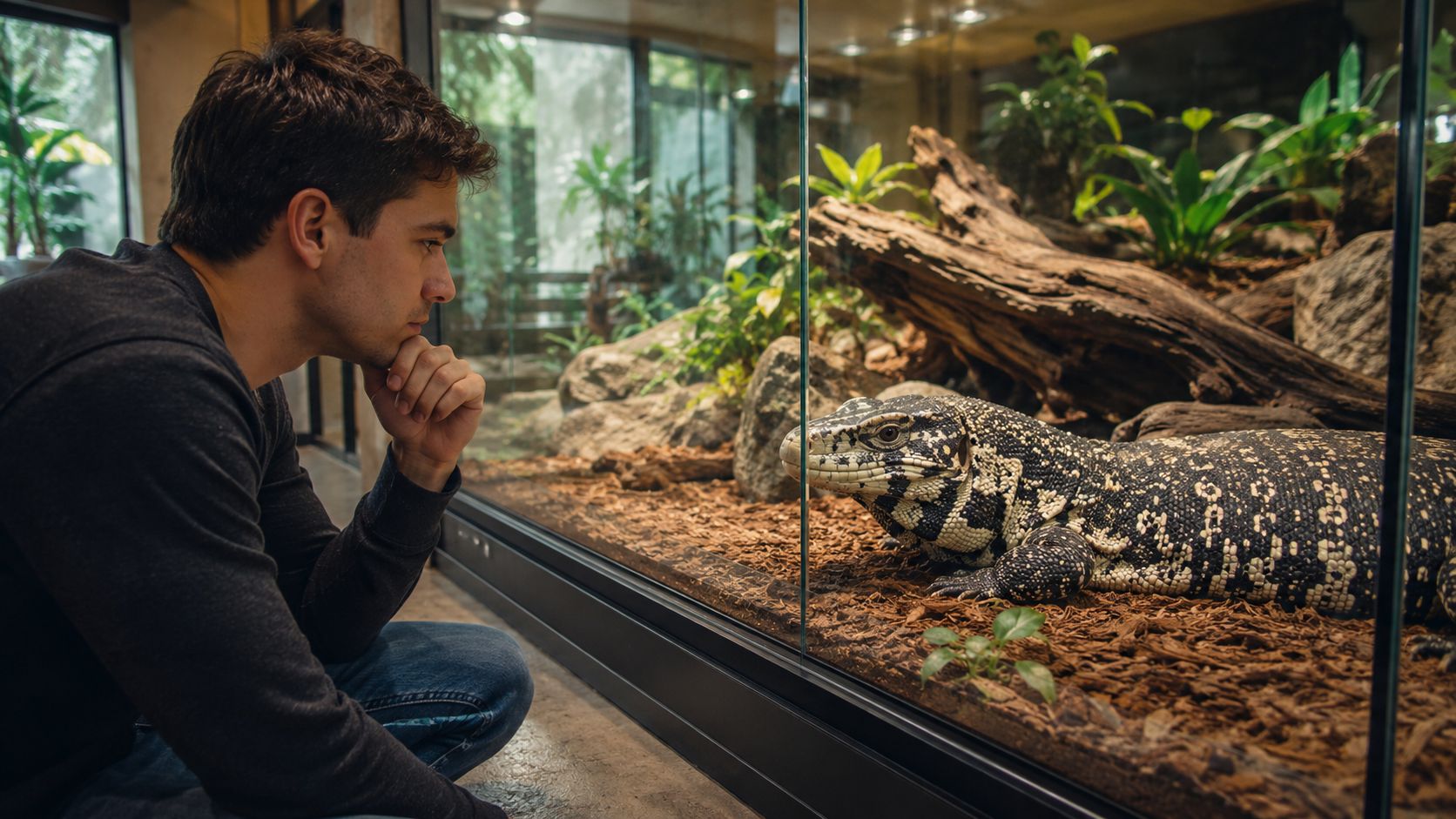
What makes tegus different is not just size. It is scale over time. A hatchling or young juvenile can fool people into planning for the animal they see today instead of the animal they will house, feed, and manage for many years. Good tegu keeping starts with adult planning. You need room in your home, money for large equipment, time for daily care, and the willingness to keep learning as the animal matures.
A first-time keeper often asks whether a tegu can become tame. That matters, but it is not the first question. Start with this one instead: can your home and routine support a large, intelligent lizard for the long term? Tegus reward steady care, but they also expose weak planning fast. If your current schedule already makes regular pet care inconsistent, a tegu will make that gap obvious.
A Practical Commitment Test
Before you buy anything, work through these questions carefully:
- Space for the adult animal: Can you dedicate a large area of your home to an enclosure and support equipment once the tegu is fully grown?
- Daily consistency: Can you check water, cleanliness, humidity, and behavior every day, including busy workweeks and travel periods?
- Budget over years, not weeks: Can you afford setup upgrades, replacement bulbs, substrate, food, and veterinary care as the animal grows?
- Life changes: If you move, change jobs, or add other responsibilities at home, will this reptile still fit into your plans?
- Comfort with reptile husbandry: Can you learn species-specific care instead of guessing from mammal habits or small-lizard starter advice?
A tegu works less like a decorative enclosure pet and more like a long-term household system. The enclosure gets larger. Feeding changes with age. Cleaning stays regular. Equipment fails and needs replacing. If you plan only for the exciting first months, you will be forced to make expensive decisions later, usually when the animal has already outgrown your setup.
People also get misled by the species' reputation. Many Argentine black and white tegus do become calm and responsive with patient, respectful handling. Intelligence does not reduce the care load. It adds another layer to it. You are caring for an animal that benefits from routine, observation, and thoughtful interaction, not just heat, light, and food.
Experience with other reptiles can help, especially if you already understand temperature gradients, sanitation, and reading body language. Still, a tegu is its own category of commitment. If you want a useful point of comparison, this guide on caring for snakes as a reptile owner shows how husbandry demands can differ across species, but tegus require more space, more physical setup planning, and a broader long-term budget than many keepers expect.
Who should wait
A tegu probably is not the right reptile for you if you want:
- A compact pet: Adult housing changes how you use a room.
- A low-cost reptile: Large enclosures, heating, lighting, substrate, and food add up over time.
- Occasional care: Daily observation and regular upkeep are part of keeping them well.
- A short-term experiment: This species can be part of your life for many years.
That may sound strict. It should. Responsible ownership begins before purchase, when you decide whether you can meet the animal's needs for its whole life, not just during its small and appealing early stage.
Building the Perfect Tegu Habitat
A lot of new keepers meet their tegu as a small juvenile, set up a reasonable-looking enclosure, and feel prepared. Then the lizard keeps growing. Within a short stretch of time, the tub or starter cage feels like a hallway closet for an animal that wants to walk, dig, soak, and choose between warm and cool areas on its own.
That is why habitat planning for a tegu should start at the end, with the adult animal you will be housing for years, not the baby you bring home.
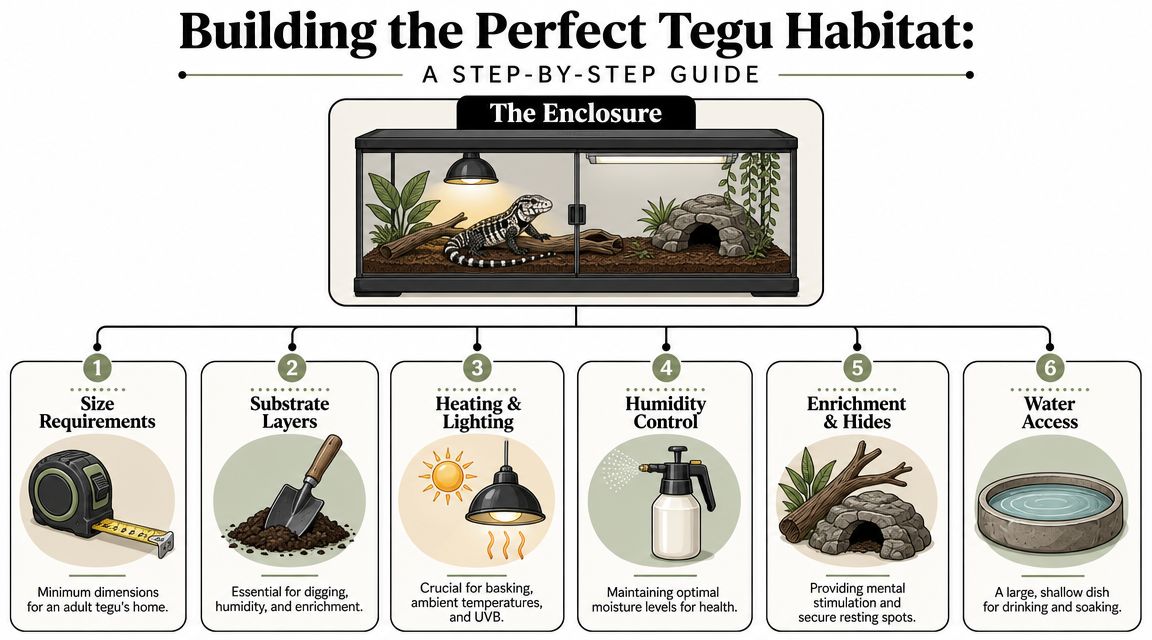
Argentine black and white tegus become large, muscular lizards, and their enclosure needs to reflect that reality. Practical husbandry advice consistently points keepers toward a full-size enclosure with enough floor space for walking, turning, digging, and using several habitat zones instead of living under one lamp in one corner.
Start with the adult enclosure
Building for the juvenile stage often costs more in the long run. You buy a temporary setup, then replace it, then modify your heating and lighting again when the animal outgrows the first plan.
A better approach is to set up the adult enclosure from the start, or to map out exactly when and how you will upgrade. That planning mindset matters with tegus. Their care scales with them. More body mass means more substrate, stronger fixtures, more food, larger water containers, and more room devoted to one reptile in your home.
If you want a point of comparison, a bearded dragon cage setup shows the same basic husbandry logic of heat, light, shelter, and sanitation. A tegu needs all of it on a much larger, heavier-duty scale.
Build usable space, not empty space
An enclosure can be large and still be poorly designed.
Your tegu needs to do several things in that footprint. It needs to warm itself, cool down, hide, dig, rest, drink, and move between those choices without crossing a barren box. Good enclosure design works like a small climate map. One area should be warmer and brighter. Another should feel cooler and more sheltered. The humid hide should hold moisture better than the open floor. The substrate should be deep enough to be used, not just looked at.
That variety helps the animal regulate its own body and behavior. Tegus do best when they can make choices.
What the enclosure must include
A well-planned setup should provide:
- Deep substrate: Tegus dig and burrow as part of normal behavior, and the substrate also helps hold humidity.
- A heat gradient: The enclosure should offer a warm basking area and a cooler retreat, so the tegu can regulate body temperature by moving.
- Reliable UVB exposure: UVB supports normal calcium metabolism and bone health.
- A humid zone: A humid hide and moisture-retentive substrate support shedding and skin condition.
- Fresh water at all times: Use a water container large enough for drinking and practical daily cleaning.
Here's a useful visual walkthrough for habitat planning:
Substrate is part of the habitat system
New keepers sometimes treat substrate like bedding in a mammal cage. For a tegu, it functions more like flooring, humidity support, and behavioral enrichment at the same time.
A shallow layer limits digging and dries out fast. A deeper, suitable substrate layer gives the enclosure a more stable feel and supports one of the species' natural habits. It also helps create a better microclimate near the ground, especially when paired with a humid hide. Tegus use their environment physically. The enclosure should account for that from day one.
Humidity supports comfort, shedding, and daily function
Tegus need an enclosure that holds moisture well enough to support normal shedding and hydration. A dry setup often leads to stuck shed, especially around toes and tail tips, and it can make parts of the enclosure less usable because the animal avoids uncomfortable conditions.
This is one reason enclosure materials and layout matter so much. Deep substrate, a humid hide, sensible ventilation, and a water bowl you can clean easily all work together. Habitat design is not a collection of separate gadgets. It is one system, and each piece affects the others.
Build zones your tegu can use every day
I recommend organizing the enclosure into clear functional areas:
| Habitat Zone | Purpose |
|---|---|
| Basking area | Allows the tegu to warm up and digest properly |
| Cooler retreat | Gives the animal a place to regulate away from heat |
| Humid hide | Supports shedding and security |
| Digging area | Encourages natural burrowing behavior |
| Water area | Provides constant access to clean dechlorinated water |
This layout also helps you as a keeper. When each area has a job, it becomes easier to monitor whether the setup is working. You can see where your tegu spends time, whether the humid hide is being used, whether the substrate is staying too wet or too dry, and whether cleaning routines are realistic.
Choose equipment you can maintain for years
A tegu habitat should be built for daily use, not just for the day you finish setting it up. Heat sources need safe mounting. Lighting needs to cover the right area. Water needs to be easy to replace. Surfaces need to be easy to clean. Doors and locks need to hold up to a strong lizard that pushes, digs, and explores.
That long-term view is what separates a decent enclosure from a dependable one. Over a tegu's lifespan, the best habitat is the one that still works on busy weekdays, during seasonal changes, and after the animal has reached full size. Responsible tegu keeping starts with that level of planning.
A Complete Tegu Diet and Supplement Guide
A young tegu can make you feel like you are doing everything right because it eats with enthusiasm. Two years later, that same feeding style can leave you with an overweight adult and a keeper who is confused about what changed. Diet is one of the clearest examples of why tegu care has to be planned in stages.
Feeding should change as the animal changes. A hatchling is building a body. An adult is maintaining one. If you keep feeding for growth after growth has slowed, problems creep in over months, not days.
That long view matters. Over a tegu's 15 to 20 year lifespan, you are not managing one static menu. You are adjusting portion size, food mix, feeding frequency, and supplement use as the lizard moves from fast growth to maturity.
Feed the life stage in front of you
Young tegus usually need more frequent meals and a stronger emphasis on animal protein. Adults still need protein, but they also need a more controlled, balanced omnivorous pattern with plant matter making up a larger share of the diet.
A simple comparison helps here. Feeding a hatchling like an adult can limit growth and condition. Feeding an adult like a hatchling can add excess weight and encourage a tegu to expect oversized meals. The right diet is the one that matches the animal in front of you, not the one that worked six months ago.
This is also why keeping records helps. A feeding log works much like a habitat care checklist for small enclosures. The species is different, but the principle is the same. Consistent care gets easier when you can see patterns instead of relying on memory.
Tegu feeding guide by age
| Age Group | Feeding Frequency | Diet Composition |
|---|---|---|
| Hatchlings 0–6 months | Frequent meals each week | Mostly animal protein, with small amounts of vegetables and limited fruit |
| Juveniles 7–12 months | Regular meals several times per week | Mostly animal protein, while steadily introducing more plant matter |
| Subadults 1–2 years | Moderate feeding schedule | Transition toward a more balanced omnivorous diet |
| Adults over 2 years | Fewer, planned meals each week | Protein remains important, with vegetables forming a larger portion and fruit kept small |
What to offer
Build meals from categories, not random treats.
- Protein foods: Use appropriately sized whole prey or other suitable animal-protein items for the tegu's age and body condition.
- Vegetable portion: Rotate reptile-safe vegetables so the diet does not become narrow or overly dependent on one item.
- Fruit portion: Keep fruit as the smallest part of the plant side, especially for adults.
Fruit causes confusion for many first-time keepers because tegus often go after sweeter foods with enthusiasm. That does not make fruit the best base for the diet. Treat it like the flavorful extra, not the main event.
A good feeding plan should be repeatable. If a diet only works when you are improvising, it usually needs work.
Supplements and feeding discipline
Calcium and vitamin supplements should follow a schedule that matches the animal's age, the foods you use most often, and the quality of your UVB lighting. There is no single dusting rule that fits every tegu. Your exotic veterinarian should help you set that schedule, then adjust it as the animal grows.
Body condition tells you whether the plan is working. A healthy tegu should look solid and well-muscled, not soft and heavy. An eager feeder can still be overfed, and a sudden drop in appetite can point to stress, environmental problems, seasonal slowdown, or illness.
Use feeding as an observation tool. Watch what is accepted, what is refused, how body shape changes over time, and whether the diet still fits the life stage you are in. That habit will serve you for years, and tegu ownership is measured in years.
Daily Weekly and Monthly Care Routines
Most new keepers don't fail because they don't care. They fail because the work feels scattered. The fix is a repeatable routine.
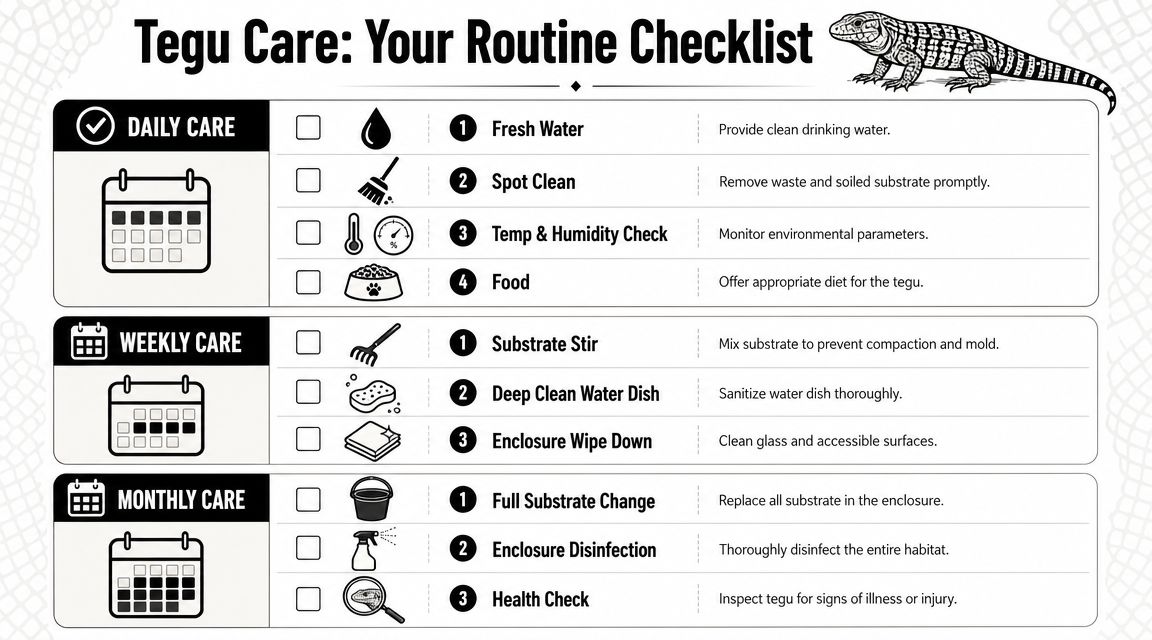
A tegu does best when your husbandry becomes mechanical in a good way. You don't want to “remember when you can.” You want a system you can run even on busy days.
For another example of enclosure-based routine thinking, this page on a hermit crab cage shows how small environmental checks add up to long-term animal health. Tegus require that same discipline on a larger scale.
Daily routine
Every day, check the basics before you interact much with the animal.
- Refresh water: Replace with clean dechlorinated water and make sure the container is usable, not fouled.
- Inspect the enclosure: Remove waste and any heavily soiled substrate.
- Check humidity and heat: Make sure the enclosure still feels and functions as intended.
- Observe behavior: Notice whether the tegu is alert, hiding more than usual, restless, or uninterested in food when feeding is due.
A daily routine shouldn't take forever. It should be short, deliberate, and done the same way each time.
Weekly maintenance
Once a week, do the tasks that keep small problems from turning into large ones.
- Stir or refresh problem areas of substrate so moisture and cleanliness stay manageable.
- Clean the water dish thoroughly instead of only topping it off.
- Wipe enclosure surfaces that collect residue, splashes, or waste.
- Review feeding response and stool quality in general terms so you can catch changes early.
This is also a good time for short, calm interaction sessions if your tegu is socializing well. Routine handling and routine cleaning often support each other because both rely on predictability.
Monthly reset
Monthly care is where you zoom out and ask whether the system still works.
- Do a deeper enclosure clean: Address buildup you can miss during quick daily passes.
- Check equipment condition: Look at lamps, fixtures, hydration tools, and enclosure wear points.
- Review body condition: Notice whether the tegu appears to be filling out appropriately, shedding cleanly, and moving normally.
- Audit your workflow: If one part of care keeps getting skipped, redesign that task so it's easier to complete.
Good husbandry is often less about advanced knowledge and more about repeating the basics without drift.
A routine like this also helps if more than one person in the household shares care duties. When the workflow is clear, the animal gets consistent care instead of depending on whoever happens to remember.
Handling and Socializing Your Intelligent Lizard
A tegu can learn that you're predictable, safe, and worth paying attention to. That trust doesn't come from grabbing the animal and hoping it “gets used to it.”
It starts with quiet repetition. A new keeper opens the enclosure, changes water, adjusts substrate, and leaves. The tegu watches. After several calm interactions like that, the animal begins to learn your patterns.
The first stage of trust
One of the best early wins is neutral presence. Sit near the enclosure. Let the tegu see your hands doing routine work that doesn't lead to restraint every time.
Then introduce positive association. Many keepers use feeding tools to create a clean, consistent connection between your presence and good experiences. The point isn't to make the tegu “perform.” The point is to remove surprise.
A common beginner mistake is pushing for handling too soon because the lizard seems curious. Curiosity and readiness are not always the same.
Read the body, not your hopes
A keeper once told me her tegu was “being dramatic” because it huffed when she reached in. What happened was simple. The enclosure had become the tegu's only secure zone, and her hand entered quickly from above during cleaning.
That huffing response was information. It said, “I'm unsure about this.” When she slowed down, approached more consistently, and stopped cornering the animal during routine tasks, the behavior softened.
Look for patterns such as:
- Calm investigation: Slow approach, tongue flicking, steady movement
- Defensive discomfort: Hissing, sharp withdrawal, body tension, avoidance
- Overstimulation: Restless movement, repeated attempts to flee, inability to settle
Those signals aren't personal. They're feedback.
Trust grows faster when the tegu has the option to leave the interaction.
Short sessions work best
Keep handling sessions brief and calm at first. Support the body well. Avoid turning every interaction into a long event. A tegu that ends a session still feeling safe is easier to work with next time.
Outside-enclosure enrichment can also help, but only in a safe, supervised area. Tegu-proof the room first. Remove hazards, block tight hiding spots you can't access easily, and keep the session controlled. The goal is exploration without chaos.
Some tegus become very steady with people. Others remain more reserved. Responsible socializing means respecting the individual animal in front of you instead of forcing a personality you wanted.
Common Health Issues and Finding a Qualified Vet
Most common tegu health problems start as husbandry problems, observation failures, or delays in getting professional help. That's why prevention is more useful than memorizing disease names.
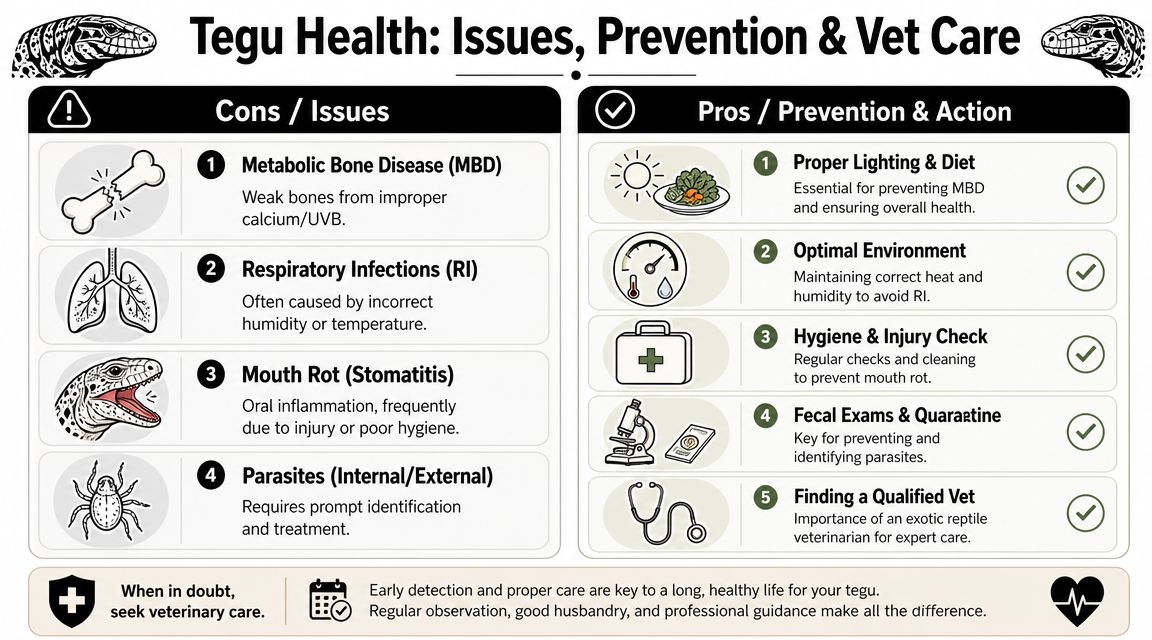
If a tegu has the wrong environment for long enough, the body eventually shows it. Your job is to notice small changes before they become advanced ones.
Husbandry-linked problems
Here's the big pattern to understand:
| Issue | Often connected to | What keepers should do |
|---|---|---|
| Metabolic bone disease | Poor UVB support or diet and supplement problems | Review lighting, diet, and get veterinary guidance |
| Respiratory trouble | Environmental imbalance, especially poor heat or humidity control | Correct the habitat and seek prompt veterinary care |
| Shedding problems | Dry conditions or inadequate humid retreat access | Improve moisture support and monitor stuck shed areas |
| Obesity | Feeding the wrong life-stage diet for too long | Reassess portions, frequency, and food balance |
Metabolic bone disease is a classic example. People often think of it as a mysterious reptile illness, but the logic is straightforward. If a tegu lacks proper UVB support or a correct calcium strategy, the skeleton pays the price. Weakness, poor movement, jaw changes, or tremors all require veterinary attention.
Respiratory problems follow similar logic. When heat and humidity are poorly managed, the environment stops supporting normal function. A tegu that seems lethargic, breathes abnormally, or shows unusual mucus needs prompt assessment.
Subtle signs matter
Watch for these changes:
- Behavior shifts: Hiding more, less interest in food, unusual irritability
- Movement changes: Weak grip, stiffness, reluctance to move
- Skin and shed problems: Retained shed, especially around toes or tail
- Mouth concerns: Swelling, debris, redness, or refusal to bite food normally
- Stool changes: Persistent abnormalities or obvious parasites
Don't diagnose at home beyond basic observation. Your role is to notice, document, and respond.
Find the vet before the emergency
This is one of the strongest habits a keeper can build. Don't wait until your tegu is visibly ill to start searching for an exotic animal veterinarian.
Call clinics early and ask whether they regularly see reptiles, including large lizards. Ask about routine wellness visits, fecal testing, and emergency availability. Keep transport equipment ready so you're not improvising under stress.
The best time to find a reptile vet is when your tegu is healthy and you can think clearly.
A veterinary relationship also helps with supplement decisions, diet questions, body condition assessment, and early warning signs that aren't obvious to a first-time owner. That support is part of responsible tegu care, not an optional extra.
Legal Ethical and Long-Term Ownership Considerations
A tegu often enters a home as a manageable juvenile. Then life keeps changing. The lizard grows, your housing may change, household routines shift, and the animal still needs space, heat, food, and secure care year after year. That is the fundamental commitment behind tegu ownership.
Laws deserve attention before you buy and every time your circumstances change. Tegus are native to South America, and escaped or released animals have caused serious ecological problems in parts of the southern United States. Because of that, ownership rules can change with little warning. An animal that is legal in one town, county, or state may be restricted in another. If you move, revisit the rules yourself instead of assuming yesterday's answer still applies.
Ethics start with sourcing. Buy only from a breeder or seller who can explain the animal's origin, feeding history, temperament, and expected adult needs. A calm baby in a small tub is easy to underestimate. Juveniles are the early chapter. Adult care is the standard you should plan for from day one.
Scale is the issue many first-time owners miss. A young tegu can fit into your routine with relative ease, but that routine has to expand as the animal does. Enclosure size increases. Food bills rise. Substrate use becomes more noticeable. Heating a large habitat costs more than heating a starter setup. The project grows with the lizard, much like a child outgrows clothes, furniture, and school supplies in stages rather than all at once.
A general care handout from Ness Exotic Wellness Center notes that adult tegus often require a large custom enclosure and may live for well over a decade in human care. Those points shape responsible planning more than any shopping list does.
Ask yourself:
- Can you give permanent floor space to a large enclosure, not just squeeze one in for now?
- Can your budget cover food, substrate, electricity, equipment replacement, and reptile veterinary care over many years?
- If you rent, move, marry, have children, or change jobs, does the tegu still fit your life?
- If you ever cannot keep the animal, do you have a realistic rehoming plan that does not depend on luck?
- Will everyone in the household follow the same care standards for the full lifespan of the animal?
These are planning questions with real consequences.
Containment is part of ethics too. Never release a tegu outdoors. Release puts the animal at risk, harms native wildlife, and can create legal problems for the owner. Secure locks, escape checks, and an emergency backup plan belong in the same category as heat and diet. They protect both the animal and the environment.
If your answers are uncertain, wait. Good tegu keeping begins long before purchase day, with enough space, enough money, lawful housing, and a realistic plan for the years ahead.
If you're the kind of pet owner who values disciplined care, clean standards, and long-term commitment, Glo More Grooming brings that same mindset to dogs in El Paso. As a veteran-owned grooming studio, Glo More Grooming offers calm, one-on-one service for families who want premium pet grooming without the chain-store rush of PetSmart or Petco. Local pet parents looking for El Paso dog grooming can also watch for monthly opportunities like affordable grooming promo events, including Snip & Style Saturday. Book now, reserve your promo slot, or contact Glo More Grooming to give your dog polished, thoughtful care.