
You're watching your dog stand on the grooming table while the dryer hums nearby. Nothing dramatic happens. There's no bark, lunge, or snap, so it's easy to assume everything is fine. Yet a quick tongue flick, a head turn, or a lifted paw may already be telling you that your dog needs the pressure reduced.
Learning to recognize stress signals in dogs helps owners make better decisions before discomfort becomes defensive behavior. It also shows why premium grooming standards depend on more than a polished haircut. A disciplined workflow, careful observation, and a calm response protect the dog, the handler, and the quality of the finished service.
A Moment Most Owners Miss at the Grooming Table
Biscuit, a small terrier, is standing on the grooming table while the dryer moves along his coat. His ears are still up. His tail is still moving. To an owner watching through a window, he appears compliant.
Then the nozzle passes his flank. Biscuit gives a rapid tongue flick, almost too quick to notice. The brush approaches his shoulder, and he turns his head away for half a second. A front paw lifts from the table and stays suspended before returning to the surface.
None of these actions looks dramatic by itself. Biscuit hasn't pulled away, barked, or tried to bite. A busy observer might call him cooperative and continue the appointment without a second thought. An experienced groomer reads the sequence differently. The tongue flick may be an early displacement behavior, the head turn may indicate that the brush feels intrusive, and the lifted paw may be a request for the interaction to slow down.
Practical rule: A dog can remain still and still be under pressure.
The handler pauses the dryer, softens the movement, and gives Biscuit a moment to shift his weight and look around. That short interruption preserves options. Biscuit doesn't have to escalate to make his discomfort clear.
This is the difference between watching for a crisis and reading communication. The signals in the rest of this guide are hiding inside moments exactly like Biscuit's. Once you learn to spot them, the entire grooming visit becomes easier to understand, and you can choose a safer, more respectful routine for your dog.
What Stress Actually Looks Like in a Dog's Body
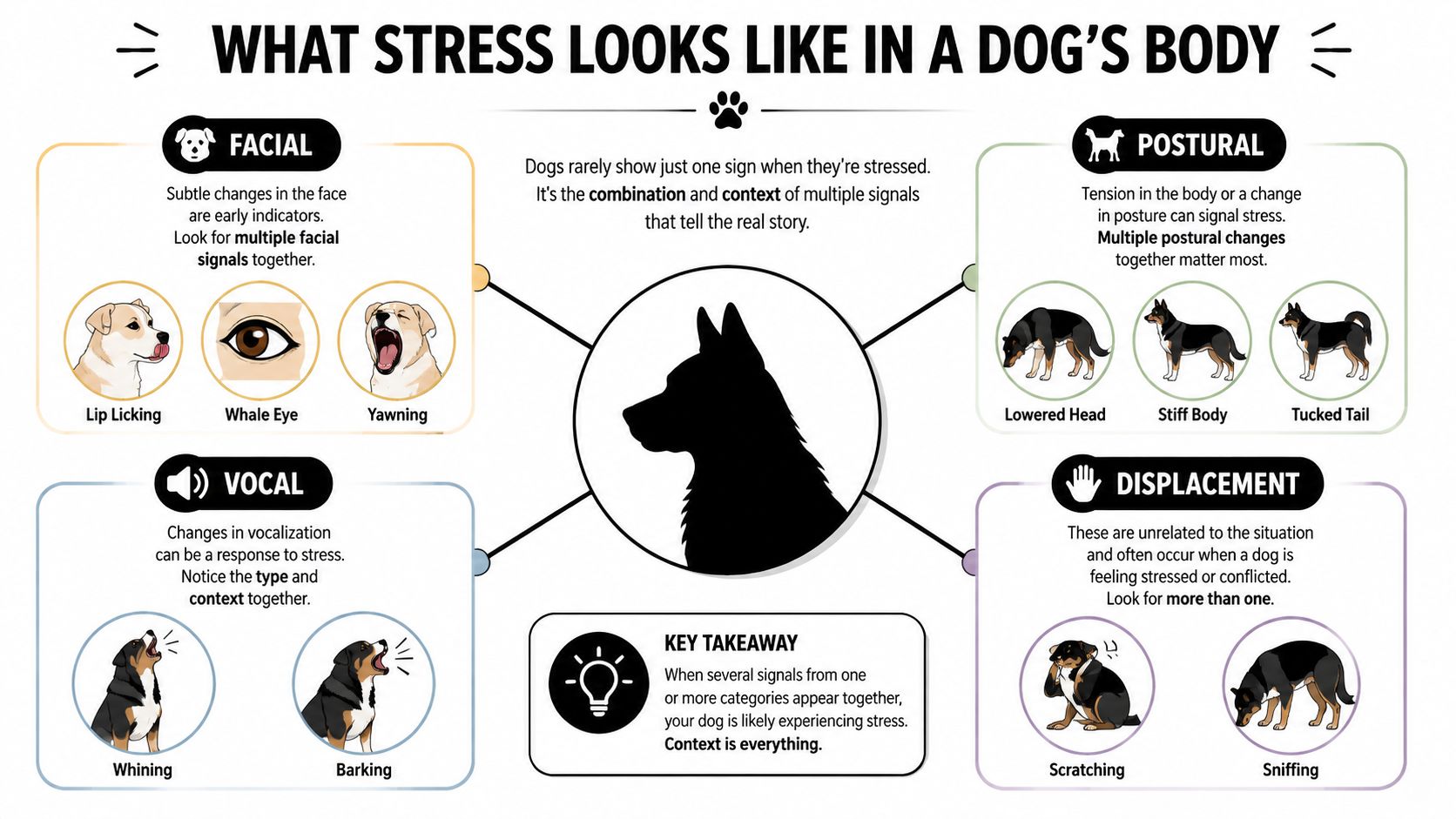
Stress is most reliably identified through a cluster of body-language changes, not a single isolated gesture. Veterinary guidance lists panting, pacing, trembling or shaking, drooling, a lowered or tucked tail, pinned-back ears, dilated pupils, whale eye, lip licking, yawning, and withdrawal among signs that may appear together (veterinary guidance on canine stress signals).
A single lip lick doesn't diagnose anxiety. Dogs may lick their lips for ordinary reasons, including food or a dry mouth. But lip licking paired with a lowered head, a tucked hindquarters, and a half-panted breath tells you much more. The meaning comes from the combination, the situation, and the change from the dog's normal behavior.
Start with the dog's calm baseline
Before interpreting pressure, observe your dog at rest. Does your dog usually carry the tail loosely, hold the ears forward, breathe softly, and settle with a relaxed mouth? That calm reference point gives you something to compare with at the groomer, in the car, or during handling at home.
Consider a dog in a grooming lobby who is panting, pacing, and trembling. The pacing suggests that the dog is trying to move away or find a safer position. The tremor reflects physical arousal, while the panting may show rising activation rather than heat alone. If the dog also drools, refuses to approach the grooming area, or withdraws from touch, the cluster becomes harder to dismiss as simple excitement.
You can learn more about the surrounding posture cues in this guide to reading dog body language. The important habit is simple: look at the whole dog, then compare the dog with their own normal state.
For more objective assessment, hair cortisol can reflect longer-term hypothalamic-pituitary-adrenal activity and is generally well tolerated during collection, according to a review of canine stress management (review of canine stress assessment). That review also cautions that universal quantitative indicators and standardized canine hormone reference ranges aren't available, so behavior, physiology, and context should be considered together rather than treating cortisol as a complete answer.
The Four Clusters of Stress Signals Every Owner Should Recognize
Dogs communicate through overlapping systems. A sound, a posture, a facial change, or an avoidance action may each carry information, but the clearest reading comes from noticing how the signals support one another.
Vocal signals often ask for distance
Whining, repeated barking, and high-pitched yips may function as attempts to create space. A dog vocalizing beside the grooming table might be responding to the dryer, a tool, another dog, or the handler's proximity. The sound isn't necessarily disobedience. It may be the dog's most obvious available request for the pressure to stop.
Posture shows how safe the dog feels
A lowered body, weight shifted backward, tucked tail, stiff stance, or leaning away can show fear or discomfort. Freezing deserves special attention. A dog that suddenly becomes statue-still may not be calm. The stillness can signal that the dog feels movement is unsafe or doesn't know how to escape the situation.
A relaxed dog usually has a loose posture and relaxed mouth, while rigid stance, tucked tail, pinned ears, and a turned head are associated with fear or discomfort (body-language comparison for grooming stress).
Facial signals reveal conflict
Whale eye, a hard stare, a tightened mouth, ears pinned or rotated back, and a yawn unrelated to tiredness can indicate rising unease. For example, a dog may keep the body facing the groomer while turning the eyes sideways to monitor the approaching clipper. That visible white area isn't a decorative detail. It can show that the dog is trying to track a threat without moving the head.
Avoidance signals are active communication
Head turns, ground sniffing, scratching, shaking off, lip licking, and a lifted paw may help the dog manage pressure or delay contact. A dog that sniffs the table when the brush comes out may be trying to redirect the interaction. A paw held off the surface can signal uncertainty about what happens next.
| Cluster | Common Signals | What It Usually Means |
|---|---|---|
| Vocal | Whining, repeated barking, high-pitched yips | “This is too much, give me space.” |
| Postural | Lowered body, stiff stance, tucked tail, freezing | Fear, discomfort, or uncertainty |
| Facial | Whale eye, tightened mouth, pinned ears, stress yawning | Conflict and rising concern |
| Avoidance | Head turns, sniffing, scratching, lip licking, paw lift | An attempt to delay, redirect, or escape contact |
These clusters aren't rigid labels. A dog may move between them quickly, or show only a few. Your job is to interpret intent, not to wait for a dramatic behavior that everyone can see.
Early Warnings Most People Overlook During Handling
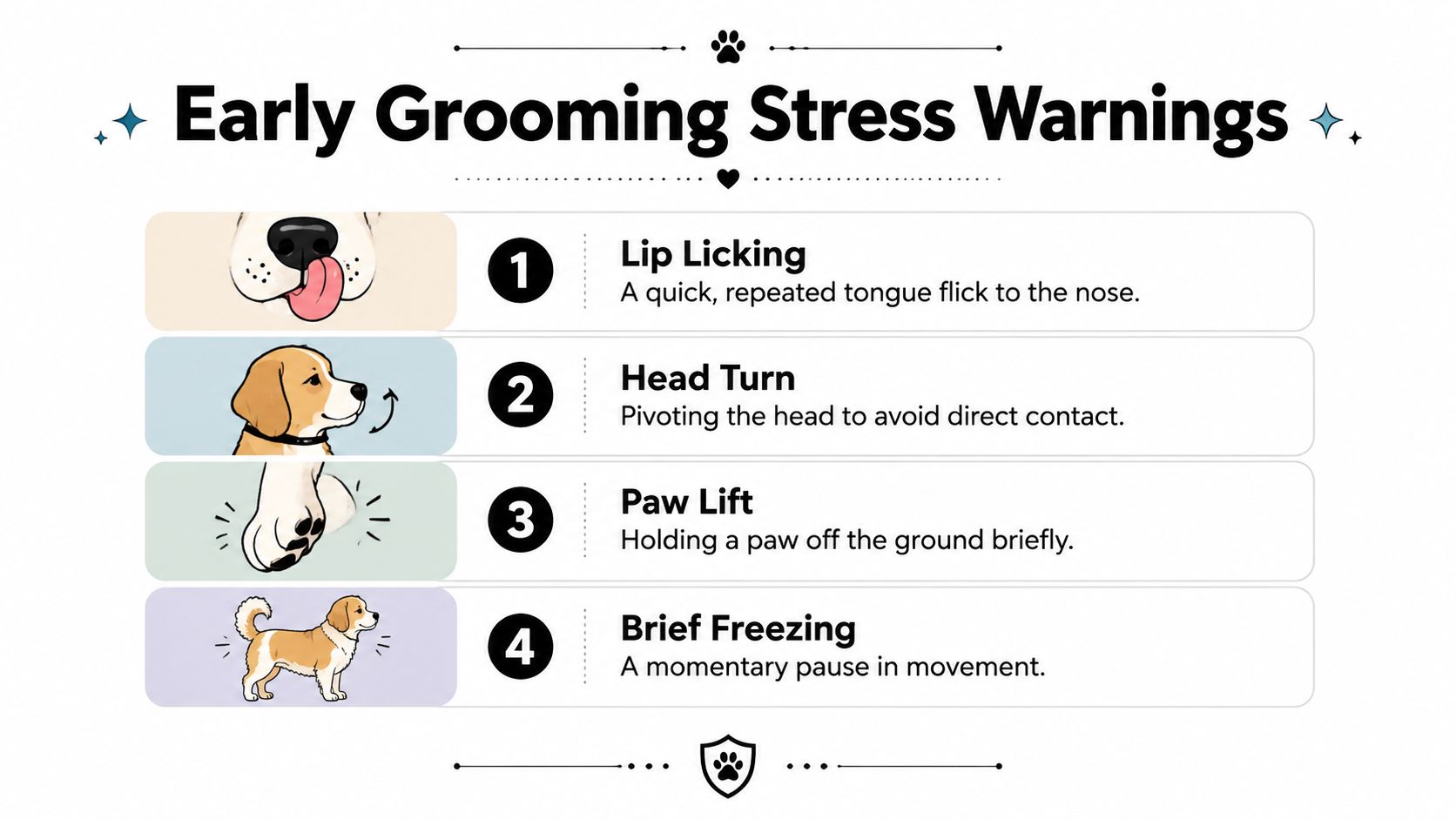
The earliest handling signals can look ordinary because dogs use familiar movements to manage unusual pressure. Lip licking, a head turn, a paw lift, and brief freezing are especially important around brushes, clippers, dryers, nail tools, and close contact.
A quick tongue flick at the corner of the mouth may appear and disappear before the owner notices. A slow chin swing away from the brush can be even quieter. The dog may not be refusing the groom. The dog may be asking for the intensity to change.
Read the small movements
- Lip licking: A repeated flick of the tongue, especially when no food is present, can signal discomfort.
- Head turn: The dog pivots away from direct contact with a tool, hand, or body area.
- Paw lift: The dog raises and holds a paw instead of placing it down, often during handling or restraint.
- Brief freezing: Movement stops suddenly, and the dog becomes rigid or unusually still.
These are often called displacement behaviors because the dog performs a familiar action while coping with conflict or pressure. In grooming, they should act as a built-in stop-and-reset cue. Ignoring them can remove the dog's quieter options and increase the chance of stronger warnings, including lip lifting, growling, or snapping.
The response doesn't require special talent. It requires a repeatable habit. Notice the signal, stop the immediate action, and ask what changed. Was the brush on a sensitive area? Did the dryer move too close? Did the dog lose footing, tire, or become overwhelmed by sound?
A disciplined handler doesn't praise stillness automatically. They check whether the dog is relaxed or holding themselves in place.
A Practical Response Plan When You See a Signal
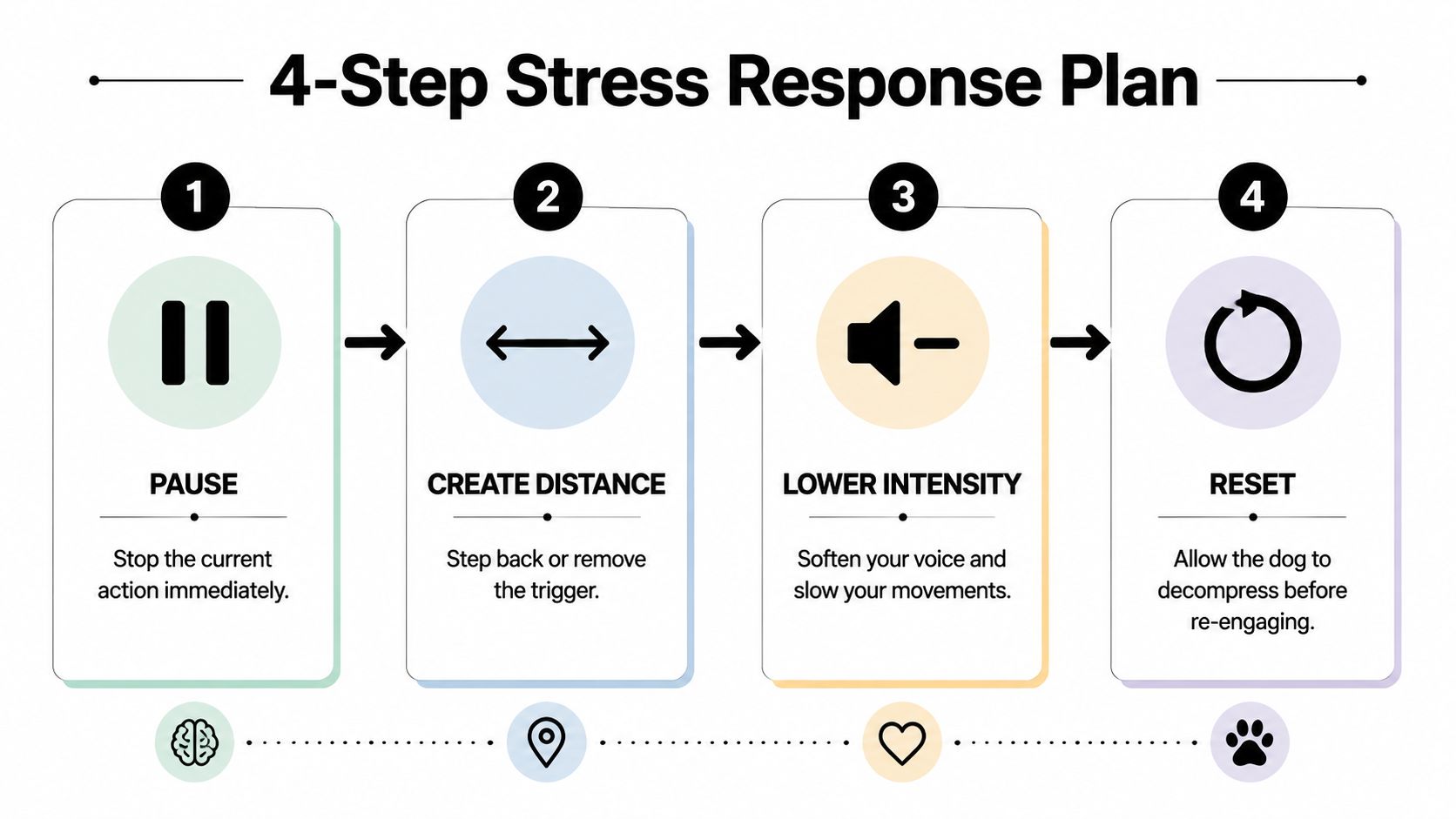
Stress calls for a response, not a debate. Use four actions in order: pause the task, create distance, lower the intensity, and reset before deciding whether to continue.
Apply the sequence in real time
Pause the current action. Stop the brush, clipper, dryer, or nail tool as soon as you see a meaningful change. A grooming guide notes that even a 5-second pause can help a dog calm before handling resumes (behaviour-based grooming response guide).
Create physical distance. Step back, loosen unnecessary pressure, or move the tool away. Distance gives the dog room to process instead of forcing them to defend themselves in close contact.
Lower intensity. Reduce sound and movement. Turn down or move the dryer away, slow the brush stroke, soften your voice, and avoid reaching over the dog's head. Small adjustments can change the dog's immediate experience.
Reset. Offer a familiar cue, allow a sniff break, or let the dog stand without a tool touching them. Continue only if the dog's body returns toward a looser state. If the signal returns quickly, change the plan or end the task.
During a monthly Snip & Style Saturday visit, for example, a calm groomer notices Biscuit lip-licking when the clipper approaches his flank. The clipper stops, the tether is managed safely, the groomer lowers their voice, and Biscuit gets time to sniff. The appointment then resumes at a reduced intensity, or the sensitive part is postponed if he can't settle.
The same logic works for brushing at home, ear care, nail handling, and veterinary preparation. A calm routine for an anxious dog should give the dog repeated opportunities to recover, rather than treating recovery as an inconvenience.
Watch this practical demonstration for another visual example of responding to canine stress:
How the Right Grooming Environment Changes Everything
Environment affects the number and intensity of triggers a dog must process. A home-based, one-on-one studio such as Glo More Grooming can operate with fewer dogs on site, while a busy chain setting may involve more barking, dryers, movement, transitions, and unfamiliar handling around the same appointment.
That comparison isn't a judgment about every individual employee or location. PetSmart and Petco stores vary by team and layout, just as independent studios vary by their operating standards. The useful question is whether the workflow gives the groomer enough time to notice early signals and respond without rushing.
Compare the operating conditions
| Factor | Calm One-on-One Studio | High-Volume Chain |
|---|---|---|
| Noise floor | Fewer simultaneous sounds may make subtle changes easier to read | Multiple dryers, voices, doors, and dogs can add stimulation |
| Dogs on site | Lower-volume scheduling can reduce nearby triggers | More dogs may share the waiting and grooming environment |
| Restraint style | Handling can be adjusted around the individual dog's signals | Standardized procedures may leave less room for pacing |
| Handler transitions | Fewer people can create a more predictable experience | Check-in, bathing, drying, and finishing may involve several transitions |
| Appointment rhythm | Breaks and observation can fit into the workflow | Time pressure may encourage continuation through early warnings |
A quiet space doesn't make stress impossible. A dog may still dislike paw handling, a dryer, a clipper, or separation from the owner. The advantage is operational: the handler has more room to identify the trigger, lower the intensity, and protect the dog's recovery.
Workflow standard: The environment should help the handler read the dog, not force the dog to shout.
For El Paso owners, regional conditions also matter. Heat can contribute to panting, so a groomer must distinguish environmental warmth from panting that appears alongside pacing, trembling, drooling, or withdrawal. Seasonal coat care, clean equipment, safe drying, and sensible scheduling all belong in a premium pet grooming routine.
When Stress Crosses the Line and Professional Help Is Needed
Stress often develops along a progression. A dog may begin with lip licking, yawning, sniffing, or a head turn. If those signals don't change the situation, the dog may show whale eye, a stiff body, lowered posture, vocalizing, or attempts to avoid touch. Stronger responses can include freezing, snapping, or shutdown.
Shutdown may look like a dog going limp, appearing blank, or urinating involuntarily. These responses don't mean the dog has suddenly become stubborn or dangerous. They indicate that the dog's coping options are severely limited and that continuing can increase risk.
Choose the right level of support
Contact a qualified professional when:
- The pattern repeats: Signals appear across multiple situations rather than only during one unusual event.
- The intensity rises: Your adjustments don't reduce the dog's response, or recovery becomes harder.
- Safety is involved: A growl, snap, or bite sequence requires careful management, not punishment.
- Daily care suffers: Stress interferes with eating, walking, grooming, handling, or routine medical care.
- Guarding spreads: Resource guarding expands to additional people, places, or objects.
A certified force-free groomer or behavior consultant may help with handling plans, cooperative care, and gradual exposure. A veterinary behaviorist is a better fit when the response is severe, widespread, or potentially linked to pain, thyroid imbalance, sensory decline, or another medical contributor.
Decision rule: If stress signals appear in three or more contexts, escalate to professional support rather than trying to solve the pattern through grooming practice alone.
A groomer for anxious dogs can help assess whether the service environment and handling plan are appropriate, but veterinary input matters when health may be part of the picture. The goal is not to force a finished haircut. The goal is to keep care safe and make future handling more manageable.
Building a Calm Routine With a Studio That Shares Your Standards
Stress awareness should influence where you book grooming, not only what you do after a dog reacts. A low-volume, one-dog-at-a-time workflow puts body-language reading into daily operations. It removes avoidable pressure points, including a barking lobby, nearby dryer noise, crowded transitions, and time pressure to push past a head turn.
A calm intake begins before tools touch the coat. The groomer watches how the dog enters, approaches the table, accepts touch, and responds to the room. That observation creates a practical baseline for the appointment and helps identify whether the concern is sound, separation, restraint, a body area, or the grooming process itself.
What disciplined care looks like
- Quiet intake: The handler allows the dog to orient instead of rushing straight into a task.
- Break-based handling: Lip licks, paw lifts, and head turns prompt a pause and a change in approach.
- Controlled tool use: Clippers, brushes, and dryers are introduced with attention to distance, sound, and body response.
- Careful finishing: The final brush, nail trim, or dryer pass doesn't become a hurried stress spike.
- Clear standards: The groomer communicates what can be completed safely and what may need a separate plan.
This approach supports seasonal care as well. El Paso dogs may need regular coat maintenance, bathing, drying, nail care, and ear cleaning, but the schedule should still respect the individual dog's tolerance. Owners can ask about full grooming packages, touch-up sessions, luxury bath and blow-dry options, and an affordable grooming promo such as the monthly Snip & Style Saturday offer.
A veteran-owned grooming business also brings an independent, long-term vision to its standards. Glo More Grooming is rooted in El Paso, operates as a home-based premium pet grooming studio, and limits the number of dogs on site. That model gives owners a clear alternative to chain-style volume without asking them to compromise on professional precision, hygiene, or consistent care.
The right partner doesn't promise that every dog will love every tool immediately. The right partner builds a repeatable process that notices discomfort early, protects the dog's trust, and delivers polished work through patience and discipline.
Glo More Grooming offers one-on-one premium pet grooming in El Paso, including full grooming, touch-up care, luxury bath and blow-dry services, and the monthly Snip & Style Saturday affordable grooming promo. Visit Glo More Grooming to book your appointment, reserve a promo slot, or contact the veteran-owned studio about a calm grooming routine for your dog.