
You notice it when the coat starts pulling at the brush, the dog smells less than fresh, or nails click across the tile with every step. By then, grooming has already shifted from routine care to damage control. A disciplined grooming schedule for dogs prevents that scramble, protects comfort, and gives you a clear standard for choosing between home maintenance and professional service.
In El Paso, that schedule has to account for coat structure, outdoor activity, seasonal shedding, desert heat, and your dog's age. Premium care isn't about chasing a perfect show-ring finish every week. It's about consistent handling, clean tools, careful observation, and appointments timed before small problems become painful ones.
Establishing a Baseline for Professional Care
A client once arrived with a dog whose coat looked manageable from across the room. Up close, the brush caught behind the ears, around the collar, and beneath the legs. The nails had grown long enough to change how the dog stood. The owner hadn't ignored the dog. They had no schedule, only the familiar promise to book “when it gets bad.”
That approach costs the dog comfort and costs the owner more time. A professional appointment should happen before mats tighten, nails interfere with movement, or dirt and oil become difficult to remove.
The working interval
For many healthy adult dogs with normal skin, bathing every four to six weeks is a practical baseline, according to veterinary guidance on bathing and grooming intervals. Higher-maintenance coats often need professional grooming every four to eight weeks, while some short or lower-maintenance coats can stay on an eight-to-twelve-week full-groom rhythm when owners maintain brushing, nails, ears, and hygiene at home. Those intervals depend on coat condition, not a calendar picked at random.
The ASPCA takes a broader minimum view, recommending that most dogs receive a bath at least once every three months, with more frequent bathing for dogs that spend substantial time outdoors or have skin problems. Its dog grooming guidance also supports regular brushing for short, smooth coats and short, dense coats that mat easily.
Practical rule: Book the next appointment before you leave the current one. A schedule beats a rescue operation.
A 2022 peer-reviewed U.S. survey found that 81% of dog owners had groomed their pet during the previous 12 months, while professional grooming occurred about four times per year on average. The same U.S. dog-owner grooming survey found that households under $45,000 averaged 3.2 professional grooms annually, compared with 4.6 among households earning $125,000 or more. At-home grooming was the most common method at 41%, followed by full-service salons at 30%, mobile grooming at 9%, retailers at 8%, and self-service centers at 6%.
Build care around the dog
Those figures show the average baseline, but averages don't decide your dog's appointment. A double-coated dog that hikes outdoors in El Paso needs a different workflow from a smooth-coated companion who spends most of the day indoors. A doodle with fast-growing, curly hair can mat between visits even when the owner thinks the coat looks clean.
A full service should be specific about what it includes. Review what's included in a full-service groom before booking, then ask how the groomer handles bathing, drying, haircutting, nail care, ear cleaning, sanitation, and coat condition. Premium pet grooming treats the appointment as a controlled maintenance process, not a rushed wash-and-trim transaction.
Tailoring the Grooming Schedule for Dogs by Coat Type
Coat type determines how quickly a dog moves from tidy to tangled. Loose hair behaves like lint caught in a filter. If you remove it regularly, air and a brush can move through the coat. If you leave it in place, friction and moisture compress it into a dense layer that pulls against the skin.
Start by identifying the coat, then assign the home routine before deciding how long to wait between professional visits.
Coat structure comes first
Purdue's Canine Welfare Science guidance supports a clear coat-based frequency range. Long-haired and silky breeds benefit from daily brushing, as do wavy-coated dogs such as Poodles and their hybrids. Thick undercoats generally need brushing once or twice a week, with more attention during heavy shedding. Curly-haired dogs benefit from brushing two to three times a week, while short-haired and smooth-coated dogs generally need brushing about once a week. The coat-care guidance summarized by Woofies explains why shedding load and coat structure must shape the cadence.
Use a slicker brush for many longer or wavier coats, but don't stop at the top layer. Follow with a metal greyhound comb, especially behind the ears, beneath the front legs, around the tail, and through the furnishings. For undercoats, choose a tool designed to lift loose hair without scraping the skin. Aggressive raking can irritate a dog that already has sensitive skin.
Coat Type Maintenance Matrix
| Coat Type | At-Home Brushing | Professional Groom Interval |
|---|---|---|
| Short or smooth | About once a week | Often eight to twelve weeks, with baths and nail care adjusted to lifestyle |
| Thick undercoat | Once or twice a week, more during heavy shedding | Often four to eight weeks during active shedding or outdoor-heavy routines |
| Curly | Two to three times a week | Commonly four to eight weeks, depending on length and matting risk |
| Long or silky | Daily | Commonly four to eight weeks, with shorter intervals when the coat is kept long |
| Wavy, including Poodle hybrids | Daily | Commonly four to eight weeks, based on length, brushing success, and skin condition |
These professional ranges are practical operating guidance, not permission to ignore the coat between appointments. A short coat still needs inspection, nail maintenance, and occasional bathing. A long coat may need a shorter appointment interval if the owner can't comb from skin to ends.
For detailed handling of longer coats, use this long-haired dog grooming resource as a reference point, then ask a groomer to demonstrate the correct brush and comb technique. If the comb can't pass through the coat cleanly, the schedule is already too loose.
Bathing should follow the same logic. Healthy adult dogs with normal skin often fit the four-to-six-week bathing baseline, but dogs that swim, work outdoors, or develop skin problems may need a veterinarian-guided adjustment. Too little washing allows buildup. Too much washing can be unnecessary for some skin and coat types. The right schedule protects the skin while keeping the coat manageable.
Adjusting Routines for Age and the El Paso Climate
A grooming calendar that works for a young, active dog may fail an aging dog or a heavy-shedding double coat. Age changes stamina, joint comfort, and tolerance for handling. El Paso's dry desert conditions add dust, intense sun, hot pavement, and sharp seasonal shifts to the maintenance equation.
Puppies need repetition, not long battles
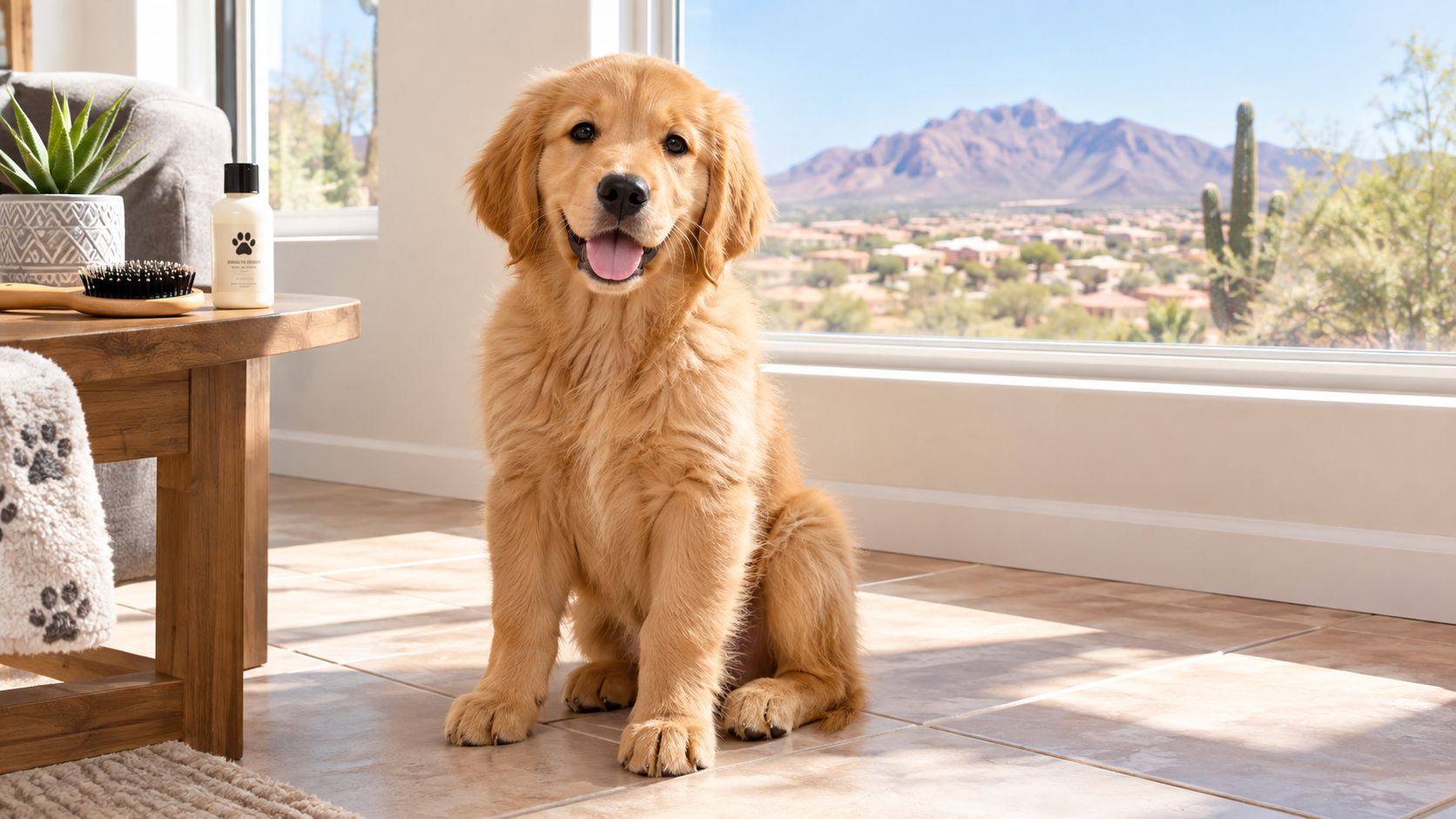
Puppies under six months benefit from grooming visits every two to three weeks to establish positive routines, according to PetMD's puppy grooming guidance. These visits don't need to become full haircut appointments each time. The objective is controlled exposure to the table, dryer, brush, nail tool, ear handling, and calm restraint.
At home, keep sessions short. Touch the paws, lift the ears, run a brush through easy areas, and reward stillness. Stop before the puppy becomes overwhelmed. A young dog that learns grooming is predictable will usually handle future care with more resilience than one introduced only after severe matting.
Seniors require gentler pacing
Older dogs may need more frequent but shorter maintenance sessions instead of one exhausting appointment. Joint stiffness can make standing difficult, and reduced balance can make slick surfaces uncomfortable. Ask for supportive positioning, careful handling, sanitary trimming, and breaks when needed.
A senior dog may also need closer nail attention because reduced activity doesn't always wear nails down naturally. Keep your veterinarian informed about skin growths, pain, mobility changes, or unusual reactions during grooming. A groomer can observe and report changes, but veterinary diagnosis belongs with the veterinary team.
El Paso conditions change the calendar
PetMD recommends year-round brushing, with extra attention during spring and fall shedding seasons, when loose coat can collect and contribute to matting. Its seasonal grooming guidance also notes that thick or matted fur can trap moisture in winter and make a dog colder, while paw fur should be checked and trimmed when necessary.
For El Paso households, inspect paws after walks across hot pavement, dusty paths, and rough outdoor surfaces. Keep paw hair neat enough to avoid collecting debris, but don't treat shaving as a universal solution. The correct trim depends on the dog's coat, paw condition, and exposure.
Outdoor dogs need more frequent checks for dust, plant material, burrs, and moisture trapped between toes. Dogs that spend more time indoors may hold a longer baseline, but they still need regular brushing and nail inspection. Use heat-stress prevention guidance to plan walks and grooming around the hottest parts of the day. Grooming should support cooling and comfort, never add avoidable heat exposure.
The Premium Studio Experience Versus Big Box Chains
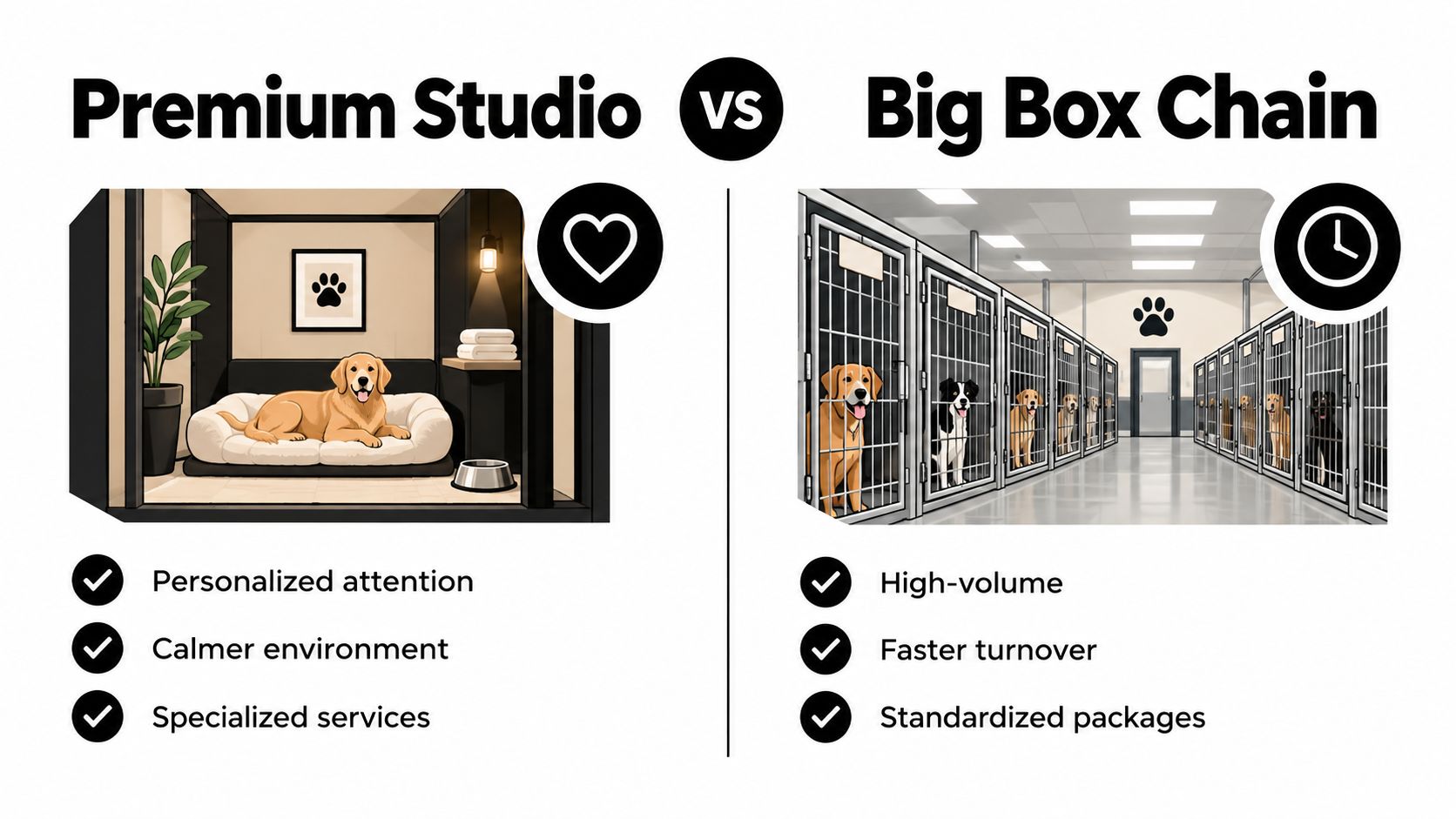
The appointment location matters because handling quality changes when a groomer must move through a crowded queue. Big-box retailers such as PetSmart and Petco offer recognizable, standardized service models. They can suit owners who prioritize broad availability and package familiarity. They aren't automatically the right fit for a dog that becomes distressed around noise, unfamiliar animals, or rapid transitions.
A veteran-owned studio makes a different trade. It limits volume, protects attention, and builds the appointment around the individual dog rather than the next open slot.
Two operating models
A chain environment may involve more ambient activity, shared traffic, and faster turnover. That structure can work for confident dogs with simple coats and owners who need convenience. It can be less comfortable for dogs that need slow introductions, detailed coat planning, or close observation.
A one-on-one studio approach is narrower by design. The groomer can review the dog's history, discuss the target length, identify trouble areas, and adjust handling when the dog signals discomfort. The value isn't merely a quieter room. It's the discipline of making fewer dogs compete for the groomer's eyes and hands.
| Premium studio approach | Big-box chain approach |
|---|---|
| Personalized attention and a calmer setting | Higher-volume workflow and faster turnover |
| Coat and handling decisions can be tailored | Standardized packages and processes |
| Booking is structured around limited capacity | Availability may be broader |
| Hygiene and tool control receive deliberate attention | Procedures follow a larger retail operating model |
What premium standards look like
Premium pet grooming should include a straightforward booking process, clear intake information, controlled sanitation, and honest communication about coat condition. A groomer should ask about behavior, allergies, veterinary concerns, prior grooming experiences, and the owner's maintenance capacity. If the requested style requires daily brushing that the household can't provide, the professional should say so and recommend a sustainable trim.
Glo More Grooming operates as a veteran-owned grooming studio in El Paso with a home-based, one-on-one model and a limited number of dogs on site. Its services include full grooming packages adjusted by size, touch-up sessions, luxury bath and blow-dry options, and complimentary add-ons with select services.
That model reflects a long-term vision built on Greatness, Loyalty, and Ownership, the G.L.O. values. Veteran-owned independence means accepting responsibility for every detail, from the first booking conversation to the final coat check. It also means building trust through consistency instead of relying on chain recognition.
Actionable Checklists and Monthly Promotions
A schedule only works if it fits real life. Busy professionals need a routine that takes minutes during the week and reserves the more technical work for a planned appointment. Families need visible checkpoints so brushing, nail observation, ear checks, and booking don't disappear beneath school, work, and travel.
Use the following workflow as a starting point, then tighten it for curly, wavy, long, or heavily shedding coats.
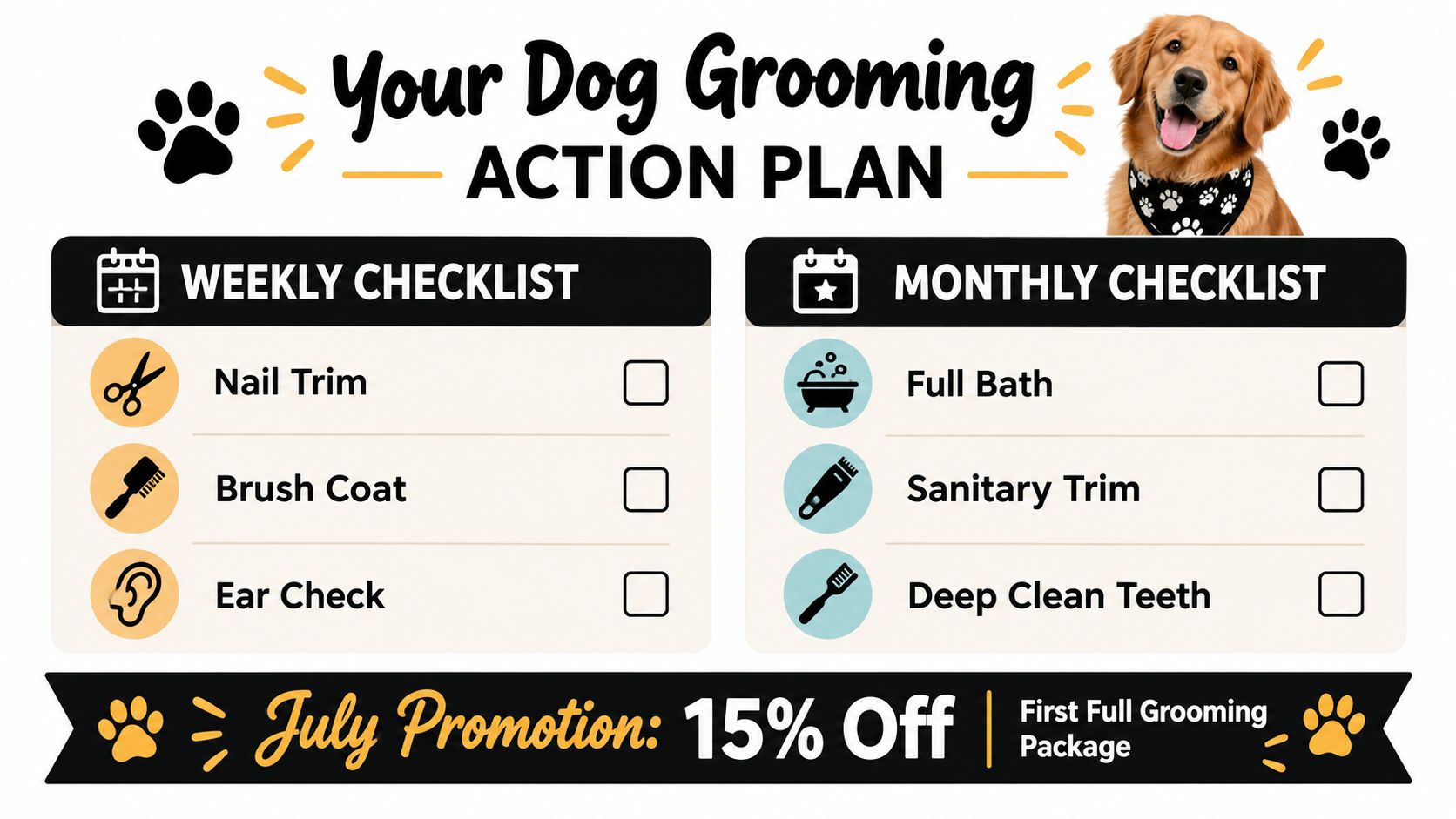
Weekly home checklist
- Brush the coat: Work in sections and reach the skin. Use a slicker brush, then a metal comb where the coat is long, wavy, or curly.
- Check the nails: Listen for clicking and look at nail length during calm handling. Don't force a trim if your dog is fearful or you can't identify the safe cutting point.
- Inspect ears and paws: Look for debris, redness, unusual odor, burrs, or moisture. Contact a veterinarian for signs of illness rather than trying to solve a medical problem with grooming products.
- Review high-friction areas: Check the collar line, armpits, groin, tail, and behind the ears. These locations mat first because movement and moisture compress loose hair.
Monthly booking routine
Reserve the professional appointment while the coat is still workable. A bath, blow-dry, nail trim, ear cleaning, sanitary trim, or haircut can be selected according to the dog's needs rather than waiting until every service becomes urgent.
For an in-between refresh, a luxury bath and blow-dry can remove surface dirt and loose coat without automatically committing to a full haircut. Ask about complimentary add-ons available with the selected service, and keep the dog's vaccination and veterinary information ready for the intake process.
Use promotions strategically
An affordable grooming promo should support the schedule, not replace it. Snip & Style Saturday is a once-monthly promotion offering a $55 full groom for all sizes. Book that slot early, especially if the dog's coat requires careful preparation or the household needs a predictable monthly appointment.
Between promotional visits, maintain the coat at home and use a touch-up or bath service when needed. A discount appointment still deserves the same standards: honest coat assessment, safe handling, clean equipment, and a finished result that suits the dog's lifestyle.
A promo saves money only when it prevents emergency de-matting and rushed appointments.
El Paso owners can also build the calendar around outdoor activity. Schedule deeper coat work before heavy shedding, inspect paws after active weeks, and avoid delaying care until dust, heat, and tangled hair have combined into a comfort problem. The strongest routine is simple enough to repeat and strict enough to protect the dog.
Elevating Care with Concierge Services and Community Tributes
Premium grooming should continue beyond the table. Some El Paso pet owners need more than a haircut appointment. They need help coordinating veterinary communication, arranging travel, or keeping a dog's care organized while work and family obligations pull them in different directions.
That's where concierge-level support earns its place. A dedicated service can provide veterinary advocacy by helping organize information and communicate care concerns, while coordinated travel support by car or air helps busy professionals manage pet logistics. These services don't replace a veterinarian or a transportation provider. They create a more orderly process around the dog's needs.
Care with a wider purpose
A veteran-owned grooming business carries a different responsibility to its community. Independence makes room for clear standards, direct accountability, and a long-term investment in local relationships. In El Paso, that means serving households with different budgets and routines while keeping craftsmanship, hygiene, and respectful handling at the center.
Community care also includes grief. Petals for Paws provides custom floral arrangements for families mourning a beloved pet. That tribute recognizes that grooming professionals often become part of a family's life over years, through puppy introductions, senior-care adjustments, ordinary maintenance, and difficult goodbyes.
G.L.O. stands for Greatness, Loyalty, and Ownership. Those values show up in practical ways: honoring the appointment, protecting the dog's comfort, communicating plainly about coat condition, and taking responsibility for the finished work. They also support a long-term vision for veteran-owned grooming that remains personal instead of becoming anonymous.
The right grooming schedule for dogs is not a generic breed chart. It's a working agreement between the owner, the dog, and the groomer. Brush according to coat structure, adjust for age and El Paso weather, book before problems escalate, and choose a setting where the dog receives the attention the service requires.
Glo More Grooming offers one-on-one premium pet grooming, touch-up care, luxury bath and blow-dry services, and concierge support for El Paso pet parents who expect disciplined, consistent care. Visit Glo More Grooming to book your next appointment, reserve a Snip & Style Saturday slot, or contact the studio to build a grooming schedule that fits your dog.