
A 90-pound dog can turn an ordinary bath into a serious handling job. The coat holds water, the dog shifts weight without warning, and a slippery floor gives neither of you much room for error. For owners searching for dog grooming for large dogs, the main question isn't whether the finished coat looks polished. It's whether the entire appointment protects the dog, the groomer, and the coat from beginning to end.
Large breeds already carry substantial economic weight in professional grooming. One 2025 market analysis reported that large breeds generated about 53.8% of U.S. pet grooming services revenue in 2024, while dogs represented more than 83% of global pet grooming revenue that year, according to Grand View Research's U.S. pet grooming market analysis. That makes large-dog care a central part of the industry, not a specialty service added after smaller dogs are finished.
Premium grooming starts with a disciplined workflow. The dog gets enough time to settle, the coat gets assessed before water touches it, and drying continues until the undercoat is dry. In a calm El Paso studio, that standard matters more than rushing a full schedule.
What Large-Dog Grooming Really Demands
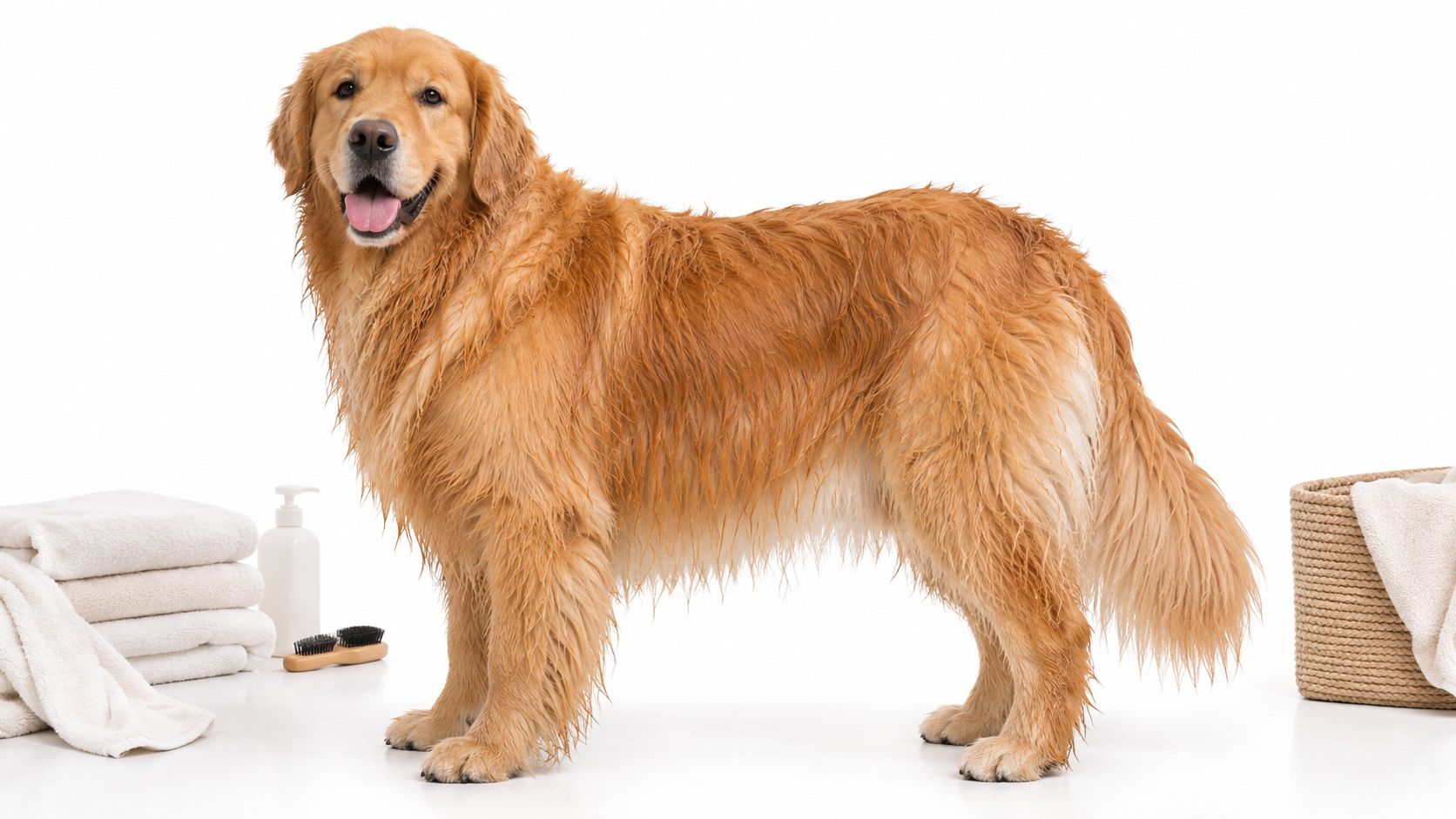
The Golden Retriever arrives with damp fur from the morning sprinklers, hips swaying slightly as he crosses the studio floor. He isn't misbehaving. He's carrying a large frame, a heavy coat, and a different center of gravity than a small companion dog.
The tub must support his weight without movement. The table must stay stable when he turns. The groomer has to anticipate each shift instead of reacting after the dog is already leaning toward the edge. Even a friendly dog can create a dangerous moment when wet paws meet a slick surface.
The work behind a polished finish
Large-dog grooming replaces cute styling shortcuts with restraint, coat assessment, and drying control. A Golden Retriever, Labrador Retriever, German Shepherd, Bernese Mountain Dog, or Mastiff may need different tools, but each requires the same basic respect for mass and fatigue.
The common failures are predictable:
- Rushing the bath: Shampoo remains in dense hindquarters or beneath the chest.
- Skipping the pre-brush: Water tightens hidden tangles around elbows, ears, and harness lines.
- Stopping the dryer early: The topcoat feels dry while moisture remains against the skin.
- Overbooking difficult dogs: Staff fatigue makes careful handling harder later in the day.
- Sending a damp dog home: A wet underbelly or undercoat can encourage matting, odor, and irritation.
A busy chain salon may have capable professionals, but a high-volume schedule can force compromises. Dogs may wait in crates, encounter several handlers, or receive a shorter drying window because another appointment is already waiting. Sedation isn't a grooming shortcut a responsible professional should treat casually, and grooming should never depend on making a dog too subdued to communicate discomfort.
Practical rule: A large dog should leave comfortable, fully dry, and steady on its feet. A faster appointment isn't automatically a better appointment.
Professional grooming remains a recurring habit for many owners. A peer-reviewed article citing a 2020 APPA-based survey found that 81% of U.S. dog owners groomed their pet during the previous 12 months, with professional grooming occurring about four times per year on average. The same source reported at-home grooming as the most common approach at 41%, while full-service salons accounted for 30%, mobile grooming 9%, retailer grooming 8%, and self-service centers 6%, as detailed in the peer-reviewed survey discussion.
For a large dog, professional help often becomes necessary even when the owner brushes at home. Heavy coats take longer to saturate, rinse, brush, and dry, and the groomer must recognize when a coat needs maintenance rather than a cosmetic trim. That judgment is the foundation of premium pet grooming.
Setting Up a Safe Premium Grooming Space
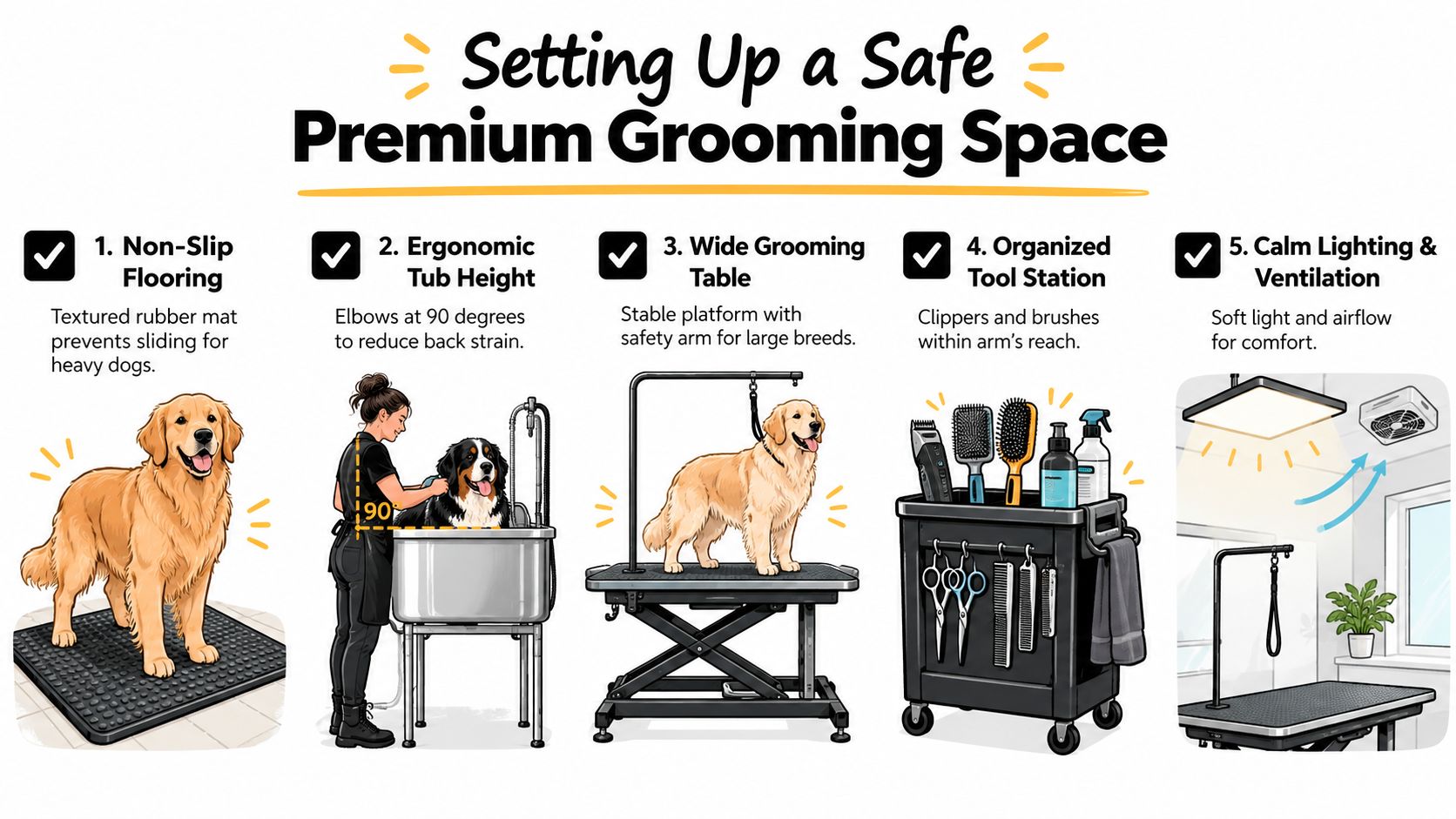
A safe grooming room is designed around the dog, not around whatever equipment happens to be available. Large-dog handling becomes more predictable when the floor, tub, table, restraint, tools, and dryer support the same calm sequence.
Start with the room
Use a non-slip, uncluttered floor that gives the dog traction from the entrance to the tub and table. Textured rubber flooring or properly secured mats are more useful than a loose towel that bunches under wet paws. Keep hoses, cords, bottles, and tools out of the walking path.
The tub should let the groomer work with elbows near a comfortable right angle rather than bending over a deep basin. That setup reduces back strain and makes it easier to support a dog that turns, sits, or braces.
A large grooming table needs a wide platform, a stable base, and a no-slip mat sized for the dog's entire stance. A small-breed pad leaves feet near the edges and gives a heavy dog less confidence.
Restraint should guide, not punish
A properly fitted figure-eight harness distributes control across the head and chest. It shouldn't function as a thin loop pulling directly against the neck. The loop should allow a natural head turn while remaining short enough to prevent a lunge from launching the dog off the table.
The safety arm and restraint are there to prevent a fall, not to force a frightened dog into a posture. The handler still has to read breathing, weight shifts, facial tension, and attempts to retreat.
Keep drying controlled
Place a dedicated column dryer or cage dryer away from the dog's eyes and ears, and use directed airflow carefully. High-volume air removes water efficiently, but the nozzle must keep moving and the groomer must lower intensity around sensitive areas.
The same standard applies to home containment. A large pet crate for safe recovery and transport should provide enough room for the dog to stand, turn, and settle without pressing against wet coat or equipment.
Chain salons can work within their own systems, but large dogs benefit from a room where one handler controls the pace. A private studio reduces unnecessary movement, limits exposure to unfamiliar dogs, and keeps the dog on a predictable surface throughout the visit. That isn't decoration. It's risk management.
Bathing and Drying Dense Coats the Right Way
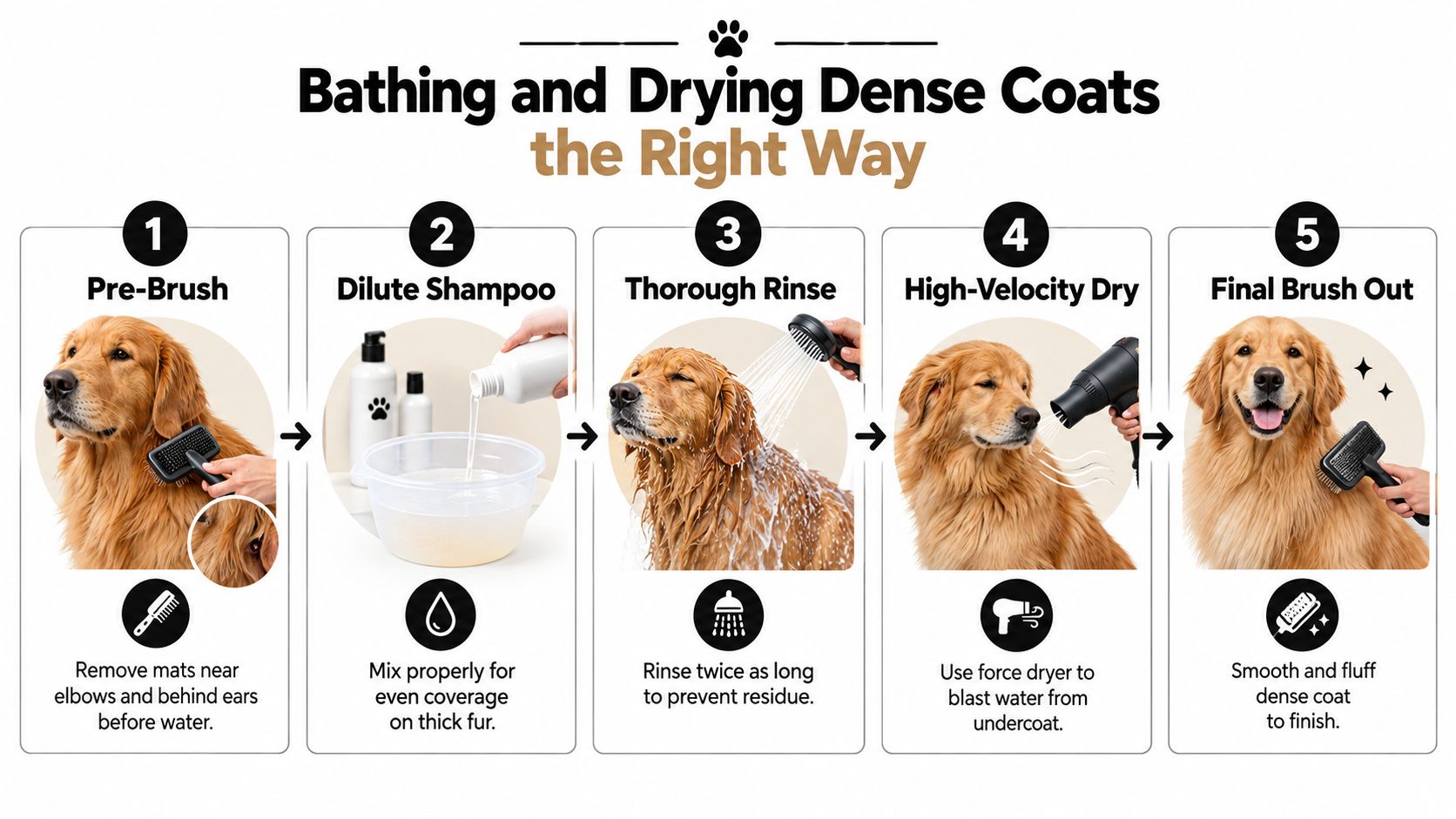
Bathing a dense coat isn't one event. It's a sequence, and each stage determines whether the next stage works.
Begin before the water
Pre-brush the entire coat, even when it looks clean. Run a slicker brush and then a wide-tooth comb through friction zones, especially behind the ears, around the elbows, under the harness line, across the belly, and behind the hind legs.
Mats enlarge and become harder to manage once they're wet. Independent veterinary and grooming guidance also warns that long- and double-coated dogs need thorough pre-brushing and complete drying rather than air-drying, as explained by Ossvh's guidance on grooming and mat prevention. Never attack a tight mat with household scissors. A professional can decide whether a small tangle can be loosened or whether clipping is safer.
Wash in a controlled order
Use a dog-specific shampoo and dilute it according to the product's directions. Work from the neck toward the tail, following coat growth while massaging rather than aggressively scrubbing. A second lather may help with odor and buildup, but the rinse must run clear through the chest, belly, feathering, and heavy hindquarters.
Conditioner needs enough contact time to improve manageability. A short pause, often five to ten minutes when the product calls for it, lets the coat soften before the final rinse. That time is more productive than repeatedly fighting a tangled coat after the bath.
Treat drying as the main service
Press towels against the coat to remove surface water. Don't twist or rub a heavy coat into knots. Then use high-volume forced air in sections, starting on a low setting and working outward from the skin.
For large, double-coated dogs, air volume drives water out of the underlayers more effectively than heat alone. Guidance on drying thick and double coats with grooming dryers recommends working section by section, keeping the nozzle moving, drying top-down, and progressing when each section is roughly 80 to 90% dry.
Brush against the grain first to lift dead coat and expose damp areas, then brush with the grain to smooth the finish. Skipping that brush-dry process leaves a coat that looks fluffy at the table but develops frizz, clumping, or irritated damp spots later.
Watch the technique in motion before trying it at home:
Handling, Lifting, and Stress Control for Big Dogs
Large-dog handling should be repeatable enough that an owner can use the same cues at home. Start by deciding whether the dog needs to move at all. If a senior dog can walk into the room, don't lift the dog just because lifting seems faster.
Use support before strength
For dogs over 50 pounds, use a two-person approach for any lift. One person supports the shoulders and chest, while the other supports the hips and rear. Solo lifting often fails because the dog shifts in the middle of the movement, leaving the person to absorb both the dog's weight and the sudden imbalance.
Look for early stress signals before touching a sensitive area:
- Tight lip: The mouth and facial muscles become rigid.
- Whale eye: The dog shows more white around the eye while turning away.
- Weight shift: The dog loads one leg or leans away from the hand.
- Freeze: The dog stops moving instead of relaxing.
These signals call for a slower approach, not a firmer grip. Keep a flat collar available for general control without gripping the neck. A slip lead should only be introduced when the dog is calm and understands the handling.
Support older and anxious dogs differently
For an older or arthritic dog, use a hip-and-shoulder support lift. Keep the spine level, bring the dog close to your body, and move as a coordinated pair. For an anxious dog, brace and guide with steady pressure through the chest and hips rather than dragging or forcing the dog forward.
Noise conditioning should happen before the grooming appointment. Turn on a dryer at a distance, reward calm behavior, and gradually reduce that distance. Clippers should receive the same treatment. Owners should never hold a vibrating tool directly against a dog that is already trying to escape.
Stop the session when the dog shows escalating panic, repeated escape attempts, uncontrolled panting, or signs of pain. Great Danes, Mastiffs, and Saint Bernards deserve particular caution because a slip can injure the dog or create a costly veterinary emergency.
Owners handling reactive dogs can review calm grooming support for reactive dogs before attempting home maintenance. The safest session is the one that preserves trust and ends before control disappears.
Frequency, Seasonal Care, and El Paso Climate
A fixed calendar doesn't suit every large dog. Coat type, outdoor workload, swimming, allergies, and the condition of the coat should determine the schedule. General guidance places most professional grooming at four to eight weeks, while long, curly, or continuously growing coats often need four to six weeks, double-coated dogs commonly fit six to twelve weeks, and short-haired dogs may fit eight to twelve weeks, according to Rover's coat-based grooming schedule.
In El Paso, the environment adds its own demands. Spring dust can settle deep in an undercoat. Summer heat can tempt owners to over-bathe or shave a double-coated dog without considering coat function. Dry winter air can leave paw pads and ear edges rough, so the routine needs seasonal adjustments rather than one automatic appointment interval.
Grooming Frequency by Coat Type in El Paso
| Coat Type | Brush Out | Bath | Full Groom | El Paso Note |
|---|---|---|---|---|
| Short single | Several times weekly | As needed | Every eight to twelve weeks | Wipe dust from paws and belly after outdoor activity |
| Short double | At least two to three times weekly | As needed | Every six to twelve weeks | Increase undercoat work during heavy shedding |
| Long double | At least two to three times weekly, more during shedding | As needed | Every six to twelve weeks, based on coat condition | Check friction zones after dust, swimming, and walks |
| Drop coat | Frequent combing, often every other day | As needed | Every four to six weeks | Prevent tangles before bathing tightens them |
Guidance for large dogs commonly recommends brushing two to three times per week, with nail trimming and ear cleaning often included every six to eight weeks, as outlined by large-dog grooming routine guidance. The brush schedule drives everything else. Bath day follows the brush, not the other way around.
Adjust the routine by season
During autumn, increase brushing to three to four times per week, inspect ears, wipe muddy paws after walks, and schedule at least one professional groom. Heavy shedders may benefit from two seasonal appointments, according to autumn grooming recommendations.
For El Paso owners, a practical seasonal plan includes de-shedding in April and May, a restrained sanitary trim in June when appropriate, and paw balm beginning in November. Working dogs, swimming dogs, and dogs with allergies need individualized plans. Over-bathing can remove protective oils, while under-drying can leave moisture beneath the coat.
Premium One-on-One Care Versus Chain Grooming
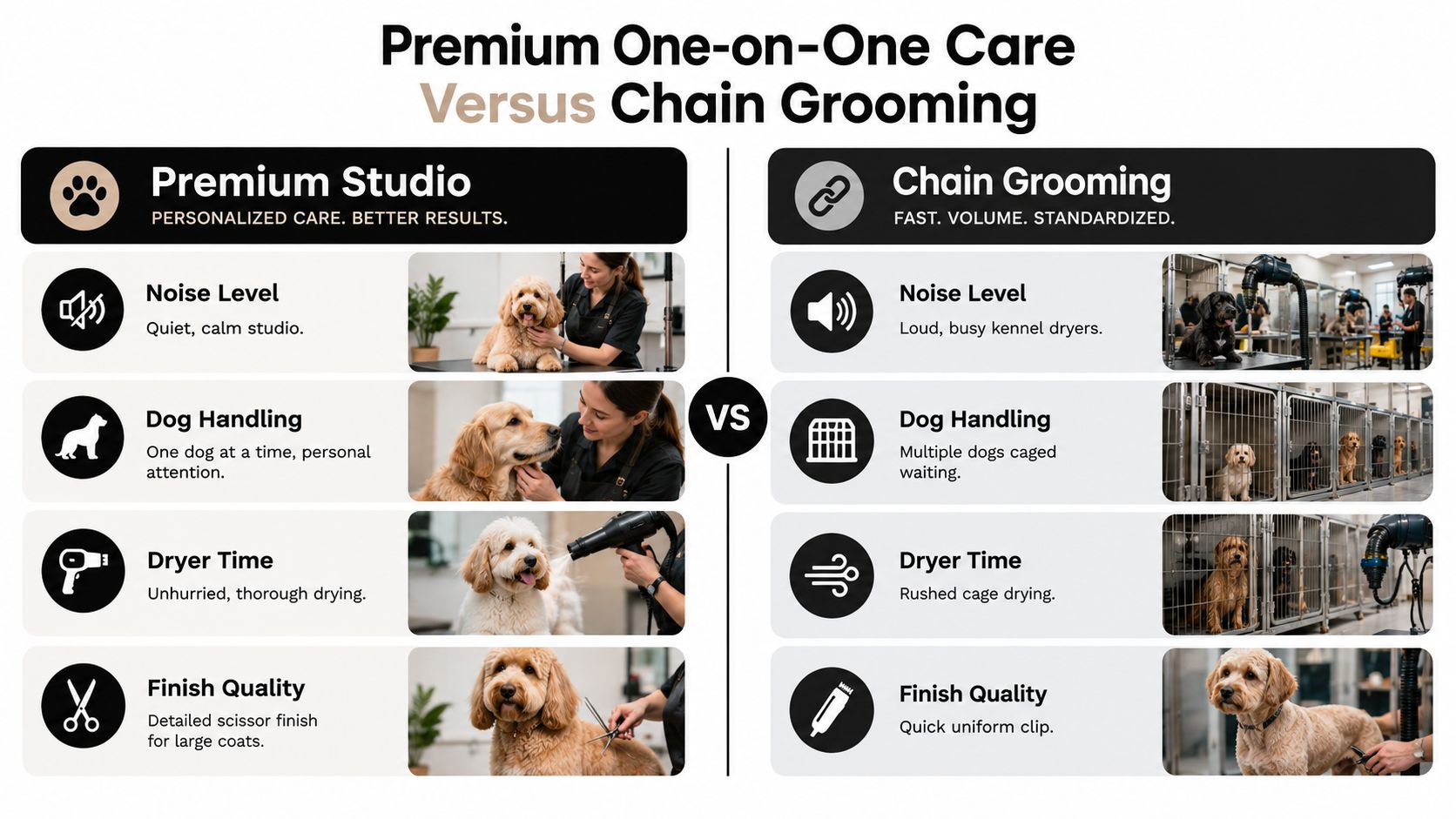
The difference between a private studio and a chain salon isn't just the logo on the door. Large dogs feel the difference through noise, handling, drying time, and how carefully the final coat is shaped.
A nervous Labrador or German Shepherd may struggle in a room filled with barking dogs, running kennel dryers, and rotating handlers. A private studio gives that same dog fewer competing sounds, one consistent handler, and a non-slip surface that stays familiar from arrival through finishing.
The trade-off is time
High-volume salons work around tight turnover. When a seventy-pound double coat arrives with packed undercoat, tangles, or a nervous temperament, the groomer has to choose between extending the appointment, reducing the finish, or moving the dog through before the coat is completely ready. The owner pays for that compromise through a rushed result, a wet undercoat, or a return visit.
Premium grooming costs more because the appointment includes the minutes that large coats require. That means full saturation, thorough rinsing, patient forced-air drying, brushing during the dry, and careful finishing around paws, ears, sanitary areas, and feathering. Large and giant dogs commonly cost about $120 to $160 per visit, with giant breeds often reaching $150 to $180 or more, according to recent reporting on large-dog grooming costs and mobile service logistics.
The right comparison isn't the lowest posted price. It's whether the coat, handling, and drying time match the dog in front of you.
A hand-scissored silhouette can preserve the natural outline of a large coat, while a quick clipper outline may flatten shape and remove more coat than intended. Owners considering one-on-one dog grooming should ask who will handle the dog, how drying is managed, and what happens if the coat needs extra time.
Booking the Right Service and What Comes Next
A large dog can arrive clean but still need a full appointment if the coat is dense, packed, or difficult to dry. Choose the service according to coat condition, behavior, and household schedule, rather than breed name alone. A maintained dog needing only paws, sanitary areas, or face tidied may suit a targeted touch-up. A senior, anxious dog or multi-dog household may need concierge-level planning.
Send the details that affect handling and timing before booking:
- Health history: Share arthritis, allergies, skin irritation, ear problems, or recent procedures.
- Vaccination records: Keep current records available for the studio's intake process.
- Handling triggers: Explain reactions to feet, dryers, clippers, ears, hips, or restraint.
- Finish preference: Describe the desired length and whether you want a natural outline or shorter maintenance cut.
- Coat history: Mention swimming, missed brushing, previous matting, or at-home products.
Match the service to the dog
A first full appointment should include a coat assessment, skin and paw inspection, bath, complete dry, breed-appropriate trimming, sanitary work, ear cleaning, nail care, and finishing. Size, coat density, behavior, and coat condition determine the working time. A professional should assess the dog instead of promising one rushed turnaround for every large breed.
Use this schedule as a starting point:
- Dense coats: Plan full grooming every six to eight weeks, with brushing and coat checks between visits.
- Shorter coats: Full grooming may fit every 10 to 12 weeks, depending on dirt, nails, shedding, and household needs.
- Between appointments: Use touch-up baths, paw cleaning, brushing, and coat checks before tangles become a full-grooming problem.
- Special circumstances: Consider concierge service for seniors, anxious dogs, multi-dog households, or owners coordinating travel and veterinary support.
El Paso offers both big-box providers and independent studios. Care.com local data lists an average grooming rate of $14 per hour as of September 2026, while PetSmart's El Paso grooming location shows the availability of chain services in the community. The practical choice depends on whether you need basic affordability, specialized large-dog handling, or a consistent private appointment.
A veteran-owned grooming business may operate with controlled scheduling and fewer dogs on site. Glo More Grooming is a home-based, veteran-owned El Paso studio offering size-based full grooming, touch-ups, luxury bath and blow-dry services, and concierge support. Its once-monthly Snip & Style Saturday includes an affordable grooming promo, a $55 full groom for all sizes, according to Glo More Grooming's service information.
Reserve a premium appointment with Glo More Grooming for one-on-one care built around your large dog's coat, handling needs, and El Paso routine. Contact the studio about a full groom, touch-up, luxury bath and blow-dry, concierge support, or the next Snip & Style Saturday promo before spaces fill.