
You can tell a lot about a groomer before the first brush touches your dog. If you've ever picked up a panting Lab from a Saturday appointment at a big-box salon, carried home a dog that's still keyed up, and then wondered why the coat still doesn't look right three days later, you already know the problem isn't just “grooming.” It's the way the business is run.
Boutique dog grooming feels different because the workflow is different. Fewer dogs. More control. Cleaner handoffs. Better finishes. In El Paso, that difference matters even more because heat, dust, and busy family schedules punish sloppy routines fast.
Why Boutique Dog Grooming Feels Different From the Start
A stressed dog doesn't lie. The panting, the pacing, the tight body language, the muddy face that still somehow looks uneven after a trim, all of it tells you the appointment was handled like volume, not care. That's usually when people start looking for El Paso dog grooming that feels calmer and more personal.
A boutique studio changes the entire rhythm. Instead of a row of dogs waiting through the noise, you get tighter scheduling, fewer handoffs, and a groomer who isn't trying to keep ten timelines moving at once. That's the core appeal of a one-on-one setup, and it's exactly the kind of model described in Glo More Grooming's one-on-one dog grooming approach.
What the owner actually notices
The first difference is silence. The second is body language. Dogs settle faster when they aren't dealing with crowding, barking, and constant movement around them, and owners notice that the pickup feels less like a recovery period and more like a normal handoff.
Practical rule: if the visit feels chaotic in the lobby, the groom often ends up looking rushed too.
That's why I tell owners to stop asking whether grooming is “nice” and start asking whether the studio is built to keep dogs calm, clean, and handled in a predictable way. A boutique shop isn't a luxury label, it's an operating decision.
What Boutique Dog Grooming Actually Means
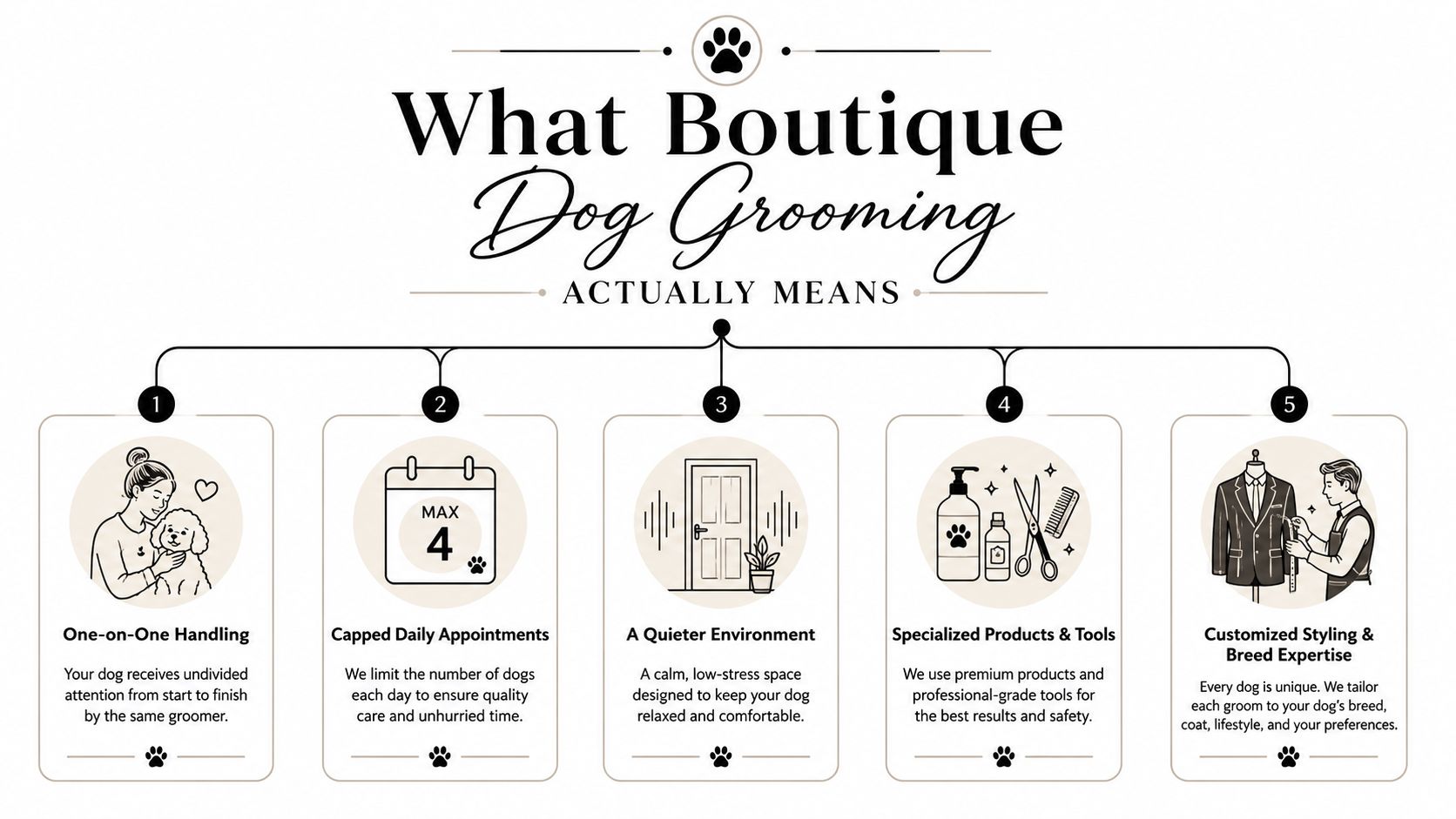
Boutique dog grooming is not just “smaller.” It's a premium pet grooming model built around control, consistency, and a narrower daily load. The groomer knows which dogs are coming in, what each coat needs, and how much time each appointment deserves.
The traits that define the category
A real boutique studio usually has one-on-one handling, capped daily appointments, and a quieter room where dogs aren't being stacked into a high-volume assembly line. It also tends to use professional sanitation surfaces, practical grooming tools, and a service menu that's curated instead of bloated with random upsells.
That matters because the whole experience depends on workflow. A bathing station, grooming table, clippers, drying systems, and sanitation-ready surfaces are not optional extras in a serious studio, they're the backbone of throughput and hygiene. Industry guidance places total equipment spend for a professional salon around $15,000 to $75,000, while a home-based studio can often be launched for roughly $13,000 to $30,000 all-in when tools, software, licensing, and setup are included (equipment and startup guidance).
What to look for on the floor
A boutique groomer should know your dog's coat history, not just today's haircut. That means the intake conversation matters as much as the scissors. It also means you should expect a fixed service menu, vaccination requirements, card-on-file policies, and a pace that matches how many dogs can safely be handled in a day, which is the kind of discipline highlighted in startup guidance for groomers (business setup guidance).
Simple standard: if the studio can't explain its handling rules clearly, it probably doesn't have enough of them.
That's the dividing line. Boutique grooming isn't just a prettier waiting room. It's a system that keeps the dog, the coat, and the schedule under control.
Boutique vs Chain Grooming and Where Each Wins
Chains like PetSmart and Petco win on reach. They're easy to find, and that convenience matters for a lot of households. If you need broad access, familiar branding, or a quick appointment path, the chain model has a place.
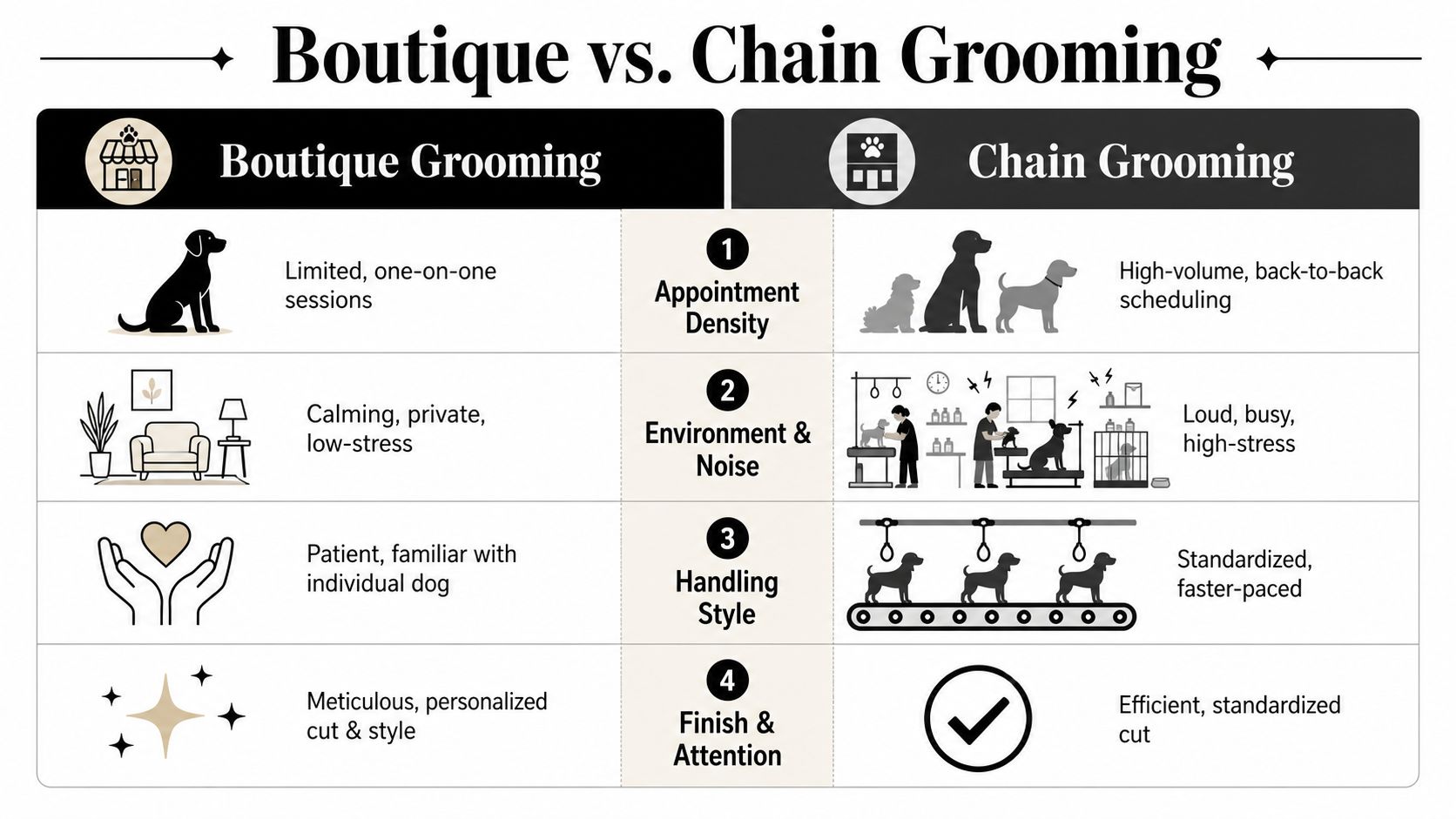
The tradeoff shows up in the details owners feel. Boutique grooming limits appointment density, which keeps noise down and gives the groomer more time to work the coat properly. Chain grooming tends to move dogs through a more standardized flow, which is efficient, but not always ideal for anxious, senior, or high-maintenance coats.
Where boutique wins
Boutique studios usually win on calm, customization, and consistency. The handling is more personal, the finish tends to be more meticulous, and the hygiene standards are easier to maintain when fewer animals are on-site at once. For owners who care about finish quality and a steadier experience, that matters more than a crowded calendar.
Where chains still make sense
Chains can be a better fit when you want convenience above all else. They're built for broad access and familiar processes. If your dog does fine in a busy environment and you mainly need a routine trim, the chain model can do the job.
Here's the part I care about as a groomer-owner. A veteran-owned boutique shop should be judged on the same professionalism as any larger operation, but it should still feel like a neighborhood studio. That means clean lines, direct communication, and a groomer who can answer specific questions instead of hiding behind a script.
The industry is large enough to support both models. IBISWorld estimates the U.S. pet grooming and boarding sector at $11.3 billion in 2026, with 199,000 businesses and an 8.2% CAGR from 2021 to 2026 (IBISWorld industry overview). The market is fragmented, which is exactly why a disciplined boutique can stand out without pretending to be a chain.
Services, Add-Ons, and How Pricing Usually Works
The service menu should read like a real grooming process, not a laundry list of fluff. A full appointment usually starts with a bath, then moves through drying, haircutting, styling, ear cleaning, and nail work. If the coat needs more care, touch-up sessions and luxury bath-and-blow-dry options make sense too.
Boutique pricing has to track the work involved. A neutral industry summary says grooming appointments typically run $60 to $120, depending on breed size, coat type, and included services, while full grooms for medium dogs are often $65 to $85 nationally and $75 to $120 in major metropolitan areas. More premium facilities can charge $150 to $350+ per session when spa-style or therapeutic services are included (pricing summary). Dogster's industry overview also places typical pet grooming costs around $30 to $90, with a small breed averaging about $40 and a large breed about $75 (Dogster pricing data).
How to read the menu
If a studio adds value without nickel-and-diming, you'll see it in the structure. Complimentary extras should feel like part of the experience, not a trap at checkout. That's a cleaner model than padding every ticket with unnecessary line items.
| Service | What's Included | Typical Price |
|---|---|---|
| Full groom | Bath, haircut, styling, ear cleaning, nail trim | Varies by size and coat |
| Bath and blow-dry | Washing, drying, finishing | Varies by dog and coat condition |
| Touch-up session | Light maintenance between full grooms | Varies by need |
| Luxury bath option | Enhanced bathing and finish care | Higher than standard bath |
Where promos fit without cheapening the brand
A monthly promo can be smart when it supports coat health and predictable maintenance. Snip & Style Saturday is a good example, a once-monthly $55 full-groom promotion for all sizes that gives budget-conscious families a way to stay on a routine without waiting until the dog is overdue. That kind of affordable grooming promo works because it encourages consistency instead of crisis scheduling.
Practical rule: a lower-cost promo should still preserve the same standards, the same hygiene, and the same handling discipline.
If you want to compare service tiers directly, the clearest breakdown is on Glo More Grooming's dog grooming prices page. The point isn't to chase the cheapest ticket, it's to match the coat, the dog, and the schedule to a service level that holds up.
Preparing Your Dog for a Boutique Appointment
Good grooming starts at home. Brush the coat before the appointment, especially if your dog mats behind the ears, under the legs, or along the collar line. If the coat is already packed down, no groomer can make that disappear without giving the hair more time than a normal slot allows.
Keep vaccination records ready and be honest about feeding, anxiety, and skin problems. A dog that comes in with redness, itching, or a history of stress needs different handling than a dog who walks in loose and calm. That's not overthinking it, that's responsible intake.
A simple pre-visit routine
- Brush thoroughly: Work through tangles before arrival so the groomer can focus on finish, not rescue work.
- Check sanitary areas: Light trimming keeps the coat cleaner and makes the appointment smoother.
- Bring records: Vaccination proof should be organized before booking, not hunted down in the lobby.
- Watch for stress signs: Panting, hiding, trembling, or repeated scratching are worth mentioning right away.
- Time the meal: Don't send a dog in on a full stomach if you can avoid it, especially if the dog gets anxious.
A disciplined boutique groomer will ask intake questions that sound specific, not generic. That's a good sign. It means the studio is trying to match timing, handling, and finish to the dog in front of them, not the average dog in their head.
If you want a calmer visit and a better coat, show up prepared and expect the groomer to be equally prepared.
How to Choose the Right Boutique Groomer
The best boutique groomers don't hide their standards. They show them in the floor, the booking process, and the way they handle a nervous dog without drama. Look for non-slip, easy-to-disinfect flooring, non-porous walls, floor drains in wet zones, and secure, ventilated holding areas that keep noise and moisture down.
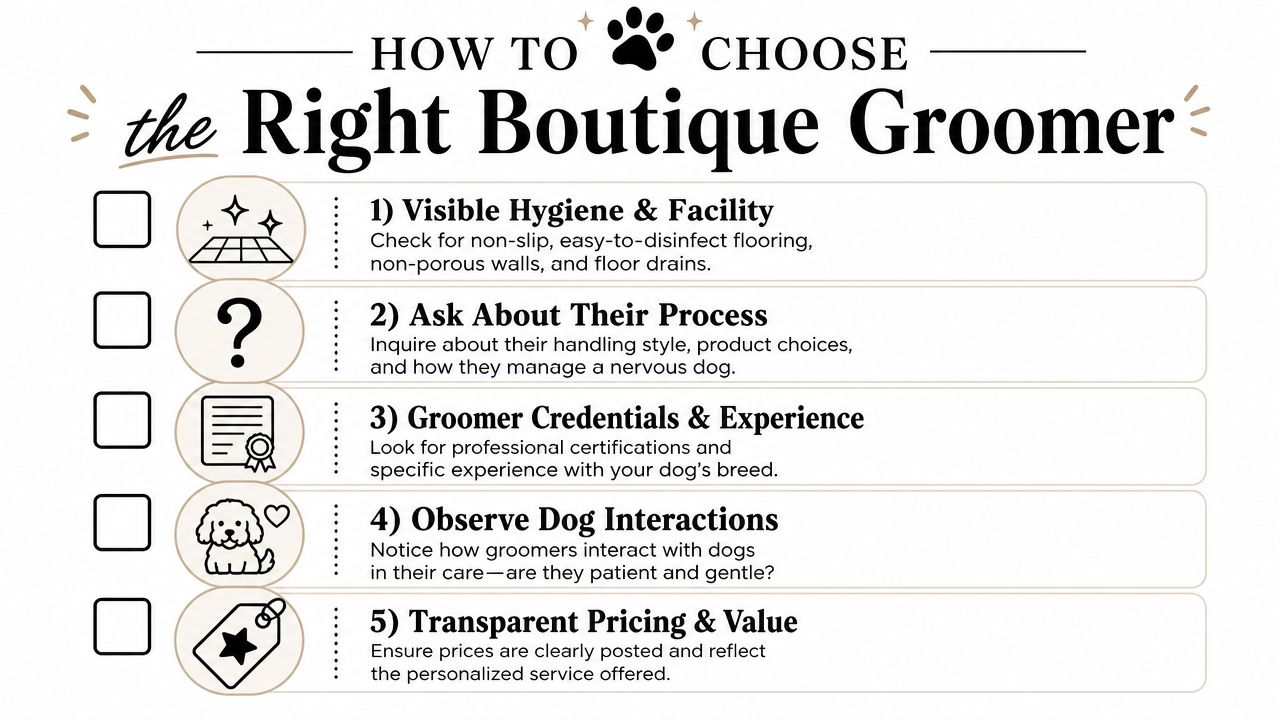
The screening questions should be direct. Ask how they sanitize between dogs, what vaccination policy they enforce, how many appointments they cap each day, and how they handle anxious or senior dogs. If the answers are vague, keep moving.
The standards that matter
- Visible hygiene: Clean surfaces should be obvious, not implied.
- Clear process: The studio should explain intake, handling, and pickup without improvising.
- Breed awareness: Coat history and styling experience matter more than generic pet-salon language.
- Dog behavior: Watch whether the groomer is patient and steady, not rushed or overly noisy.
- Transparent pricing: You should know what you're paying for before the dog gets on the table.
That's also where veteran-owned grooming can signal something real. Ownership discipline usually shows up in the little things, consistent standards, accountable communication, and a long-term attitude toward the business instead of a short-term booking chase. In a premium service, that kind of pride matters.
A local studio with defined rules is easier to trust than a place that tries to sound fancy but can't describe its workflow. If the groomer can't tell you how they protect the dog, they haven't really built protection into the business.
El Paso Grooming Realities and Seasonal Care
El Paso doesn't reward lazy coat care. Heat dries out skin, dust dulls the finish, and sudden weather swings can make a dog's coat feel rough fast. If you live here, you can't treat grooming like a once-in-a-while cosmetic errand.
What each season does to the coat
Summer is about paw care and heat management. Trimmed feet, clean pads, and a coat that isn't holding extra debris all help a dog move more comfortably.
Fall is when brushing becomes essential. Dust settles into the coat and makes a clean dog look tired faster than owners expect.
Monsoon weather can bring humidity and skin irritation, so a thorough dry matters more than a rushed one. Winter brings dry air and static, which means conditioning attention should not disappear just because the weather feels cooler.
A local rhythm that makes sense
Operational planning guidance for groomers suggests estimating market demand by counting dogs in the county and neighboring counties, then using 60% of that figure as a rough guide to the number of dogs needing regular grooming every 6 to 8 weeks (market planning guidance). That cadence fits a lot of breeds here because it keeps the coat under control before matting, odor, and skin issues show up.
A local studio offers advantages over a generic playbook. A neighborhood groomer sees the same weather patterns, the same dust, and the same owners trying to balance work, school, and pet care. A national chain can be consistent, but it won't know El Paso the way a local operator does.
For a home-based premium studio, that regional awareness is part of the service. It's not an extra.
Concierge Service, Community Programs, and Booking
A serious boutique shop should do more than wash and clip. It should help people solve real-life problems around care, travel, and timing. That's the idea behind Glo More Grooming's concierge service, which adds personalized support for busy owners who need more than an appointment slot.
The broader point is simple. Boutique grooming works when the business treats the dog like a whole responsibility, not a ticket. That includes disciplined intake, careful handling, and a willingness to coordinate around travel or veterinary concerns when clients need it. It also includes community programs that make the brand feel rooted instead of disposable.
What a strong local brand should stand for
Petals for Paws matters because grief is part of pet ownership too. A studio that offers custom floral arrangements for families grieving a beloved pet shows it understands the emotional side of the relationship, not just the maintenance side.
That same mindset supports a long-term vision for veteran-owned grooming. The business should be built to last, with standards that hold up under pressure and a customer base that trusts the work because it sees the discipline behind it. A home-based studio in El Paso can be warm without being casual, premium without being cold, and local without feeling small.
If you want proof of fit, look at the whole package. Quiet handling. Clear standards. Seasonal care. Promo slots for families who want a predictable routine. Concierge support for people who need practical help, not fluff.
Book the visit that matches your dog's coat and temperament, not the loudest waiting room in town. Reserve a Snip & Style Saturday slot, ask about the service menu, and choose the studio that treats grooming like craft.
If you want premium care with disciplined standards, Glo More Grooming offers one-on-one dog grooming, full grooming packages, touch-ups, luxury bath and blow-dry options, and concierge support for clients who need extra coordination. Visit Glo More Grooming to book now, reserve a promo slot, or contact the studio about the right routine for your dog.