
At 30 mph, a 40-pound dog can generate about 1,800 pounds of force in a crash (Long Haul Trekkers). That's why a dog crate for car travel is not a comfort accessory, it's a containment system that has to survive violent deceleration, not just a bumpy drive to the trailhead or groomer.
Many buyers choose the wrong crate initially. They select for aesthetics, ease of folding, or a brand name that seems trustworthy, only to find out too late that the crate wasn't designed to remain sturdy under structural stress and heavy strap tension. If you transport dogs in El Paso traffic, on desert highways, or on longer regional trips, the right crate must be chosen like safety gear, installed like safety gear, and checked like safety gear.
Why Your Dog Crate Choice Is a Life-or-Death Decision
A crate that only keeps a dog enclosed is not enough. In a collision, containment without structural retention can still turn into a blunt-force hazard, because the crate itself can collapse, slide, or open under load. Independent crash-safety reviews have repeatedly shown that many pet travel products do not perform reliably in collisions, and the gap in formal standards has historically pushed buyers toward products built specifically for cargo-area use and impact retention (Pet Health Network).
The market matters here because people do use crates. A 2019 survey published in Applied Animal Behaviour Science found that 55% of dog owners in the United States restrained their dogs in vehicles, compared with 67% in Australia and 72% in the United Kingdom, and in both the U.S. and U.K. the most common restraint method was a cage or crate placed in the cargo area (PubMed). That tells you two things. First, cargo-area crates are already part of how people travel with dogs. Second, your crate choice needs to hold up under the actual way people use vehicles, especially large SUVs, pickups, and utility vans.
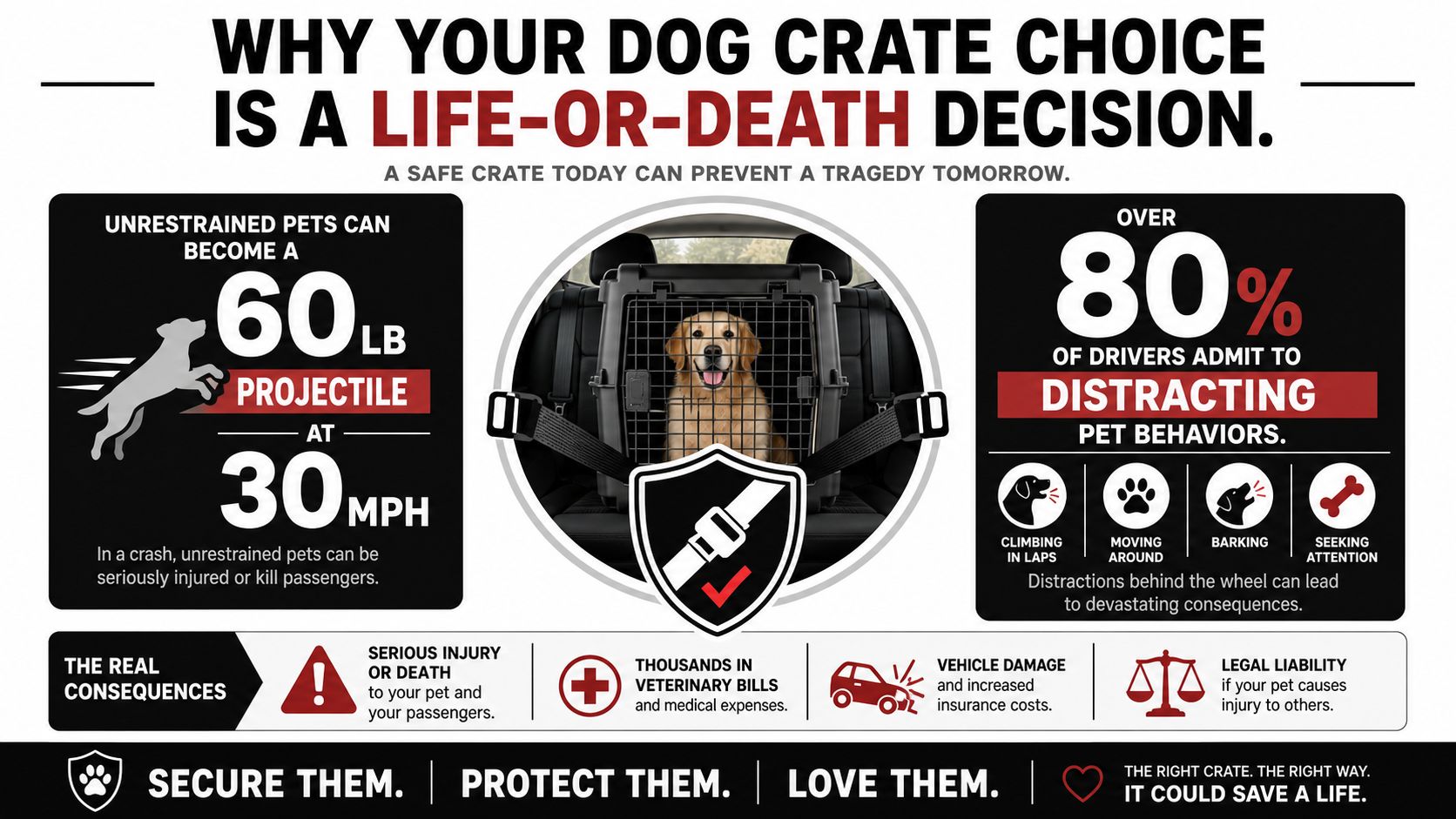
What the physics says
The hard truth is simple, and it's why marketing fluff doesn't impress me. A crate must resist crash loads, not everyday motion, because the dog inside keeps moving when the vehicle stops. Wire, fabric, folding, and standard clamshell airline crates are not made for that job, which is why they're the wrong answer for in-car use (Long Haul Trekkers).
Practical rule: if the crate isn't vehicle-specific and crash-tested, I treat it as luggage, not protection.
That's the standard I use when I evaluate anything meant for travel. In a market with weak regulation and a lot of vague claims, only engineering matters.
Comparing Crate Types for Vehicle Use
The wrong crate usually fails in one of two ways. It breaks, or it shifts. Either one can injure the dog and put people at risk, because loose cargo becomes part of the impact event. That is why I judge crate types by crash behavior first, and convenience second.
What each crate type can and can't do
Wire crates are fine for home training and short periods indoors. In a collision, the frame can deform and collapse because it was never built to hold shape under impact. If a crate bends easily with hand pressure, it has no place in a vehicle.
Soft-sided carriers are even weaker for crash use. They may work for small, calm pets in controlled settings, but fabric gives you almost no structural protection. If the carrier is the main barrier between the dog and the vehicle interior, that is not a safety plan.
Folding travel crates solve storage, not crash physics. Foldability usually means moving joints, lighter framing, and more failure points. That does not make them bad products. It makes them the wrong products for collision protection.
Standard airline kennels are built for transport logistics, not vehicle deceleration. They may be sturdy enough for air travel, but airline approval does not mean crash performance. That label can mislead buyers who care about highway safety.
Purpose-built vehicle crates are the category I trust. They are designed for cargo-area use, secure anchoring, and impact retention. The better ones are explicitly crash tested and built for restraint, not just enclosure.
| Crate Type | Crash Performance | Anchor Capability | Vehicle Use Recommendation |
|---|---|---|---|
| Wire crate | Poor | Limited | Not recommended |
| Soft-sided carrier | Poor | Minimal | Not recommended |
| Folding travel crate | Weak for impact loads | Inconsistent | Not recommended for crash use |
| Standard airline kennel | Not crash designed | Varies | Use only if the maker specifically proves vehicle crash performance |
| Purpose-built vehicle crate | Strongest option | Designed for straps or anchors | Recommended |
If you are shopping for a large vehicle solution, start with a purpose-built option like the large pet crate guide at Glo More Grooming, then verify that the product is meant for car use, not just indoor containment. Manufacturer claims matter less than how the crate is built, how it anchors, and whether it can keep its shape when the vehicle stops hard.
Measuring Your Dog for a Safe Car Crate Fit
A sloppy fit can turn a crate into dead space during a crash. If the crate is too large, the dog has more room to build momentum before impact, and that extra movement raises injury risk during hard braking or a collision. The goal is simple, a crate that gives the dog enough room for natural posture without leaving a lot of empty space.
Measure the dog, then size the crate
Start with nose-to-rump length. That gives you the dog's real body length instead of a guess based on breed label or weight. Use that number to choose a crate that lets the dog stand, turn around, and lie down without sliding around inside the box.
Keep the clearance tight. The crate should fit the dog snugly enough to limit movement, and the dog should still have enough room to settle into a normal travel posture. Use the crate sizing guidance at Glo More Grooming's crate-sizing page as a practical reference point, then check the internal dimensions against the dog's body length and standing height.
Use the smallest safe fit
For puppies, measure the dog you have now, not the adult dog you hope to have later. Buying oversized creates the empty-space problem immediately. Buying too small means replacing the crate before the dog is ready.
If you are choosing between sizes, choose the one that leaves the least extra room while still allowing normal movement. In a car, extra space is not a comfort upgrade. It is room for the dog to build speed inside the crate before the crate itself stops.
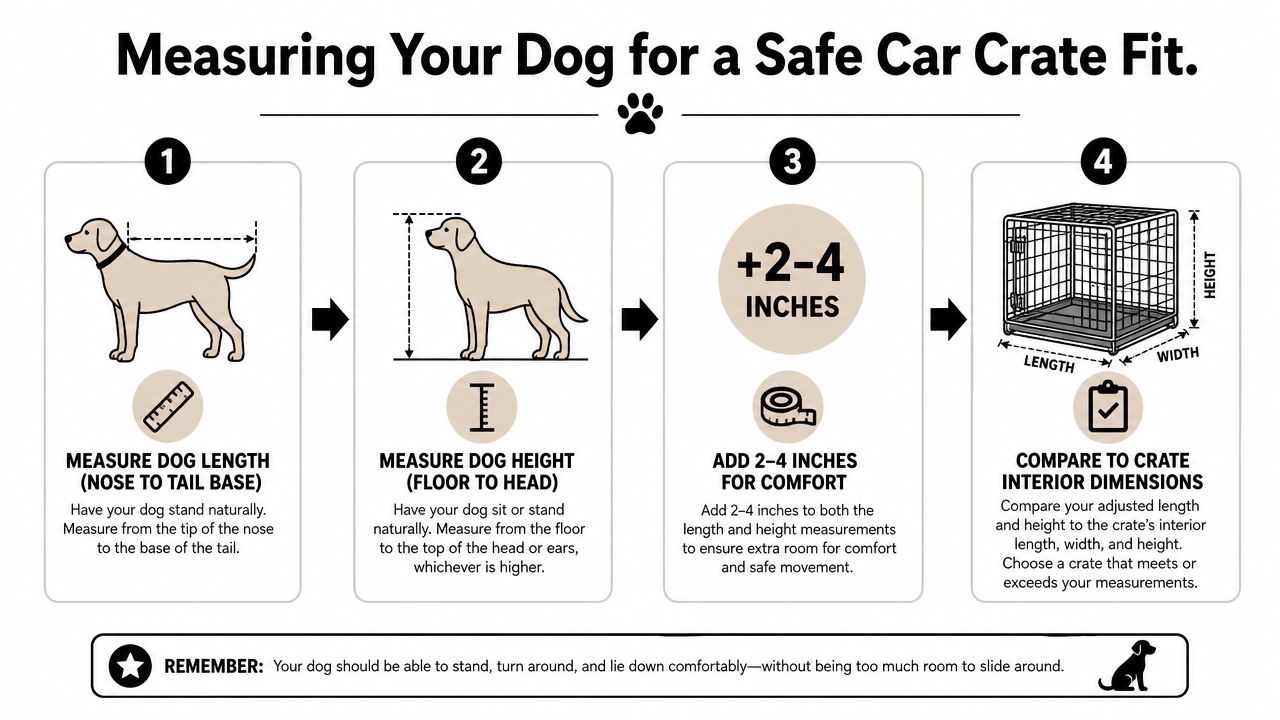
A crate that fits the dog tightly, then fits the vehicle tightly, gives you the best chance of keeping the dog in one controlled space instead of letting it become loose cargo.
Installing and Anchoring Your Crate Securely
A crate that is not anchored is cargo that can move. Even a strong crate becomes a hazard if it slides across the cargo floor, tips on a slope, or rotates under braking. The installation has to be tight enough that the crate barely shifts when you push it by hand, because that same stability matters if the vehicle takes a hard impact. Thule lays out the same basic standard for secure crate placement.
Use real anchor points, not fake security
Use the vehicle's cargo hooks, seat belt anchors, or LATCH points to secure the crate. Skip anything stretchy or improvised. One practical guide warns against bungee cords and points you toward heavy-duty ratchet straps or crate-specific tie-downs instead. car seats for dogs reference at Glo More Grooming
That warning is about physics, not preference. Stretch adds delay. Delay adds motion. Motion adds force. In a crash, the crate needs to be tied into the vehicle structure as directly as possible.
Here is the order I use for installation:
- Position the crate flat and square. Do not leave one side floating or hanging over a lip in the cargo area.
- Attach to vehicle anchor points. Use the cargo hooks or anchors built into the vehicle.
- Tension the straps hard. The crate should not walk forward, back, or side to side.
- Test by pushing firmly. If you can move it easily by hand, it is not ready.
A crate should feel like part of the car, not like a box sitting in the car.
Match the crate to the vehicle layout
SUV cargo floors, sloped backs, and tight hatch openings make setup awkward. That is not a reason to compromise on restraint. It is a reason to use a crate and strap system that matches the vehicle instead of forcing a generic setup into a space it does not fit.
If you also use transport-friendly seating or barriers for short rides, the car seats for dogs reference at Glo More Grooming helps you think through how the rear of the vehicle should be arranged for pets. For crate transport, the rule stays the same. Tight straps, rigid placement, no slack.
Identifying Genuinely Crash-Tested Crates
A crate that looks solid can still fail badly in a collision. The only crates worth your money are the ones with independent crash testing, clear test details, and proof that the door stayed shut when the shell deformed. I ignore marketing language until I see those facts.
What to look for before you buy
Independent testing is the standard. The names I want to see are TÜV testing in Germany and the Center for Pet Safety in the United States, because those programs show that someone outside the manufacturer checked the crate against a real test process.
I also want specifics. If a manufacturer will not tell you:
- What collision test was used
- What impact speed was used
- How the door lock behaved under deformation
- Whether the crate stayed closed under load
then I treat the crate as unproven.
The testing gap matters. The 2015 Crate and Carrier Crashworthiness Studies found that there were no U.S. federal test protocols or performance standards for pet crates and carriers at the time, which is why buyers still have to scrutinize claims instead of trusting the label.
Why expensive doesn't always mean verified
Price does not prove crash safety. A premium finish, polished branding, and high-end photos can hide weak engineering if nobody has checked the product against a real collision protocol.
If the company cannot point to independent crash testing, I treat the crate as unproven, no matter how expensive it is.
That standard protects dogs and passengers. It also keeps you from paying for style when you needed structural performance.
Transport Tips for Grooming Appointments and Concierge Services
El Paso pet owners use vehicle crates for more than road trips. They use them for grooming drop-offs, salon pickups, vet visits, and bundled errands when the day is already packed. A calm trip starts before the car moves, because anxious loading is usually the first sign that the routine needs work.
Build a travel routine the dog can predict
Use short practice rides before a grooming appointment. Let the dog get in, settle, hear the door close, and come right back out before you make it a real trip. That lowers stress and makes the crate part of a normal routine instead of a surprise event.
Temperature matters in this market. El Paso heat punishes bad planning, so I'm strict about timing, shade, and quick loading. Keep the vehicle cool before the dog goes in, avoid unnecessary idling delays, and never leave a dog sitting in the car while you handle something else.
For grooming appointments, tell the provider how the dog travels. If you use a crate, say so when you book. If you need a pickup window for a monthly promo like Snip & Style Saturday, say that too, because a disciplined schedule keeps the handoff smooth and reduces lobby stress.
Keep the crate clean and ready
Hair, moisture, and nail dust build up fast. Wipe the crate down after trips, let it dry fully, and keep the bedding simple so it can be cleaned without fuss. A crate that smells stale becomes harder to use, and dogs notice that.
If you want concierge-level support, Glo More Grooming's veteran-owned grooming model and premium pet grooming workflow fit well with clients who care about structure, hygiene, and consistent handling. That matters for crate-transported pets, especially when owners want one-on-one attention and a clear handoff for grooming day.
Your Car Crate Buying Checklist and Next Steps
The buying decision gets simple when you strip away the marketing. First, verify independent crash testing. Then confirm the crate fits the dog with only a small clearance margin. After that, make sure the crate can anchor tightly in your vehicle and that you can keep it from shifting by hand. If any one of those fails, keep shopping.
Use this checklist before you click buy
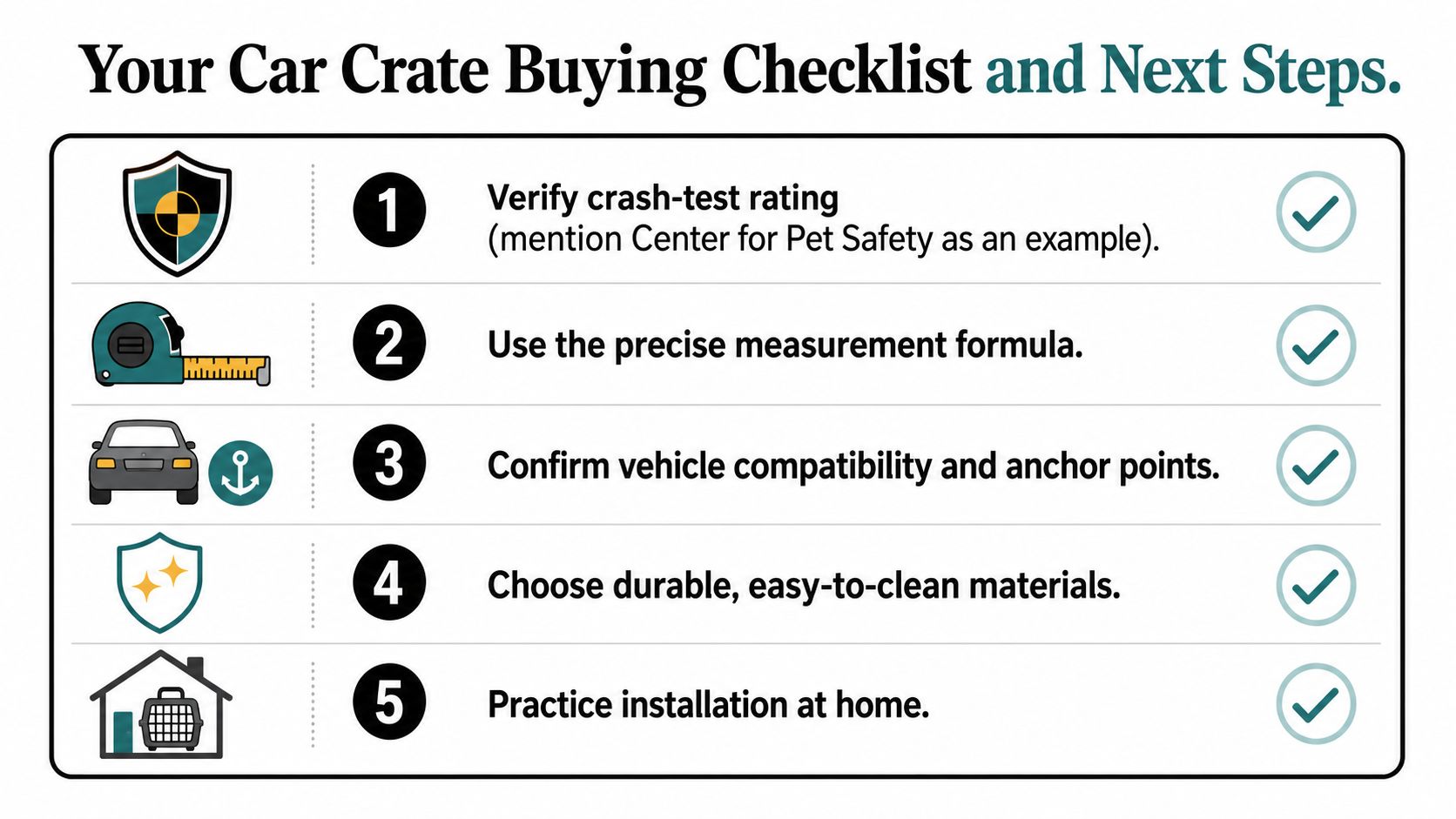
- Verify crash testing. Look for independent verification, not just a product claim.
- Measure the dog precisely. Use body length and standing height, then keep the fit tight.
- Check vehicle compatibility. Make sure anchor points, cargo space, and crate shape work together.
- Choose durable materials. Cleanability matters, but not at the expense of structure.
- Practice installation at home. If you can't secure it confidently now, you won't do it well when you're rushed.
I'd rather see a buyer spend more on the right crate once than replace a cheaper one after a scare. Premium pricing only makes sense when it reflects real engineering, proven retention, and better attachment hardware. If those elements aren't there, the price is just decoration.
For El Paso families who want organized pet care around travel days, grooming days, and monthly affordable grooming promo opportunities, the cleanest path is to pair a verified travel setup with a disciplined grooming routine. That's how you protect the dog, reduce stress, and keep the day moving.
Glo More Grooming keeps pets moving through grooming day with calm handling, clear standards, and a one-on-one process that respects the crate-to-table transition. If you want travel-aware grooming support, a disciplined booking flow, and service built around real care instead of chain-store volume, visit Glo More Grooming and reserve your spot today.