
A planted tank full of tiny mouths can turn feeding into a small daily puzzle. Tetras dash upward, rasboras hang in the middle, a betta inspects every pellet, and food that breaks apart too fast quickly becomes part of the cleanup problem.
Hikari Micro Pellets fit that kind of setup because they are made for small tropical fish that feed at the surface and in midwater. Their semi-floating behavior gives fish a better chance to eat before the food drops into spots that are harder to reach, which matters in community tanks where wasted food can settle into the substrate and affect water quality That Pet Place product description. In practice, a pellet that matches the fish's feeding zone can improve feeding efficiency and reduce the amount of uneaten food you have to deal with later.

For anyone working with a compact system, a careful setup matters just as much as the food itself, and a 10-gallon fish tank setup guide pairs well with that approach. Small tanks leave less room for feeding mistakes, so the goal is not only to get fish to eat, but to do it in a way that keeps the tank clean and the routine predictable.
The Search for the Perfect Small Fish Food
A mixed nano tank can look balanced at the store and then turn awkward the moment you feed it. One fish grabs from the surface, another pecks in midwater, and a third waits until anything sinks. If the food falls apart too quickly, the result is cloudiness, scattered fragments, and more waste than you planned for.
Hikari Micro Pellets fit that gap because they are built around the feeding zone of small tropical fish, not just around convenience. Their semi-floating behavior gives surface and midwater feeders a better chance to eat before the food drifts into places that are harder to recover. In practice, that means less chasing, fewer missed bites, and less material settling where it can break down.
Why small fish keepers look for this format
The reason is simple. Small fish do not all feed the same way, but they often share the same limitation, their mouths are tiny, and faster tankmates can crowd them out. A micro pellet narrows the gap between what the fish can handle and what the aquarist can deliver.
Practical rule: match the food to the fish's feeding zone before you decide whether they “like” it.
That matters in community tanks, where diet choice is only part of the job. The rest is choosing a food that feeds cleanly in a real aquarium, not just one that looks good in a product photo.
For small systems, feeding choices connect directly to tank maintenance. A 10-gallon fish tank setup guide is a useful reminder that compact aquariums leave little room for feeding mistakes, so the goal is not only to get fish to eat, but to do it in a way that keeps the routine predictable and the water easier to manage.
The best way to look at Hikari Micro Pellets is as a tool with a narrow but useful role. They are not a fix for picky eaters, and they are not a replacement for good husbandry. They are a strong option when the tank is full of small fish, the keeper wants cleaner feeding, and the goal is to cut down on the mess that comes from oversized flakes or food that sinks too fast.
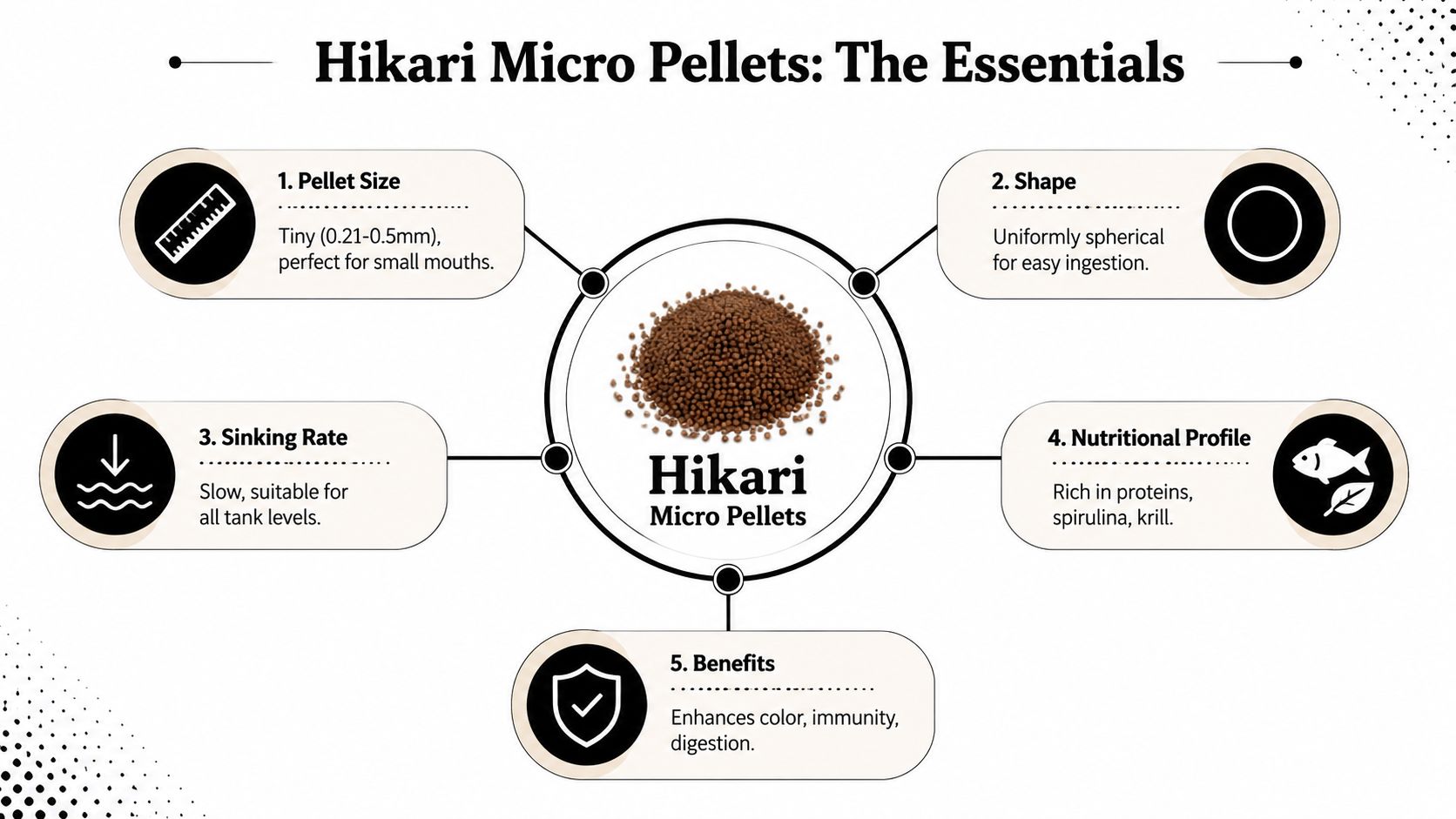
What Exactly Are Hikari Micro Pellets
A small fish food can look straightforward on the label and still behave very differently in the tank. Hikari Micro Pellets are made for fish that feed in the upper and middle water layers, and that physical shape matters more than the name suggests.
The pellet design and why buoyancy matters
The key feature is the semi-floating behavior. Hikari Micro Pellets are formulated as a semi-floating feed for surface and midwater feeders, so the food stays where small tropical fish are most likely to find it That Pet Place product description. That gives fish more time to take each bite before the pellets drift into the substrate or break apart.
That matters in real tanks because sinking food creates avoidable waste. If a pellet falls faster than the fish can reach it, part of the feeding ends up feeding the bottom, the filter intake, or the mulm layer instead of the fish you meant to feed. In a community aquarium, that kind of mismatch can turn a simple feeding into extra maintenance.
What the water-clear claim means in practice
The product description says the pellets are easily digested and will not cloud aquarium water That Pet Place product description. In practice, that points to a food that should leave less visible residue in the water column than foods that soften and scatter quickly.
Clear water does not give permission to feed freely. It only means the food is less likely to add to the mess when portions are kept in check. That distinction matters most in nano tanks, where a little extra waste can show up fast in both water quality and filtration load.
How to read the product responsibly
Pellet size and buoyancy are fit points, not guarantees. Fish still need to recognize the food, take it promptly, and receive portions that match the tank's capacity. The value of the pellet lies in how well its physical design fits the feeding pattern in the aquarium, not in any promise that it can make poor feeding habits harmless.

Decoding the Nutrition Label Ingredients and Benefits
Fish food is easiest to judge by the front of the package, but its true value shows up on the label. If a pellet is meant for regular use, the ingredient list and guaranteed analysis tell you far more than the branding ever will.
The core nutrition profile
Public coverage describes Hikari Micro Pellets as having about 43% protein and including spirulina for color support AquaIndex product page. That protein level makes sense for active small tropical fish that need steady body condition, not just a quick meal that disappears in seconds.
Protein supports growth and maintenance, but the source and digestibility still matter. A food can look good on paper and still leave more waste behind if the fish do not handle it well. That is why the earlier claims about water clarity and digestibility matter in practice, they point to a food designed to stay tidy in the tank while still being eaten efficiently.
Why spirulina gets attention
Spirulina comes up often in fish food discussions because it is linked with color support and broad dietary quality. In this pellet, it suggests a formula built for more than just filling tiny mouths. It is one reason aquarists reach for it as a daily staple rather than treating it like a random snack.
Bottom line: a micro pellet can be small and still be nutritionally serious.
The trade-off is simple. A pellet with solid protein and color-supporting ingredients can work well as a staple for some tanks, but that does not mean it suits every fish or every feeding routine. I look at foods like this in the same practical way I would choose from an easy-to-care-for fish food, by asking whether it fits the livestock, the tank size, and the mess it leaves behind.
Staple or convenience food
That is the important question. Public discussions often praise the convenience and the reasonably balanced formula, but they do not always compare it closely with other micro-diets AquaIndex product page. From an aquarist's point of view, that makes the food a strong option for routine use in the right tank, while still leaving room for other foods when the goal is variety or conditioning.
If your fish eat consistently and the aquarium is small, convenience has real value. If you are feeding for breeding support or more specialized conditioning, a single pellet can be too narrow on its own. Good fishkeeping usually looks less like finding one perfect product and more like building a feeding routine that stays clean, consistent, and suited to the animals in the tank.
Which Fish and Invertebrates Thrive on Micro Pellets
The product's effectiveness moves from theory to practice. The right fish don't just accept the food. They eat it naturally, at the level where the pellets stay accessible long enough to matter.
Strong matches for this food
Small schooling fish are the obvious fit. Tetras, guppies, rasboras, and many barbs tend to work well with a micro pellet because their mouths are small and their feeding habits align with surface and midwater delivery. Bettas can also take to the food, especially when the pellet is offered carefully and individually.
A tank full of active small fish is where the semi-floating format earns its keep. The fish can intercept the food before it drops out of reach, and the aquarist gets a more controlled feeding session than with loose flakes.
Where the food is less ideal
Dedicated bottom-dwellers are a poor match if you expect this food to carry the whole diet. Corydoras catfish, for example, are not the target audience for a semi-floating pellet. Large predatory fish are also a mismatch because the pellet size and feeding style don't suit them.
Amano shrimp and Nerite snails may pick at leftovers, but that shouldn't be treated as a feeding strategy. If the invertebrates are eating the scraps, the tank is already telling you the portion was too generous.
A quick decision framework
- Choose it first if your tank is filled with small tropical fish that feed in the upper or middle water column.
- Use it cautiously if you keep a single betta, since that tank size leaves little margin for leftovers.
- Skip it as a sole solution for bottom-focused species that need food delivered where they forage.
- Rotate it thoughtfully if your livestock benefits from variety and you don't want one pellet to do all the work.
The broad lesson is simple. Feed the fish you keep, not the fish you wish were in the tank.
For owners comparing maintenance habits across species, this easy-to-care-for fish guide is a useful companion because low-maintenance setups still need disciplined feeding.
Proper Feeding Techniques to Avoid Common Pitfalls
A good pellet still causes problems if the feeding routine is sloppy. In nano tanks, a few extra crumbs matter more than people expect, because the water volume is small and the margin for error is thin.
Start with a tiny portion
Hikari's guidance is straightforward, feed only what the fish can consume in about a minute, and for bettas, give one pellet at a time. That is the habit to build around. Start small, watch the fish, and only add more if the food is disappearing cleanly.
The temptation is to feed more because the fish look excited. Don't do it. Excitement is not the same as hunger, and extra food is what turns a tidy aquarium into a maintenance project.
Practical rule: if you can still see pellets after the feeding window closes, you fed too much.
Remove leftovers before they become a problem
The same Hikari guidance stresses removing uneaten food. That matters because leftover fragments can quickly increase waste load, especially in a small tank. Once food starts breaking down, you are no longer just dealing with uneaten pellets. You are dealing with water-quality fallout.
A small net, turkey baster, or siphon can help depending on the setup. If you keep sand, a careful pass with an aquarium sand vacuum guide can help pull out trapped bits before they decay into the substrate. In a planted tank, it is often easier to target visible leftovers immediately instead of waiting for them to settle and rot.
Adjust for nano tanks and betta bowls
Small water volumes leave no room for casual feeding. A single betta does not need a pile of pellets, it needs a routine that is slow, observant, and consistent. Offer one pellet, wait, then decide whether the fish ate it before offering another.
The same logic applies in nano community tanks. Fast feeders can make a tank look hungry even when the fish are fine, so the aquarist has to watch the individuals, not the surface frenzy. That kind of discipline protects stability and keeps the tank easier to maintain.
Build the routine around water quality
Use feeding as part of tank management, not as a separate event. If the fish are missing food, the schedule is off. If leftovers show up often, the portions are too large. If the tank starts showing quality issues, the feeding method is one of the first places to tighten up.

For deeper cleanup habits, keep the aquarium sand vacuum guide in mind, because leftover food and substrate maintenance are tied together.
Hikari Micro Pellets vs Alternatives and FAQs
Flakes are usually the first comparison point, and they still have a place. They spread quickly and work for many community fish, but they can also fragment fast and create a mess if the tank is crowded or the fish feed inconsistently. Hikari Micro Pellets are more controlled, which helps when you want less drift and more precision.
Frozen foods and live foods sit at the other end of the spectrum. They can be excellent for variety and conditioning, but they're also less convenient and often more demanding to manage. For a daily staple, a micro pellet is usually easier to portion and easier to repeat cleanly.
The real trade-off
A pellet like this wins on convenience, consistency, and feeding control. It loses if your fish need variety, if your tank is dominated by bottom feeders, or if you're trying to build a more complex feeding program around conditioning or breeding.
A lot of experienced aquarists settle into a simple pattern, use micro pellets as the routine base, then rotate in other foods when the livestock or the goal justifies it. That approach respects both nutrition and husbandry.
FAQ
Can Hikari Micro Pellets be the only food I use?
They can be used as a staple for compatible fish, but that doesn't mean every tank benefits from a single-food routine. Variety still matters for many setups, especially when you want broader dietary coverage.
Why won't my fish eat them right away?
Some fish need time to recognize the pellet, while others prefer food in a different zone or texture. Try smaller portions, feed closer to the fish's usual level, and avoid flooding the tank with extra food during the first few tries.
Are they better for small tanks than flakes?
Often, yes, if your priority is cleaner portion control and less floating debris. In a tiny aquarium, that can make a real difference in how stable the tank stays between maintenance sessions.
If you want a cleaner feeding routine and a more disciplined way to care for a small tank, use Hikari Micro Pellets with restraint, observation, and consistency. And if you're in El Paso looking for the same kind of premium pet care mindset outside the aquarium, book a visit with Glo More Grooming to reserve a promo slot, get thoughtful one-on-one service, and support a veteran-owned grooming business that stands apart from chains like PetSmart and Petco with premium pet grooming, clear standards, and an affordable grooming promo built for real families.