
You leave the vet's office carrying a new bag or a case of cans, and your brain is already full. Your dog may have just been diagnosed with a weight problem, blood sugar issue, digestive trouble, or a urinary concern. Then the veterinarian says, “We're switching to Hill's w/d.”
A lot of owners hear that and immediately think the same thing. Is this just expensive dog food with a prescription label, or is there a real reason behind it?
That question is fair. When your dog's health is involved, you want more than instructions. You want to know why this food was chosen, what each part of it is supposed to do, and what changes you should expect at home. If you're also comparing long-term feeding costs, this look at dog food cost considerations can help you think through the practical side without losing sight of the medical purpose.
Your Vet Prescribed Hill's w/d Now What
The first thing to know is that a prescription diet usually isn't chosen at random. In clinic settings, Hill's Prescription Diet w/d is often recommended when a dog needs nutrition to do a job, not just provide calories. That's why the bag or can may feel different from the food you've bought before.
A common example is the dog who seems hungry all the time but also needs to lose weight. Another is the dog with stool changes that keep coming back. Another is the diabetic dog whose meals need to be more predictable. Owners often focus on the label first, but vets are usually thinking about the condition behind the label.
Practical rule: Treat Hill's w/d like part of the care plan, not a side purchase from the checkout counter.
That mindset helps because this food is meant to support several body systems at once. If your vet chose it, they likely saw a connection between your dog's symptoms and the way this formula works. The goal isn't to make feeding more complicated. The goal is to make each meal more useful.
What owners usually worry about first
Most concerns fall into a few buckets:
- Will my dog even eat it? Some dogs switch easily, some need patience.
- How much do I feed? Portion accuracy matters more with a therapeutic diet.
- Is this forever? Sometimes it's long term, sometimes it depends on the condition and your vet's follow-up plan.
- What if stools change? With higher-fiber food, bowel habits may look different at first.
If you're feeling uncertain, that doesn't mean you're behind. It means you're paying attention. That's a good place to start.
Understanding Hill's Prescription Diet w/d
Hill's Prescription Diet w/d isn't standard over-the-counter dog food. It's a therapeutic diet, which means it's formulated for dogs with specific health needs and is meant to be used under veterinary guidance.
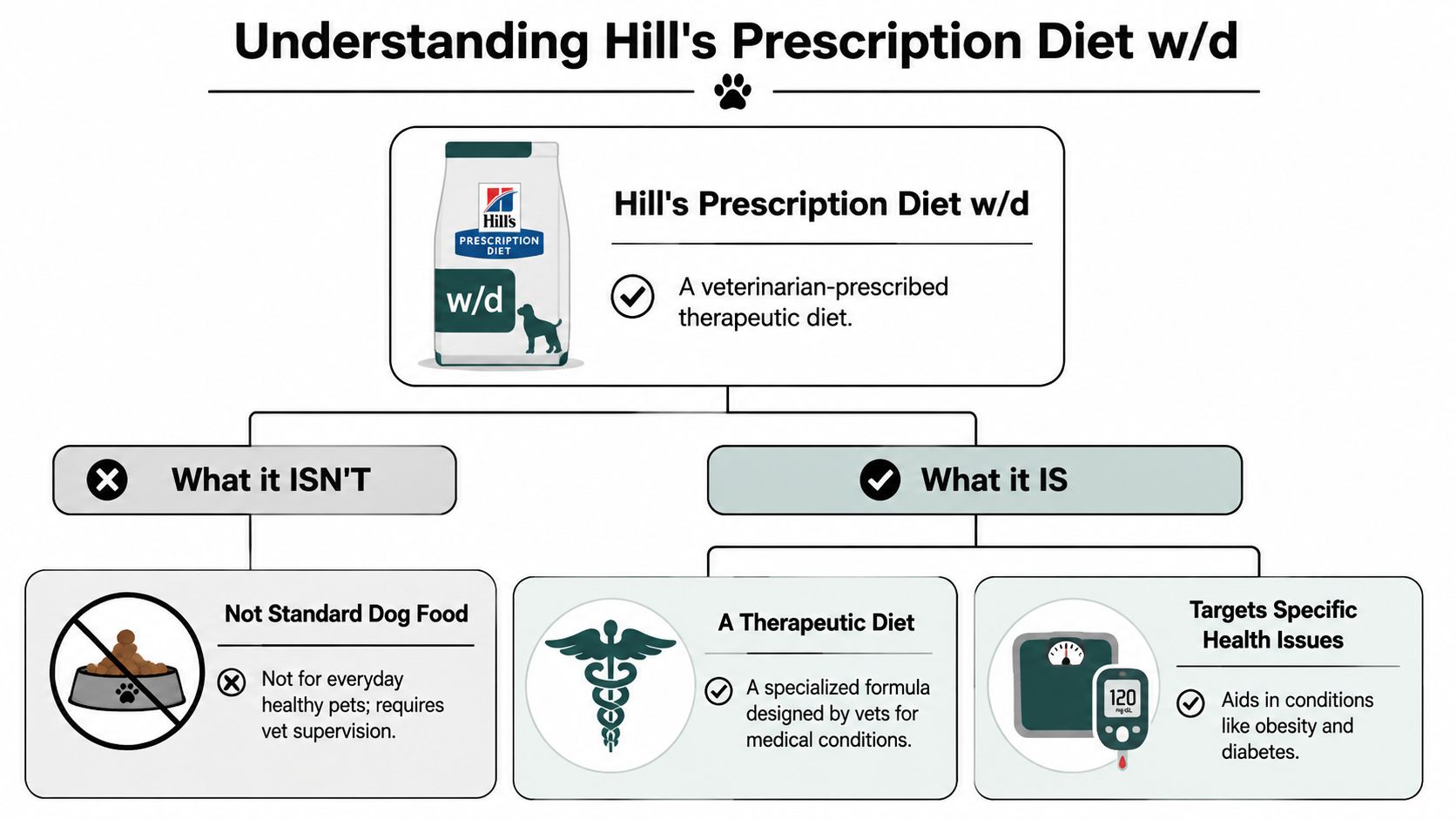
Hill's describes this formula as a clinically tested, multi-benefit food for conditions that respond to fiber, including digestive health, weight management, blood sugar regulation, and urinary health. One verified product description also notes 19.3% fiber, 11.4% protein, and 50.4% carbohydrates, while contrasting that fiber level with the 3% to 5% range common in many commercial foods, as noted in the FDA alert referencing Hill's product details.
What makes it different from regular dog food
Regular maintenance diets are built for generally healthy pets. Hill's w/d is built for dogs that need nutrition to support a medical issue. That distinction matters.
A vet may reach for this food when a dog needs help with:
| Health need | Why a vet might choose w/d |
|---|---|
| Weight management | To help a dog feel satisfied while eating a more controlled diet |
| Blood sugar support | To make meals more consistent for dogs that need glucose management |
| Digestive support | To help dogs whose gut health improves with fiber-responsive nutrition |
| Urinary support | To support a urinary environment that fits the treatment plan |
Why the fiber focus matters
When owners hear “fiber,” they often think only about constipation. In veterinary nutrition, fiber can do more than that. It can affect fullness after meals, stool quality, how quickly nutrients move through the gut, and how steadily a dog handles food after eating.
Hill's w/d is less about “diet food” and more about targeted nutrition for dogs whose bodies need a different feeding strategy.
That's the big shift in understanding. Your vet didn't just choose a brand. They chose a tool.
How Key Ingredients Support Your Dog's Health
The easiest way to understand Hills wd dog food is to ask one question. What is each major part of the formula trying to accomplish inside the body?
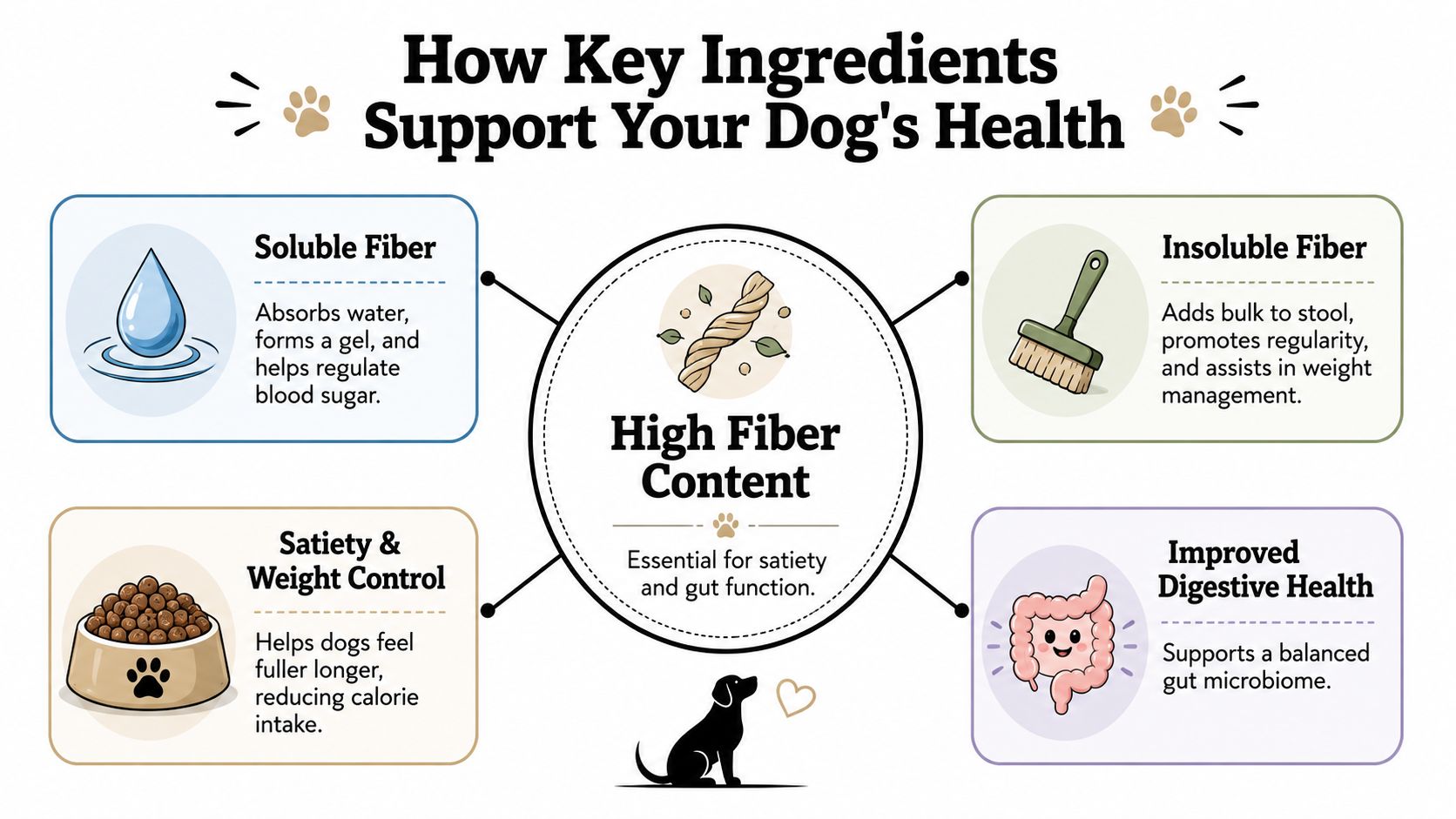
For this food, the headline feature is fiber. The dry formula is described as combining soluble and insoluble fiber, and Hill's markets it to help dogs feel full while consuming fewer calories. The dry food listing also gives a nutrient profile of 12.4% to 13.5% crude fiber, 11.3% to 12.3% fat, and 42.4% to 46.1% carbohydrate/NFE, according to the Hill's Prescription Diet w/d dry product page.
Soluble fiber and insoluble fiber do different jobs
Think of fiber as working in two ways.
Soluble fiber acts a bit like a sponge or gel-former. It interacts with water in the digestive tract and can help slow things down in a controlled way. That's one reason fiber-based diets are often part of glucose-management plans.
Insoluble fiber is more like structural bulk. It helps move material through the gut and can support regular stool formation. For some dogs, that means more predictable bowel movements. For others, it means larger stools than they had on a lower-fiber food.
Why fullness is such a big deal
Many owners underestimate how hard weight loss can feel for a dog that's used to larger portions or frequent treats. One reason vets use a high-fiber therapeutic diet is that fullness matters. If a dog feels hungry all day, compliance gets harder fast.
That's where Hills wd dog food often makes more sense than feeding less of a standard food. In plain terms, the formula is designed to help dogs eat with a purpose. It supports a routine where the dog may feel more satisfied while the owner still follows a controlled plan.
For dogs with sensitive digestion, the feeding routine matters as much as the formula. If your dog has a history of stomach issues, this guide to dog food for dogs with sensitive stomachs can help you think through transitions and meal consistency.
A higher-fiber diet can change what you see in the yard before it changes what you see on the scale.
The fat and carbohydrate profile matters too
Owners sometimes focus only on one ingredient. Vets don't. They look at the whole pattern.
A formula with moderated fat and a defined carbohydrate profile can fit a plan where calories, meal response, and body condition all need tighter control. That doesn't make the food “magic.” It makes it deliberate. Every scoop or can is part of the strategy your veterinarian chose.
Benefits and Realistic Expectations
The strongest reason to stay consistent with Hill's w/d is simple. It can support multiple problems at once in one feeding plan. That matters for owners juggling weight concerns, digestive issues, glucose monitoring, or urinary risk under veterinary care.

What improvement can look like
Improvement usually shows up in practical ways that owners can observe at home:
- Better meal structure: Your dog may seem less frantic between meals when the feeding plan is consistent.
- More predictable stools: Some dogs become more regular once the gut adjusts to the new fiber level.
- Steadier routine: Dogs doing best on therapeutic nutrition often benefit from fewer food changes and fewer “just this once” snacks.
- Support beyond one issue: A dog dealing with both body weight and urinary concerns may benefit from one tightly managed formula rather than multiple food experiments.
What this food won't do by itself
Regarding Hill's w/d, expectations need to stay grounded. Hill's w/d is a management tool, not a cure-all. If your dog has diabetes, obesity, chronic bowel disease, or a urinary issue, the food supports the plan. It doesn't replace monitoring, checkups, medication if prescribed, or your vet's judgment.
Some dogs also need time to accept the new flavor or texture. That doesn't mean the food is wrong. It means transition technique matters.
If the diet is medically appropriate, consistency usually matters more than instant enthusiasm on day one.
A realistic mindset helps. You're not waiting for dramatic overnight change. You're looking for a calmer, more stable pattern over time. That's often how therapeutic diets show their value.
Feeding Guide and Transition Plan
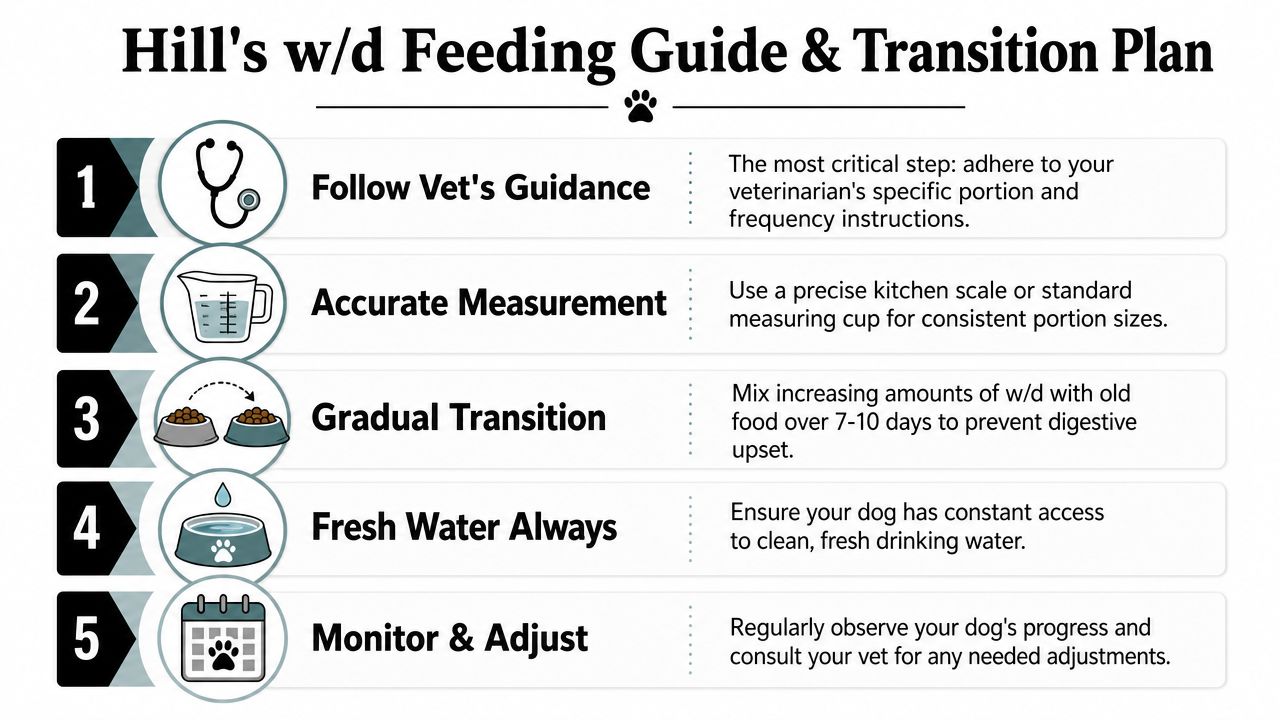
Portion control is the part owners most often want simplified. The safest answer is still the same one your veterinary team would give. Follow the exact feeding amount your vet recommends for your dog. The chart on the label is useful, but your dog's diagnosis, body condition, activity, and treatment plan all matter.
For owners comparing wet and dry formats, one verified reference states that a 370 g can provides 307 kcal and is nutritionally equivalent to 120 g of kibble, according to the PetCareRx Hill's w/d product listing. That same listing notes the product is marketed with S+OXSHIELD to help support a urinary environment associated with lower risk of struvite and calcium oxalate crystal formation.
The basic feeding rules
Use a real measuring cup, or even better, a kitchen scale if your vet wants precision. Eyeballing portions is one of the quickest ways to slow progress.
Keep treats controlled. If your dog gets extras all day, the prescription diet can't do its job as effectively.
Fresh water should always be available. That's especially important when a dog is eating a higher-fiber diet.
If you're weighing different food approaches in general, this overview of fresh food for dogs can help you compare feeding styles while keeping your vet's prescription plan front and center.
Here's a visual walkthrough of the transition process:
A practical transition plan
A gradual switch is kinder to the gut than an abrupt one. Many dogs do better when the old food is phased out over several days.
- Start small: Mix a small amount of Hill's w/d into the current food.
- Increase slowly: Every day or two, add more w/d and reduce the old food.
- Watch the stool: Softer stool, larger stool, or a little gas may happen during the adjustment.
- Stay consistent: Don't keep switching back and forth because of one off day.
- Call your vet if your dog struggles: Refusal to eat, repeated vomiting, or ongoing diarrhea deserves a check-in.
Wet, dry, or mixed
Some owners prefer dry for measuring convenience. Others use canned food because their dog likes the texture better. Some dogs do well on a mixed plan, but calorie conversion is particularly important. Wet and dry may not look equal in the bowl even when they're equivalent nutritionally, so don't substitute casually without checking with your veterinary team.
Common Side Effects and When to Call the Vet
One of the biggest misconceptions about Hills wd dog food is that any stool change means the food is causing harm. That isn't always true. A higher-fiber diet often changes bowel output in a normal, expected way.
What can be normal during adjustment
A dog starting a fiber-focused prescription food may have:
- Larger stools: More fiber can mean more bulk.
- More frequent bowel movements: Some dogs go a bit more often.
- Mild gas at first: The gut may need time to adapt.
- Temporary hesitation at meals: Some dogs need a slower transition or warming of canned food for acceptance.
These changes can look dramatic if you're used to a very different food, but they aren't automatically red flags.
Watch the whole dog, not just one bowel movement. Appetite, energy, hydration, and consistency over several days tell you more.
When to contact the vet promptly
Call your vet if your dog has ongoing vomiting, persistent diarrhea, marked lethargy, obvious abdominal discomfort, or refuses the food completely. Also check in if your dog's medical condition seems harder to manage after the switch, such as changes that worry you in a diabetic dog or urinary signs that don't look normal.
The main point is balance. Don't panic over every expected adjustment. Don't ignore signs that your dog isn't coping well either.
Frequently Asked Questions About Hill's w/d
Why does Hill's w/d require a prescription
Because it's meant for dogs with medical needs, not as a general wellness food for every healthy pet. Veterinary supervision helps match the diet to the diagnosis and adjust portions or format as needed.
Can my other healthy dog eat it
That's a question for your vet, especially in a multi-dog home. A therapeutic diet is designed for a specific purpose. It isn't automatically the best fit for a healthy dog with different nutritional needs.
What if my dog refuses to eat it
First, don't give up after one meal. Some dogs need a slower transition, a different texture, or tighter mealtime structure. If refusal continues, contact your vet rather than improvising with lots of toppers or switching foods repeatedly.
Is Hill's w/d only for weight loss
No. Owners often assume that because the diet is associated with body weight, but the point is broader. Vets may use it when they want a high-fiber therapeutic approach that also fits blood sugar support, digestive management, or urinary goals.
Is there an alternative if this diet doesn't work
Possibly, but that decision belongs with your veterinary team. If Hill's w/d isn't a good fit because of acceptance, stool response, or your dog's medical picture, your vet may recommend a different therapeutic option. The important thing is not to swap to a regular food without asking.
If you're in El Paso and want the same kind of thoughtful, disciplined care for your dog's coat and skin that you expect from a veterinary feeding plan, Glo More Grooming stands apart. This veteran-owned grooming studio delivers one-on-one, premium pet grooming with clear standards, calm handling, and a workflow built around comfort, hygiene, and consistency, not assembly-line volume like many chain shops. For families looking for El Paso dog grooming, premium pet grooming, veteran-owned grooming, or an affordable grooming promo, Glo More Grooming offers polished service with local pride, including community favorites like Snip & Style Saturday. Book now, reserve your promo slot, or contact Glo More Grooming to give your dog elevated care with an independent El Paso team built for the long run.