
You're probably here because you've reached that familiar point in fishkeeping. The tiny starter tank no longer feels enough, and a 35 gallon tank sounds like the first “real” aquarium that gives you options without taking over the whole room.
That instinct is good. A tank in this range can give you a stable, attractive setup that's easier to live with than many beginners expect. But this is also where people make expensive mistakes. They buy the wrong shape, choose fish by gallon number alone, under-equip the tank, and end up fighting stress, algae, territorial problems, and avoidable losses.
The biggest misunderstanding is simple. Not all 35 gallon tanks behave the same. A long tank, a tall tank, and a hex tank may hold similar water volume, but they create very different living spaces for fish. If you understand that one idea first, almost every other decision gets easier.
Choosing Your 35 Gallon Tank Shape and Style
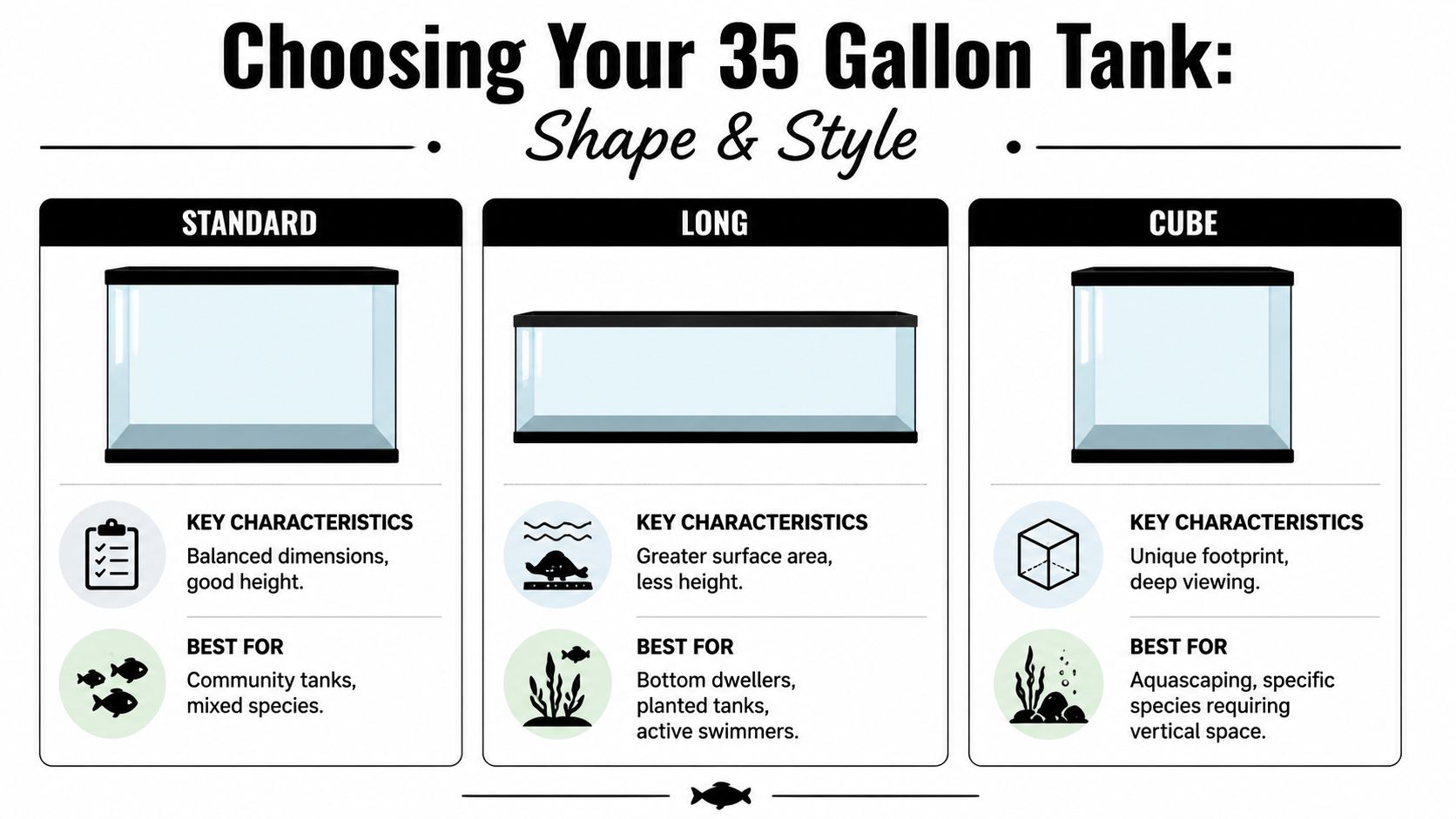
When people shop for a 35 gallon tank, they usually focus on volume first. Fish don't experience volume the way humans do. They experience swimming room, territory, sight lines, and access to the surface.
That's why shape matters more than the gallon label. Discussion from hobbyists around 35 gallon hex tanks shows repeated uncertainty about whether fish like angelfish, rams, and schooling species will do well in that layout. Experienced keepers often warn that a tall, narrow footprint can increase territorial pressure even when the total volume sounds fine, as noted in this Aquaria Central discussion about 35 gallon hex tank stocking.
Long tanks reward beginner-friendly stocking
A long 35 gallon tank gives fish more horizontal travel space. That matters for species that cruise, school, or establish loose territories across the middle and lower parts of the aquarium.
It also usually gives you more surface area. In plain terms, that improves gas exchange and often makes the tank feel less cramped to active fish. If you like rasboras, danio-type swimmers, corydoras, or a broad planted community look, a long tank is usually the safest choice.
A long footprint also gives you better aquascaping control. You can create open swimming lanes, shaded corners, and separate visual zones with wood and plants.
Tall and hex tanks need a more selective fish list
A tall or hex-shaped 35 gallon tank isn't automatically bad. It's just less forgiving. Height adds visual drama, but many community fish care more about footprint than water stacked upward.
Tall and hex layouts tend to create these beginner problems:
- Tighter floor space for bottom dwellers and territorial fish
- Reduced horizontal run for schooling species
- More visual confrontation because fish can't spread out as easily
- Harder maintenance access when you're planting, cleaning glass, or rearranging décor
Practical rule: Choose the fish for the tank shape, not the tank shape for fish you already picked.
Tall tanks can work well when your stock list fits the geometry. Some fish appreciate vertical structure more than others. The mistake is assuming height automatically equals “more room.”
Standard tanks sit in the middle
A standard 35 gallon tank is often the compromise option. It doesn't give you the long runway of a low, stretched-out aquarium, but it avoids some of the tighter limitations of a narrow hex.
If you want a mixed community and don't have a highly specialized fish list yet, standard dimensions can be a practical middle ground. If you're still comparing sizes, this guide to 180 gallon aquarium dimensions is a useful reminder that dimensions change fishkeeping far more than the headline gallon number suggests.
Essential Equipment for Your 35 Gallon Setup
A 35 gallon tank only runs smoothly when the hardware does its job every day. Beginners often try to save money on this essential equipment, and it's usually the costliest place to cut corners.
You don't need fancy gear. You need reliable gear. A disciplined setup works the same way a disciplined care routine does in any animal system. Consistency keeps stress down.
The non-negotiable shopping list
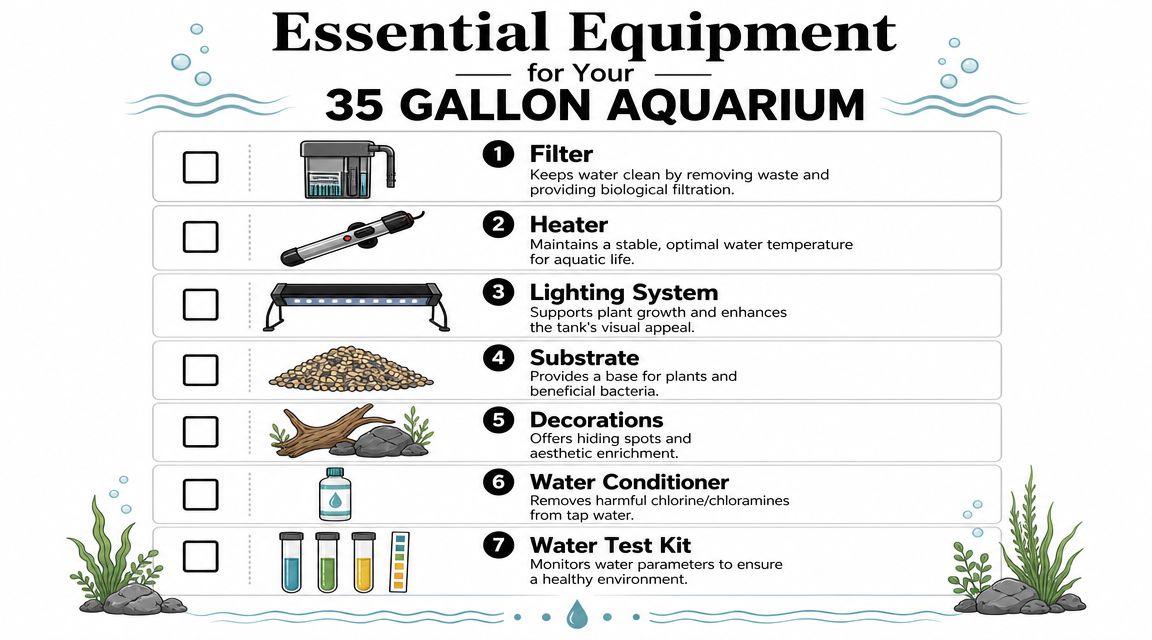
Here's what belongs on your first purchase list.
- Filter: This is your waste-processing engine. A hang-on-back filter is simple and accessible. A canister filter is quieter and often gives you more media space. Either can work if it's sized for your livestock and maintained properly.
- Heater: Fish handle stable temperatures better than swinging ones. A dependable heater matters more than people think, especially overnight or during weather changes.
- Lighting system: Fish need a normal day-night rhythm, and live plants need suitable light. The right fixture depends on whether your setup is fish-only, lightly planted, or plant-focused.
- Substrate: Gravel, sand, or planted substrate changes how the tank looks and what fish and plants thrive. Bottom dwellers often appreciate smoother substrate.
- Water conditioner: Tap water usually needs treatment before it's safe for aquarium use.
- Water test kit: This is how you confirm what the water is doing instead of guessing.
- Cleaning tools: A gravel vacuum, algae scraper, dedicated bucket, and fish net save time and prevent sloppy maintenance.
Where beginners usually overspend and underspend
People often overspend on ornaments and underspend on filtration and testing. That reverses your priorities.
If your budget is tight, keep these principles in mind:
- Protect water quality first. Buy the filter, heater, conditioner, and test kit before decorative extras.
- Match substrate to your plan. Don't buy sharp or oversized gravel if you want delicate bottom fish.
- Keep maintenance simple. If a tool feels annoying to use, you'll put it off.
Good equipment doesn't make the hobby complicated. It removes points of failure.
A lot of new keepers also forget practical supplies like a lid, a timer for lights, and a backup thermometer. None of those items are glamorous, but they support a steady workflow.
If you want more setup-related reading, the aquarium setup articles at Glo More Grooming collect beginner-friendly guidance in one place.
Build for the routine you'll actually follow
The best 35 gallon tank setup is the one you can maintain every week without dread. If a canister filter feels intimidating, a solid hang-on-back may be the better choice. If a high-tech planted system sounds exciting but you know you want low-maintenance fishkeeping, stay simple.
That's not settling. That's smart planning.
Setting Up and Cycling Your New Aquarium
The first day matters, but the first few weeks matter more. A clean-looking tank isn't the same as a safe tank.
Fish produce waste. Uneaten food breaks down. Plant debris decomposes. In a healthy aquarium, beneficial bacteria process that waste before it harms livestock. In a brand-new setup, those bacterial colonies aren't established yet. That's why cycling is not optional.
Set up the hardware before adding animals
Start with the physical build.
- Rinse substrate until the dust is mostly gone.
- Place the tank on a level, properly supported surface.
- Add substrate, hardscape, heater, and filter.
- Fill the aquarium slowly so you don't blast the layout apart.
- Add water conditioner.
- Turn on the filter and heater.
- Check that everything runs smoothly and consistently.
At this stage, the tank may look finished. It isn't ready for fish yet.
Think of cycling as building a waste crew
A fishless cycle is the safest way for beginners to start. The idea is simple. You feed the tank an ammonia source without exposing fish to toxic spikes, then let beneficial bacteria establish in the filter and across tank surfaces.
Those bacteria don't appear instantly. They need time and a stable environment.
You're building the waste-processing factory before the animals move in.
During cycling, use your test kit regularly and watch for the classic progression. Ammonia rises first. Then nitrite appears. Then nitrate shows up as the system matures. Once the tank can process waste predictably, you're in a much safer place to add livestock gradually.
Common mistakes that stall the process
Cycling problems usually come from impatience, not bad luck.
Watch for these issues:
- Adding fish too early: The water may look clear and still be unsafe.
- Changing too much at once: Large adjustments to media, décor, or chemistry can slow stability.
- Turning equipment off for long periods: Beneficial bacteria depend on oxygenated water flow.
- Overcleaning the filter: Don't treat beneficial media like something that should be scrubbed sterile.
If you've only kept small tanks before, this 10 gallon fish tank setup guide helps show how the same biological principles scale upward even when the equipment and stocking options change.
Add fish in stages, not all at once
Once the tank is cycled, resist the urge to fully stock it in one shopping trip. Add fish in measured stages and observe them closely. That gives the system time to adjust to the growing bioload.
A calm start saves trouble later. Most “mystery” fish losses in new tanks aren't mysterious at all. They come from skipping the part of fishkeeping that nobody sees on day one.
Smart Stocking Ideas and Compatibility Charts
The stock-listing phase generates excitement, and it's also a point at which many tanks go off the rails. A good stock list isn't just a collection of fish you like. It's a behavior plan for the whole aquarium.
Think in layers. What occupies the top or middle? Who uses the bottom? Which fish want company from their own kind? Which fish need personal space? In a 35 gallon tank, the best communities usually feel balanced rather than crowded.
Match the plan to the tank shape
If you remember one thing, make it this. A long 35 gallon tank usually gives you more stocking flexibility than a tall or hex version. Active schooling fish, bottom groups, and community layouts generally benefit from more footprint.
Tall tanks can still work, but they reward restraint. Keep your list tighter and choose species that won't compete heavily for the same lane of water.
The right stock list makes a tank look effortless because each fish has room to behave normally.
Sample stocking plans for a 35 Gallon Aquarium
| Plan Name | Centerpiece Fish | Schooling Fish | Bottom Dwellers | Notes |
|---|---|---|---|---|
| Peaceful planted community | A small centerpiece gourami or a calm pair of dwarf cichlid-type fish | A coordinated school such as rasboras or small tetras | Corydoras-type catfish | Best in a long tank with open midwater space and planted cover |
| Vertical focal setup | Angelfish-type centerpiece chosen with care | Deeper-bodied, calm schooling fish that won't nip | Light bottom crew such as peaceful catfish | Better suited to a taller tank, but stock lightly and avoid crowding |
| Hardwater livebearer community | A showy group of guppies, platies, or similar livebearers | The livebearers themselves often provide the movement | Small peaceful bottom fish suited to the same water style | Works best in standard or long tanks, with attention to reproduction and compatibility |
The table above is intentionally broad because exact species choices depend on local availability, water conditions, and your maintenance habits. That said, the logic behind each plan stays the same.
Three practical examples
Peaceful community for a long tank
This is the most beginner-friendly route. Use a long footprint, a planted background, and leave the center open for schooling fish. Add a peaceful midwater group, a bottom group, and one restrained centerpiece choice.
This layout works because it spreads behavior across zones. Nobody has to dominate the whole tank.
Tall display with a centerpiece fish
A taller 35 gallon tank can look striking in a living room or office, especially with plants and vertical wood. But this format needs discipline. Don't treat the height as permission to add more fish than the footprint can support behaviorally.
Choose fish that won't constantly chase, fin-nip, or crowd one another. Tall tanks can become tense if too many species compete for the same visual territory.
Livebearer-led setup
If you like constant movement and color, a livebearer-focused tank can be rewarding. These communities often feel active and cheerful, but they need supervision. Some fish reproduce readily, and that can turn a balanced tank into an overstocked one faster than beginners expect.
Keep décor structured. Add hiding spaces. Leave yourself a plan for what happens if the population grows.
Compatibility questions beginners should ask
Before buying any fish, ask:
- Does this species want horizontal swimming room or vertical structure
- Is it peaceful, territorial, shy, or fast-moving
- Does it need a group of its own kind
- Will it outcompete slower fish at feeding time
- Does it occupy the same zone as my other picks
If you can't answer those questions, wait before buying. Impulse fish purchases are one of the fastest ways to turn a promising 35 gallon tank into a problem tank.
Choosing Live Plants and Aquascaping Your Tank
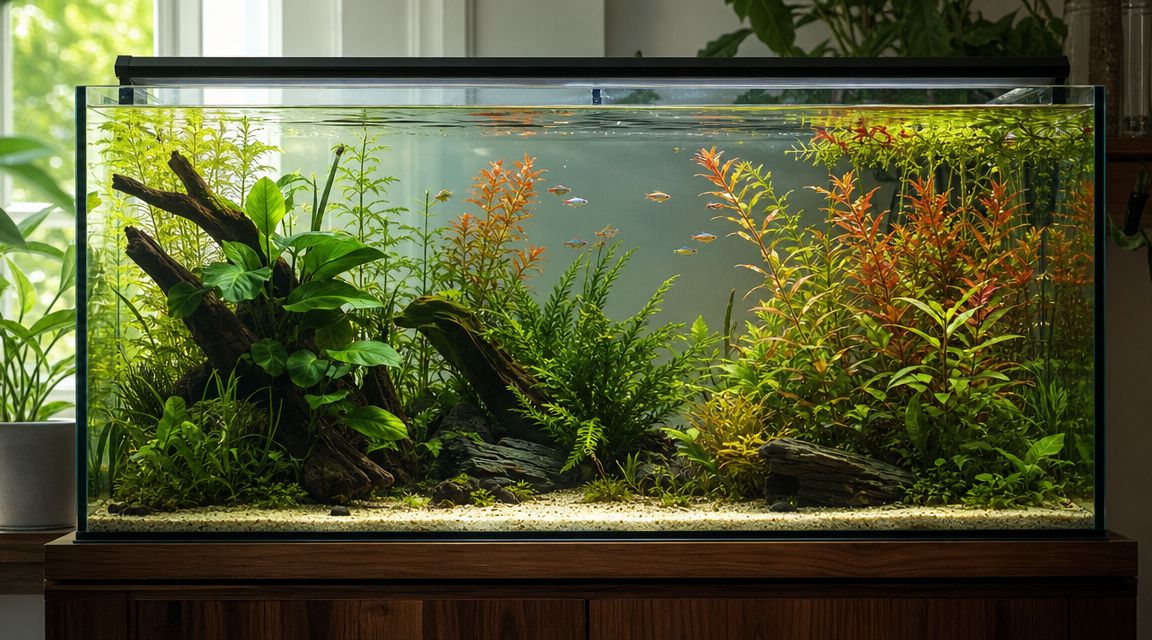
A planted aquarium looks better, but that's only part of the story. Live plants also help create a calmer, more stable environment for fish. They soften lines of sight, give shy species cover, and make the tank feel less exposed.
Start with plants that forgive beginner mistakes
If this is your first planted 35 gallon tank, choose species that don't punish every small inconsistency.
Good beginner-friendly options include:
- Anubias: Slow-growing and sturdy. Great attached to wood or rock.
- Java fern: Another excellent choice for attaching to hardscape rather than burying.
- Cryptocoryne: Useful for filling the midground with a natural look.
- Floating plants: Helpful for diffusing light and making fish feel secure, if you're willing to manage surface coverage.
These plants usually fit low-pressure setups better than demanding, highlight carpeting plans. A simple planted tank that stays healthy will always beat an ambitious layout that turns into constant maintenance.
Build the layout around fish behavior
Aquascaping isn't just decoration. It affects how fish use the tank.
Try this layout logic:
- Foreground: Keep some open substrate for visual breathing room and bottom fish activity.
- Midground: Use plants, stones, or wood to break sight lines.
- Background: Place taller plants where they hide equipment and frame the scene.
A long tank benefits from side-to-side flow. A taller tank benefits from vertical accents without blocking the whole front view. In either case, leave intentional swimming lanes.
Fish often look more confident when they have cover nearby, even if they spend much of their time out in the open.
A helpful visual walkthrough can spark ideas before you place your first piece of wood:
Keep the first layout editable
Don't glue yourself emotionally to the first arrangement. Fish will tell you what works. If one corner becomes a chase zone or a shy species never leaves cover, adjust the layout.
That's normal. Good aquascaping is part design and part observation.
Long-Term Maintenance Schedule and Running Costs
A healthy 35 gallon tank doesn't need constant tinkering. It needs a routine. The keepers who last in the hobby usually aren't the ones doing the most. They're the ones doing the basics on schedule.
If your workflow is disciplined, maintenance stays manageable. If you skip weeks and then try to “reset” everything at once, the tank usually pushes back.
A maintenance rhythm that works
Use a simple repeating schedule.
Weekly jobs
- Water change: Replace part of the water on a consistent schedule.
- Glass cleaning: Wipe algae before it becomes a project.
- Visual livestock check: Look for torn fins, odd breathing, clamped posture, or bullying.
- Test water when needed: Especially in newer tanks, after changes, or when fish act off.
- Remove debris: Trim dead plant leaves and siphon obvious waste.
Monthly jobs
- Filter check: Rinse media gently in old tank water if flow drops.
- Equipment inspection: Confirm the heater, thermometer, light, and filter are working normally.
- Plant maintenance: Trim overgrowth and re-open swimming lanes.
- Layout review: Make sure décor still supports the fish, not just the look.
Running costs are real, even if they're not dramatic
A 35 gallon tank sits in a useful middle range. It's large enough to require planning, but not so large that ordinary maintenance becomes physically difficult.
Your recurring costs usually come from:
- Food
- Water conditioner
- Replacement media and wear items
- Electricity for heater, filter, and lighting
- Plant fertilizers or plant replacements, if applicable
Those costs vary by equipment choice, stocking density, and whether you run a simple or plant-heavy system. The important point is to budget for the routine, not just the initial purchase. New keepers often spend confidently on day one and then get annoyed by the small repeat expenses that follow.
The hidden cost is neglect
Neglect is expensive. Not because routine care is glamorous, but because every skipped task tends to create a larger one later. A missed water change becomes algae, cloudy water, stressed fish, or a filter clogged with old debris.
A low-stress aquarium comes from boring consistency. That's a compliment, not a warning.
If you want to stay motivated, keep your tools organized in one place, schedule a regular maintenance day, and treat the routine as part of owning the tank, not as an extra chore that appears out of nowhere.
Is It an Aquarium or a Utility Tank
Search for a 35 gallon tank and you won't only find aquariums. You'll also find utility tanks for water, chemicals, RV use, marine setups, and equipment systems. That confuses a lot of buyers.
An aquarium is built for viewing aquatic life. A utility tank is built for storage, transfer, or system integration. The material, fittings, and installation expectations are different.
How utility tanks differ
For utility applications, a 35-gallon vertical tank is often built with a 5-inch threaded lid and a 1-inch female NPT outlet, and some versions use FDA-compliant resin and UV inhibitors to reduce sun-related polymer degradation in outdoor use, according to this 35-gallon utility tank specification.
A 35-gallon polyethylene horizontal tank can also be designed with a maximum temperature rating of 140°F, a 1.2 specific gravity limit, and a footprint of 33 in × 19 in × 21.5 in, as shown in this 35-gallon horizontal tank product specification. Those details matter because utility buyers need to think about liquid compatibility, mounting, plumbing, and heat, not fish welfare or aquascaping.
If you're buying for aquarium use, don't assume a generic “tank” listing is suitable for livestock. If you're buying for water, RV, or chemical use, don't assume an aquarium-style guide applies to your installation.
If you care about pets the way serious aquarists care about their tanks, you already understand the value of calm handling, clean results, and a disciplined routine. That same standard is what sets Glo More Grooming apart for El Paso dog grooming. As a veteran-owned grooming studio, Glo More Grooming focuses on one-on-one care, premium handling, and a workflow built around comfort, hygiene, and consistency. For pet owners who want premium pet grooming without the rushed feel of big chains like PetSmart or Petco, and for families watching for an affordable grooming promo like Snip & Style Saturday, this is the kind of local service worth booking early. If you're in El Paso and want polished, dependable care with long-term standards behind it, book now, reserve your promo slot, or contact Glo More Grooming today.