
Bringing home a guinea pig often starts with a lot of squinting, second-guessing, and searching. You look into the cage and wonder, “Is she really a girl?” Then the next questions pile up fast. Will she get along with another guinea pig? Does she need different care from a male? What health problems should I watch for?
If your pet is a female guinea pig, also called a sow, those questions matter. Female guinea pigs have their own patterns in social behavior, reproductive biology, and health risk. Some parts are simple, like learning what a sow looks like. Other parts catch new owners off guard, especially urinary problems, ovarian cyst concerns, and the fact that not every pair of girls becomes instant best friends.
A good sow owner doesn't need to be an expert on day one. You just need a calm routine, careful observation, and a willingness to learn your guinea pig as an individual. If you're building that foundation now, this practical guide to guinea pig care basics will help you stay focused on what matters in daily life.
Your Guide to the Female Guinea Pig
A lot of owners meet their first sow in a very ordinary moment. She's tucked inside a hide, peeking out for lettuce, making little sounds, and acting both curious and cautious. You can tell she has a personality already. What you can't always tell is what being female will mean for her care.
That's where people often get mixed up. Many care guides stop at “girls can live together” or “look for a Y shape.” Those basics are useful, but they don't answer the questions owners run into at home. Why is one sow peaceful while another is bossy? Why can urinary issues become serious? Why do some females need closer monitoring as they age?
Practical rule: Treat sex as one part of the picture, not the whole picture. Your sow's health, age, housing, and personality all shape what good care looks like.
Female guinea pigs have some traits that are worth knowing early. Adult sows are usually a bit smaller than males, and they have female reproductive anatomy that affects everything from sexing to breeding risk. They're also social animals, which means companionship and group setup matter a great deal.
What helps most is a step-by-step approach. Learn how to identify a female guinea pig safely. Watch how she behaves around other pigs. Build a clean, steady routine for food, housing, grooming, and weekly health checks. Then stay alert for female-specific warning signs, especially changes involving urination, the abdomen, or the mammary area.
That kind of care is quiet work. It's not dramatic. But it's what keeps small problems from turning into emergencies.
How to Identify a Female Guinea Pig
Sexing a guinea pig sounds harder than it is, but it does require a gentle hand. Many accidental litters happen because owners were told the sex incorrectly or assumed a young guinea pig was female without checking carefully. If you're unsure, ask an experienced exotic vet to confirm. It's always better to verify than guess.
Sows are physiologically distinct from males. The Louisiana Veterinary Medical Association guinea pig biology guide notes that sexing relies on identifying the Y-shaped vulva, and gentle pressure above the genital area does not evert a penis in a female. The same source states that adult sows typically weigh about 700 to 900 grams.
Here's a visual reference to make that easier to understand.
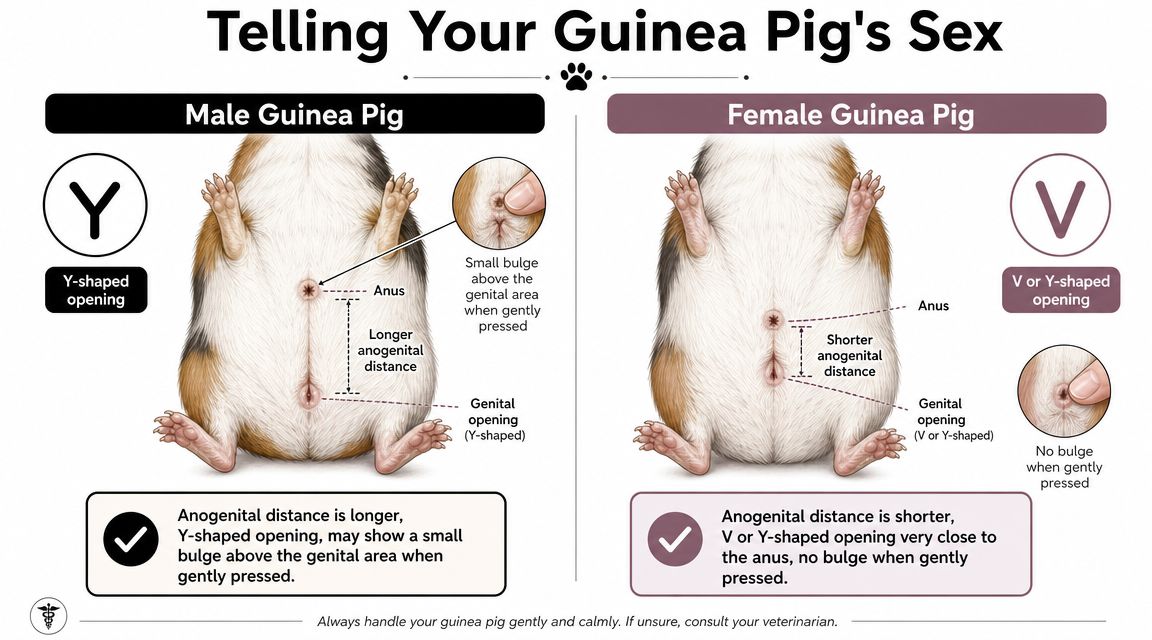
What to look for
Start with your guinea pig on a secure surface, or hold her gently against your body with her rear supported. You want her to feel steady, not stretched or dangling.
Look at the genital area just below the anus. In a female guinea pig, the opening usually forms a Y shape. The genital opening also sits very close to the anus.
A male usually has more distance between these structures, and with gentle pressure above the genital area, a penis may evert. That should not happen in a sow.
A simple handling routine
If you're checking at home, keep it brief:
- Choose a calm time so your guinea pig isn't already startled.
- Use both hands and support the chest and hind end.
- Part the fur carefully so you can see the skin, not just hair.
- Apply only light pressure if needed. Never poke, squeeze hard, or repeat the exam over and over.
- Stop if she struggles and try again later, or have a vet confirm.
One of the biggest mistakes new owners make is trying to force certainty from a moving, frightened guinea pig. A stressed animal is harder to examine, and rough handling teaches her to fear being picked up.
Later on, this video can help reinforce what you're seeing in real life.
Where owners get confused
Some females are checked when they're very young, and people assume tiny size means female. That's not reliable. Others hear “V shape” in one place and “Y shape” in another, then think they must be looking at the wrong area. In practice, the important point is the female opening is close to the anus and does not produce a penis with gentle pressure.
If you aren't fully confident, separate any unknown-sex guinea pigs until a professional confirms what you have.
That one decision can prevent a lot of stress later.
Behavior and Social Needs of Sows
Many people choose a female guinea pig because they've heard girls are easy to pair. Sometimes that's true. Two females are often a straightforward match. But “often” isn't the same as “always,” and that difference matters.
Rescue guidance from Cottontails Rescue on guinea pig pairing notes that some females are “very stroppy” and may never accept a new female. That's one of the most useful truths a new owner can learn. Sex influences behavior, but personality can override sex.
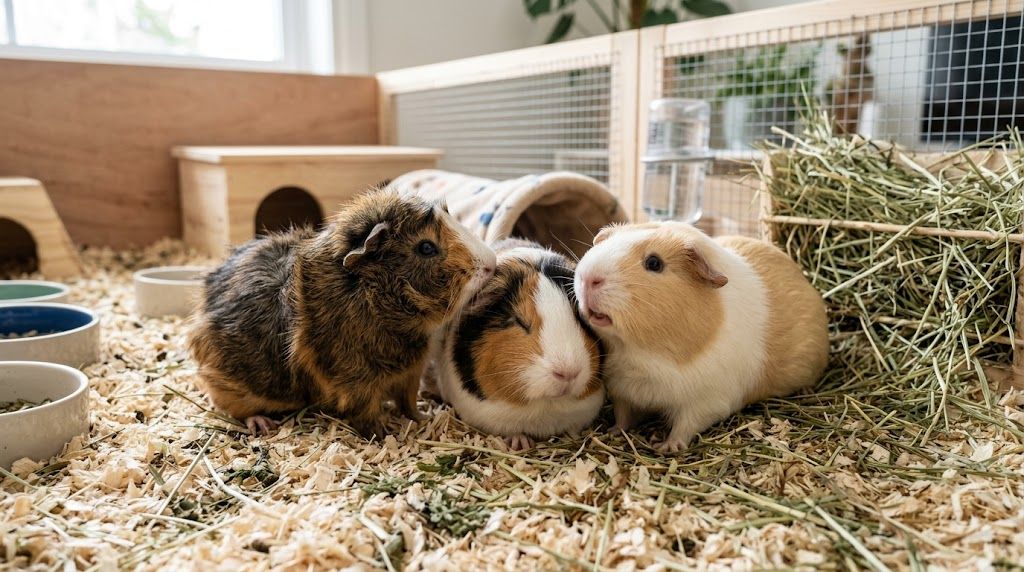
Why female pairs sometimes fail
A sow doesn't need to be aggressive to be difficult to bond. Some are pushy around food. Some guard favorite hideouts. Some dislike change. A confident older sow may resent a new adult female entering “her” space, even if she was friendly with a previous companion.
That's why a successful pair is about more than putting two girls in one enclosure. You're managing resources, territory, and temperament.
A few behaviors are common during introductions and don't automatically mean the match has failed:
- Rumbling and strutting can be part of sorting out status.
- Nose-offs and brief chasing may happen as they test boundaries.
- Minor bickering around hideouts can settle once the setup improves.
What you don't want is repeated, escalating conflict that leaves one guinea pig terrified, cornered, or unable to rest and eat comfortably.
How to set up better introductions
Neutral ground helps. So does space. So do duplicates.
Try this approach:
- Use a neutral area: Don't introduce a new sow directly inside the resident pig's usual cage if you can avoid it.
- Provide multiple resources: More than one hide, more than one food station, and more than one water source reduce guarding.
- Choose open-ended hides: A trapped guinea pig panics faster if there's only one exit.
- Watch the pigs, not the clock: Some pairs settle gradually. Others show early signs that the match is wrong.
Owner reminder: A noisy introduction isn't always a bad one. A silent, frozen, frightened guinea pig can be the bigger concern.
If you're thinking about enrichment and handling tools, this overview on a guinea pig harness is useful mainly as a reminder that not every product changes core social needs. Companionship, room to move, and safe group dynamics matter more than novelty items.
One sow, two sows, or a small herd
Some females do well in pairs. Some fit nicely into a larger female group. Rescue advice also notes that a neutered male can sometimes act as a stabilizing “peacemaker” in an all-female herd. That won't solve every personality clash, but it's a real option in some homes with experienced guidance.
A quick comparison can help:
| Living setup | Best use | Main caution |
|---|---|---|
| Single sow | Short-term only if medically necessary | Guinea pigs are social and usually need companionship |
| Two females | Common and often workable | Pairing still depends on personality |
| Female group | Can work in roomy, well-managed housing | Resource guarding and hierarchy issues can grow |
| Neutered male with females | Sometimes stabilizes a herd | Requires proper veterinary guidance and planning |
The biggest mistake is assuming any conflict means one pig is “bad.” Usually, it means the match, space, or introduction method needs rethinking.
Optimal Diet and Housing
Daily care keeps a female guinea pig stable. The best setups are usually simple, predictable, and easy to clean. Sows don't need fancy equipment. They need the right food offered consistently, enough room to move, and a living space that doesn't force constant competition.
What should be in the bowl and rack
For most healthy adult guinea pigs, the basics are straightforward:
- Grass hay at all times: Timothy hay or another grass hay should be constantly available for chewing and digestion.
- Plain pellets: Choose a plain guinea pig pellet, not a colorful mix with extras sorted in.
- Fresh vegetables daily: Include safe vegetables that support vitamin C intake.
- Clean water: Refresh it often and make sure bottles or bowls work properly.
If a sow is pregnant or nursing, her nutritional needs can change. That's one of the few times owners may hear about alfalfa hay or other richer support foods. Healthy adult females who aren't pregnant generally do better on a routine built around grass hay, measured pellets, and fresh vegetables, rather than calorie-heavy feeding.
Housing that reduces stress
A sow may be small, but she still needs room to make choices. She should be able to eat, rest, hide, and move away from a cage mate without feeling trapped. Tight housing doesn't just look crowded. It changes behavior.
A better enclosure has:
- Room for separate zones so resting, feeding, and toileting don't all happen in one cramped patch
- At least two hides for a pair, preferably with more than one exit
- Soft, dry bedding or well-kept fleece systems
- Good airflow without drafts
- A cleaning routine you can maintain
What female households need most
Owners often focus on décor and overlook traffic flow. For sows living together, layout matters more than cuteness.
Try to avoid setups where one dominant guinea pig can block a tunnel, guard the only hay pile, or trap another pig in a single-door house. Long, open floor space is often more useful than stacked levels or cluttered accessories.
Good housing lets a guinea pig choose distance without losing access to food, water, or shelter.
Seasonal care matters too. In warmer climates, watch for heat stress and stale air. In drier environments, keep water especially fresh and check that bedding stays comfortable rather than dusty and irritating.
A strong routine beats frequent changes. Guinea pigs usually do best when meals, spot cleaning, and quiet time happen on a dependable schedule.
Grooming and Female-Specific Health Checks
Many owners think grooming is mostly about appearance. With guinea pigs, grooming is really about early detection. The few minutes you spend brushing, trimming nails, or checking the rear end can be the first time you notice a health problem.
That matters even more with sows. According to Kavee's guide to male vs female guinea pigs, female guinea pigs are at risk for issues such as ovarian cysts, which are most common between ages 2 and 4. The same source notes that UTIs can be a serious concern, and unaltered sows may face a higher risk of mammary, ovarian, and uterine cancers.
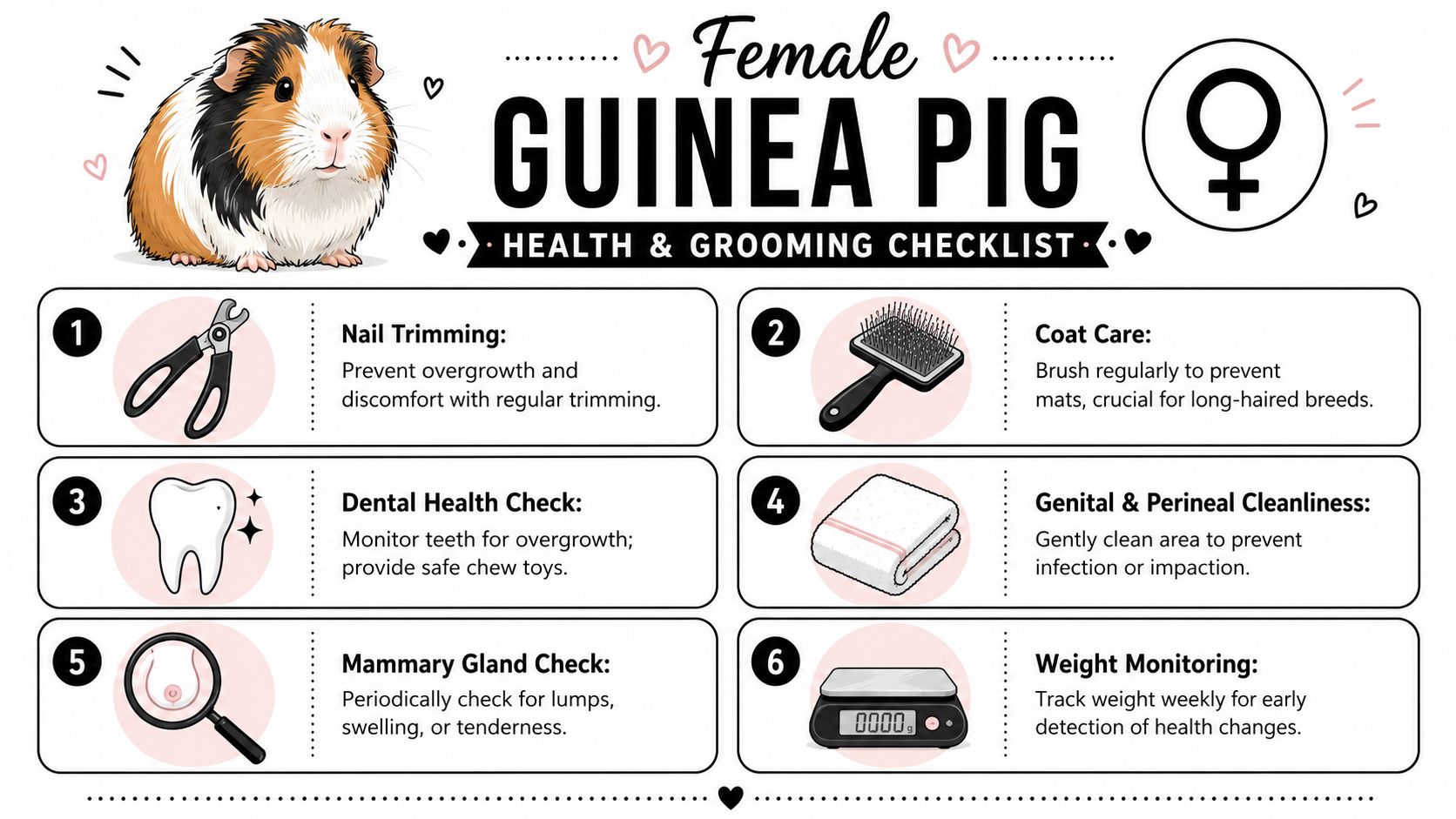
A weekly sow check at home
Pick one day each week and do the same short exam in the same order. That helps you notice change faster.
Use a small towel, good lighting, and calm handling. Then check:
- Body condition: Run your hands gently over the ribs and hips. Sudden change matters.
- Rear-end cleanliness: Look for urine scald, damp fur, staining, or discharge.
- Mammary area: Feel and look for swelling, tenderness, or anything that seems new.
- Abdomen: Notice if the belly seems unusually enlarged, firm, or uncomfortable.
- Behavior with handling: A sow who suddenly resists touch around the lower body may be telling you something.
Don't turn this into a long wrestling session. Short, repeatable checks work better than rare, stressful ones.
Grooming tasks that support health
Routine grooming is part of the same system:
| Grooming task | Why it matters |
|---|---|
| Nail trims | Overgrown nails change posture and comfort |
| Brushing | Helps prevent mats, especially in long-haired guinea pigs |
| Checking the rear end | Helps you catch urinary or reproductive concerns early |
| Weighing regularly | A quiet way to spot change before obvious illness appears |
If your sow has longer hair, pay extra attention to the area under the tail and along the underside. That's where dampness and debris can hide.
A clean coat doesn't just look nice. It makes the skin and body easier to assess.
When to call the vet promptly
Call sooner rather than later if your sow shows signs like straining to urinate, blood in the urine, repeated discomfort, a sudden swollen abdomen, or new lumps. Guinea pigs often hide illness until they're feeling quite bad.
UTIs in particular deserve urgency. Owners sometimes wait because the guinea pig is still eating a little or moving around between episodes. That delay can be dangerous. If urination looks painful or abnormal, treat it as a same-day concern whenever possible.
Pregnancy Risks and Breeding Considerations
You bring home two young guinea pigs that were labeled female. A few weeks later, one starts gaining weight, and suddenly you are not dealing with a simple housing question anymore. This is how many accidental guinea pig pregnancies begin. One sexing mistake, one short period of mixed housing, or one mother left with a male too long after birth can change the whole situation.
Female guinea pigs are not built for casual breeding. Pregnancy, birth, and rapid repeat breeding can place heavy strain on a sow's body, especially if no one planned for it.
A review in PMC on guinea pig reproduction and management reports that the estrous cycle averages about 16 days, with a range of 13 to 21 days. The same source states that gestation averages 68 days, with a range of 59 to 72 days, and that postpartum mating can be fertile in about 60 to 85 percent of cases.
That last point catches many owners off guard. A sow can become pregnant again very soon after giving birth.
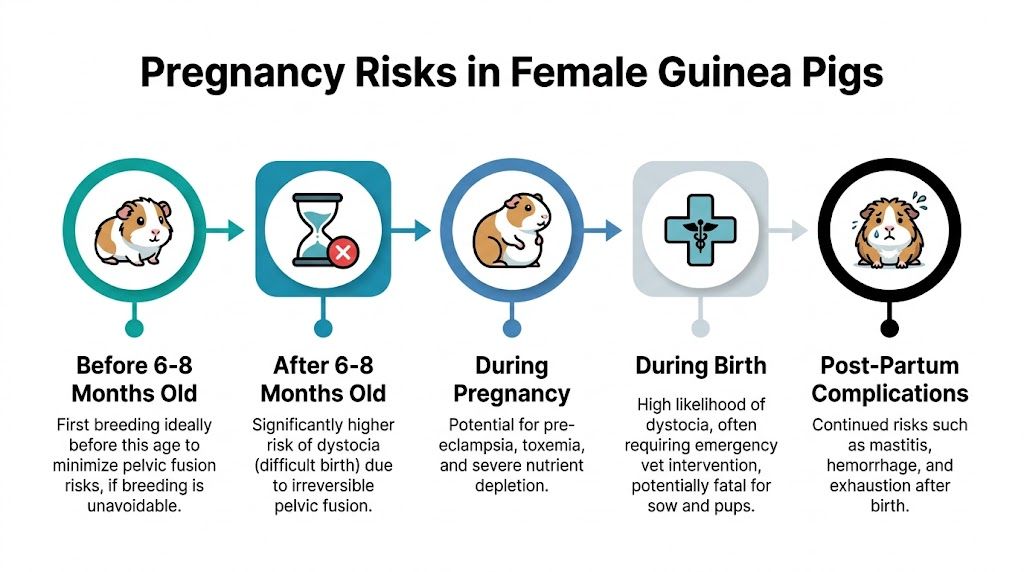
Why accidental breeding gets out of hand quickly
Guinea pig reproduction works a bit like a short-reset timer. If a male has access to a female, the next breeding opportunity may come around before the owner has even processed the first litter.
That is why “they were only together briefly” is not reassuring.
If your sow lives with an intact male, assume pregnancy is possible unless a veterinarian confirms otherwise. That includes cases where the male is a young guinea pig and looks too small to matter. Young animals are often mis-sexed, and sexual maturity can arrive earlier than new owners expect.
The age issue owners often miss
Female guinea pigs can be sexually mature while they still look very young. The Merck Veterinary Manual page on guinea pigs notes that females reach puberty at about 2 months of age.
For owners, the practical point is straightforward. Do not rely on size, baby-like behavior, or pet store labels when deciding who can safely live together.
Breeding timing also has medical importance. In guinea pigs, the pelvis becomes less flexible with age if a sow has never delivered. That is one reason intentional breeding should never be a casual home project. A breeding-age discussion belongs with an experienced exotics veterinarian, not with guesswork.
If you are still deciding whether guinea pigs fit your household at all, this guide to beginner-friendly pets and daily care commitment can help you compare what different small pets require.
If your sow may already be pregnant
Keep things calm and predictable. Feed her normal, appropriate guinea pig food, make sure hay and water are always available, and avoid repeated squeezing or pressing on the abdomen. New owners sometimes feel tempted to “check for babies.” That can stress the sow and does not replace a proper veterinary exam.
Focus on changes that matter. A drop in appetite, weakness, labored breathing, obvious pain, trouble walking, vaginal bleeding, or failure to pass stool or urine normally all deserve prompt veterinary care.
This is also a good time to think beyond the pregnancy itself. Female guinea pigs can develop health problems that owners mistake for pregnancy, especially a swollen abdomen. Ovarian cysts are a well-known example in sows, and urinary problems can also cause discomfort and posture changes. If your guinea pig seems larger through the belly but breeding exposure is uncertain, do not assume pregnancy.
Prevention as the best approach
For pet owners, the safest breeding plan is usually no breeding plan at all.
Use these rules:
- Confirm sex early and recheck if needed: A veterinarian should verify if there is any doubt.
- Do not house a sow with an intact male: Even short-term housing can lead to pregnancy.
- Separate carefully around birth: Immediate repeat breeding is a real risk.
- Question every “all female” label if the guinea pigs are young: Errors happen often enough to matter.
- Treat a suddenly enlarged abdomen as a medical question, not just a pregnancy question: Sows are prone to female-specific problems that need veterinary attention.
Breeding is not just about producing babies. It increases medical risk for the mother, creates housing and social stress, and can leave owners trying to sort out sexing, separation, and emergency care all at once. With female guinea pigs, prevention is usually the kindest and safest choice.
Adoption Advice and Long-Term Wellness
You bring home a sow that looks healthy, eats well that first evening, and curls up calmly in the hay. A few weeks later, you start noticing the details that matter more than first impressions. Does she share space comfortably with her companion, or does one pig keep getting pushed away from the food bowl? Is that rounder belly normal body shape, or the start of a health problem owners often miss?
That is why adoption decisions and daily wellness belong together.
A good rescue or experienced foster home can tell you more than a seller who only knows age and color. Ask how the sow behaves around other females, whether she guards food, whether she has had urinary trouble, and whether anyone has noticed signs that could fit ovarian cysts, such as flank sensitivity, a broadening abdomen, or hormonal behavior changes. Female guinea pigs are often described as the "easy" choice, but real life is more nuanced. Many do wonderfully in pairs or groups, yet some female-female matches need careful setup and close observation to stay peaceful.
What to look for before you adopt
Start with the basics, then go one layer deeper.
A healthy sow should be alert, clean around the rear, interested in hay or vegetables, and able to move without stiffness or hesitation. Her coat should look well kept, and her breathing should be quiet and easy. If she already lives with another guinea pig, spend a few minutes watching them together. You want to see normal shared living, not constant crowding, blocking, or tension around food and hideouts.
Ask practical questions:
- Has she been weighed regularly?
- Has she ever had blood in the urine or signs of straining?
- Has her abdomen changed shape over time?
- Has she lived successfully with females before?
- Has she been seen by an exotics veterinarian?
Those questions help you spot problems that do not always show up in a quick meet-and-greet.
If you are still deciding whether a guinea pig fits your household, this guide to beginner-friendly pets can help you compare daily care needs and commitment level.
What long-term wellness looks like at home
Long-term care is a pattern, not a single good purchase.
The owners who catch problems early usually do simple things consistently. They notice how much their sow normally eats, where she likes to rest, how she sounds when handled, and how she acts around her cage mate. That baseline works like a map. Without it, subtle changes are easy to miss.
Focus on habits like these:
- Weigh her regularly: Weight loss often shows up before obvious illness.
- Handle with a purpose: Feel for body condition, check the rear end, and notice any discomfort around the belly.
- Watch the water and litter area: Changes in urination can be an early clue for urinary irritation or infection.
- Protect access to food: In female pairs or trios, quiet social pressure can lead one sow to eat less even when no fighting is obvious.
- Plan ahead for companionship changes: If one guinea pig dies or a bond breaks down, you will need a thoughtful plan for introductions, side-by-side housing, or rescue support.
Lifespan varies with genetics, housing, diet, stress, and medical care. Female guinea pigs can live for several years with good care, and many owners find that steady routines and early veterinary attention make the biggest difference over time.
A realistic outlook for sow owners
Female guinea pigs are rewarding pets. They are also easy to underestimate.
New owners often learn how to sex guinea pigs and how to avoid accidental breeding, but they are not always warned about the slower, quieter problems that show up later. A sow with ovarian cysts may seem less tolerant of handling. One with a urinary issue may sit differently, urinate more often, or stop acting comfortable in the cage. Social stress between females may look mild until you realize one pig has been eating less for days.
Good care is not about watching for dramatic emergencies alone. It is about noticing small changes early and acting on them.
That kind of attention gives your sow the best chance at a long, comfortable life.