
You close the door, hear the latch click, and still don’t trust the kennel.
That feeling is common with Pitbull owners because this breed can expose weak equipment fast. A cheap crate bends. A sloppy door gap turns into a paw trap. A bad latch becomes an escape test. If the kennel fails, the dog pays first.
That’s why serious dog kennels for pitbulls aren’t about keeping a dog “put away.” They’re about control, safety, recovery, structure, and responsible ownership. A proper kennel gives your dog a calm place to settle after exercise, after grooming, during travel prep, or when guests, deliveries, and daily chaos raise the temperature in the home.
In El Paso, that standard matters even more. Heat, dust, dry air, and long workdays all put pressure on routines. If you want a stable dog, you need stable systems. The kennel is one of them.
Beyond the Box Why the Right Kennel Is a Lifeline
A Pitbull doesn’t need a decorative crate from the pet aisle. A Pitbull needs a kennel that matches the dog’s strength, drive, and intelligence.
Owners often make the same mistake. They buy for appearance first, price second, and function last. That order fails with strong dogs. Wire flexes, plastic cracks, doors warp, and flimsy tray systems slide out when the dog starts pushing with chest, shoulder, or jaw.
The kennel is part of leadership
A well-chosen kennel creates clean boundaries. It supports house training, prevents destructive rehearsals, protects your dog during downtime, and gives you a safe management tool when workers come to the house or family traffic gets busy.
That matters because management failures don’t stay small. A dog that escapes a weak kennel can ingest objects, damage doors, hurt paws, or bolt into the street. Even when nothing dramatic happens, repeated escapes teach the dog that pressure and persistence work.
Practical rule: If your dog can rattle, bow, or mouth the kennel into movement, the kennel is below standard.
The bigger responsibility sits beyond your front door too. Approximately one million pit bulls are euthanized in U.S. shelters each year due to overcrowding and breed biases, despite being only 5 to 6% of owned dogs, according to this report on overcrowded shelters and pit bull outcomes. Secure containment at home won’t solve every problem facing the breed, but it does prevent avoidable incidents that lead to surrender.
What the wrong kennel teaches
A bad kennel doesn’t just fail physically. It creates the wrong mental pattern.
- Weak doors create obsession: Dogs learn to target the latch area.
- Bad fit creates panic: Too small feels restrictive. Poor airflow adds stress.
- Cheap finishes create risk: Flaking paint and rough edges put mouth and skin in play.
- Unstable placement creates noise: Sliding, banging kennels keep the dog alert instead of helping the dog settle.
Good ownership means thinking ahead. Your kennel should function like safety equipment, not furniture. If you respect the breed, you choose hardware that respects what the dog can do.
Sizing Your Kennel with Military Precision
A Pitbull hits the kennel door at speed, turns, resets, and tests the corners again. If the fit is wrong, every movement gets sharper. Tight quarters create friction on hips, shoulders, and mindset. Too much unused space creates its own training problems. Size has to be exact.
USDA APHIS guidance gives owners a practical baseline. The interior height should be at least 6 inches taller than the dog’s standing height. Minimum floor space is calculated by taking the dog’s length from nose to tail base, adding 6 inches, then squaring that figure. Earlier in this guide, that method was tied to a rough 9-square-foot reference for many Pitbulls. Use that as a checkpoint, then measure the dog in front of you.
How to measure correctly
Put the dog on level ground. Use a tape, not a guess.
- Measure body length: Tip of the nose to the base of the tail.
- Add 6 inches: This gives the floor-space figure used in the APHIS formula.
- Square that number: That gives the minimum floor space in square inches.
- Measure standing height: Take the full standing height, not shoulder height alone.
- Add 6 inches: That sets your minimum interior kennel height.
Owners who want a more detailed walkthrough can use this dog crate sizing guide for accurate at-home measurements.
Why exact sizing matters
A kennel that runs small forces compensation. The dog stands crooked, turns in pieces instead of one clean motion, and drops into a cramped rest position. I see the effects show up in boarding and grooming settings. Dogs that never settle well in their crate often arrive tight through the shoulders, restless in handling, and harder to bring down to a calm baseline.
Oversizing creates a different problem. During crate training, extra room can blur the den instinct and weaken house training because the dog can separate sleeping space from soiling space. For adult Pitbulls with stable crate habits, a little extra room may be fine. For puppies, rescue dogs, or dogs still learning confinement, too much space often slows the process.
The right kennel gives enough room for normal movement and no wasted room that works against training.
Pitbull kennel sizing chart
Use this chart as a starting reference, then confirm with your own measurements. Breed labels on product boxes are loose. Kennel fit should be based on the individual dog’s frame, chest width, and standing height.
| Pitbull Weight | Dog Length (Nose to Tail Base) | Recommended Kennel Dimensions (L x W x H) |
|---|---|---|
| 35 lbs | about 28 inches | about 36 in x 36 in floor, 28+ in height |
| 40 lbs | about 30 inches | about 36 in x 36 in floor, 28+ in height |
| 45 lbs | about 32 inches | about 38 in x 38 in floor, 28+ in height |
Pitbull-type dogs commonly fall into a broad size range, so this chart is only a starting point. A compact, heavy dog and a taller, cleaner-built dog can weigh the same and still need different kennel dimensions.
Practical fit checks
Run these checks before you commit to a kennel size:
- Standing check: The dog should stand naturally without the head or ears crowding the top.
- Turn check: The dog should turn without banging hips, shoulders, or tail base into the sides.
- Rest check: The dog should be able to lie on the side with legs relaxed, not folded tight against the body.
- Entry check: The dog should walk in and out without ducking hard, twisting, or clipping the shoulders on the door frame.
That level of fit matters in a home kennel, a boarding setup, and a professional care environment. At Glo More, sizing is part of the same standard as sanitation, coat care, and controlled handling. Respect for the breed starts with equipment that fits the dog correctly.
Fortress-Grade Materials and Construction
Material choice tells you whether a kennel is built for containment or built for marketing.
Pitbull owners should ignore soft phrases like “strong,” “rugged,” or “chew-resistant” unless the kennel’s actual construction backs them up. A determined dog doesn’t test slogans. The dog tests welds, corners, latch points, bar flex, floor support, and coating durability.
What earns trust
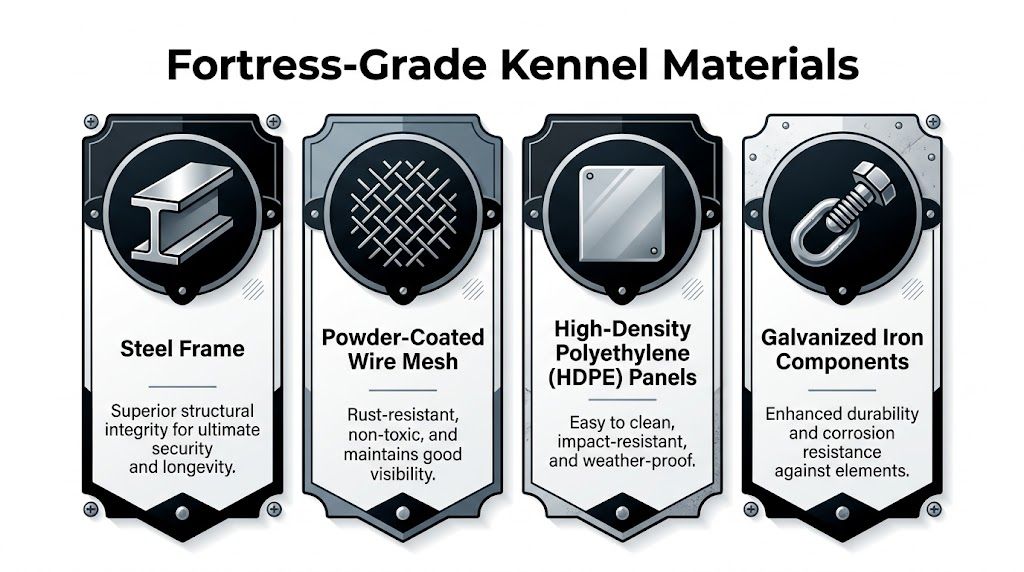
Heavy-duty steel remains the standard for high-drive, high-strength dogs. It resists flex better than lightweight wire crates and holds shape under repeated pressure. If the frame moves every time the dog leans, paws, or slams into the door, that movement becomes wear. Wear becomes failure.
Powder-coated finishes are also worth prioritizing. They tend to hold up better than cheap painted surfaces, especially in homes where the kennel gets cleaned often and exposed to moisture, grooming residue, or paw traffic. A finish that chips easily creates both a rust problem and a mouth hazard.
HDPE panels and galvanized components can also make sense in the right build, especially where cleanup, moisture resistance, and weather exposure matter. The key is how those materials are integrated. The strongest panel in the world won’t save a kennel with weak fasteners or a bad door assembly.
Construction details that separate good from bad
Look closer than the frame.
- Weld quality: Welds should look clean and complete, not spotty or rushed.
- Bar spacing: Gaps should prevent paw threading and jaw wedging.
- Door alignment: The door should close square, not drag or sit crooked.
- Floor support: The base shouldn’t sag under the dog’s weight and movement.
- Hardware quality: Bolts, hinges, and latches should feel substantial, not hollow or loose.
A kennel can look impressive online and still fail in a week. Owners should inspect every stress point. Corners matter. Door frames matter more. If the door is the weak side, the whole kennel is weak.
What doesn’t work for strong dogs
Thin wire crates often fail first. They’re fine for some dogs. They’re a gamble for a powerful dog that paws hard, mouths bars, or reacts to outside stimulation.
Soft-sided crates belong in a different category entirely. They’re useful for very specific dogs in very controlled conditions. They are not a smart primary option for most Pitbulls.
Buy for the dog on its worst restless day, not its calmest afternoon.
Chain-store convenience versus purpose-built gear
Mass-market crates sell on packaging, footprint, and convenience. Purpose-built kennels sell on structure. That’s the dividing line.
If you’re comparing options, ask direct questions. Does the frame flex? Can the latch be manipulated? Are the edges clean? Is the coating durable? Are replacement parts available? Dog kennels for pitbulls need to perform under pressure, not just look acceptable in a product listing.
Security Ventilation and Weather-Proofing for El Paso
Strength alone isn’t enough. A kennel can be built from solid material and still fail as a system.
Security, airflow, surface temperature, and placement all work together. In El Paso, that combination matters because heat changes the risk profile fast. A kennel that traps warm air, bakes in direct sun, or holds heat in the floor can become dangerous long before the owner notices a problem.
Security starts at the door
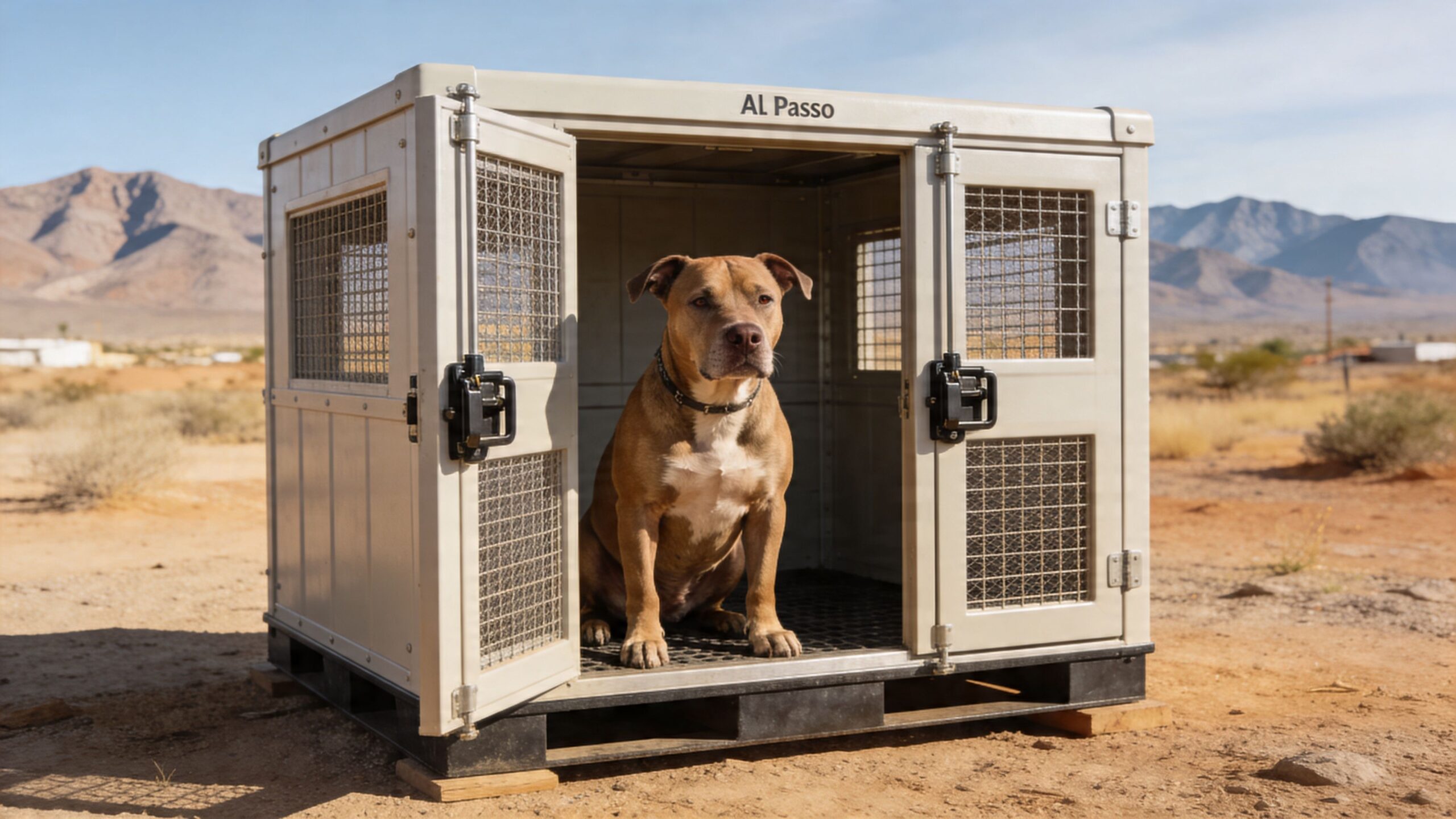
Most escapes happen at the door side. That means latch quality is not a minor feature.
You want a latch that closes cleanly, resists pawing, and doesn’t loosen with repeated use. Door hinges should move smoothly without wobble. If the door shifts inside the frame, even a strong latch can become unreliable because the pressure no longer lands where it should.
For indoor setups, place the kennel where the dog can settle without constant trigger stacking. Don’t put it beside a front window with nonstop foot traffic. Don’t wedge it against furniture that lets the dog brace and push. Stable placement reduces noise, frustration, and hardware stress.
Ventilation is part of safety
El Paso owners know what hot air feels like when it stops moving. Dogs know it faster.
Outdoor kennels need shade, open airflow, and surfaces that don’t hold brutal heat. Indoor kennels need room ventilation, clean air, and distance from garage heat or sealed sunrooms. Air exchange matters after exercise, after bathing, and during warm months when the dog’s body is already working to cool itself.
- Choose open-sided airflow where possible: Solid walls on every side can trap heat.
- Avoid dead-air corners: A kennel in a tight, unventilated nook is a poor setup.
- Watch flooring temperature: Metal and dark surfaces can store heat.
- Use dry bedding: Damp bedding in a warm environment turns stale fast.
Indoor versus outdoor use
Indoor kennels are easier to control. You manage temperature, monitor behavior, and keep the dog out of weather swings. For many homes, that’s the better everyday option.
Outdoor kennels need a higher standard. They should have reliable shade, weather-resistant construction, and a floor plan that keeps the dog off mud, standing water, or heat-loaded ground. A secure roof or cover also matters where sun exposure is harsh.
This short visual gives a useful look at practical kennel setup considerations:
The El Paso test
Before you approve any kennel setup, test it like this:
- Stand in the exact location at midday: If it feels punishing to you, it’s worse for the dog.
- Touch the floor surface: If it’s hot on your palm, it’s too hot for prolonged contact.
- Check cross-breeze: If air doesn’t move, fix that first.
- Inspect after a dust event: El Paso dust finds weak points in design and maintenance.
A safe kennel doesn’t just contain the dog. It protects the dog from the environment around the kennel.
Crate Training and Creating a Comfortable Den
The kennel should become the dog’s place, not the dog’s punishment.
That distinction changes everything. When crate training is done well, the dog walks in with confidence, settles faster, and treats the kennel like a quiet den. When it’s done poorly, the kennel becomes a fight, and every close of the door adds tension.
This matters at a bigger level too. In 2023, pit bull-type dogs accounted for 22% of all dogs entering North American shelters and 40% of shelter euthanasias despite representing only 5% of the U.S. dog population, according to The Pit Bull Coalition statistics page. Stable home routines, including proper crate training, help reduce the kind of stress and management breakdowns that can end in surrender.
Start with calm repetition
Bring the dog to the kennel before the dog is over-aroused. Don’t wait until the dog is barking, pacing, or fighting sleep.
Use food rewards, calm praise, and short sessions. Leave the door open first. Let the dog enter, exit, sniff, turn around, and discover that the kennel predicts good things.
A few basics help:
- Feed value inside the kennel: Meals, treats, and stuffed toys build a clean association.
- Keep sessions short at first: End while the dog is still succeeding.
- Use a release cue: Teach that coming out happens on your terms, not by rushing the door.
- Stay neutral on exits: Don’t create drama every time the dog comes out.
Build comfort without creating hazards
Bedding should match the dog’s behavior. Some Pitbulls do well with thick crate pads. Others shred them in one session. If your dog destroys bedding, switch to tougher kennel-safe options and supervise the transition.
For dogs that need a sturdier rest surface, this Kong crate bed guide is a useful starting point.
Toys should also be selected with discipline. One durable chew item is better than a pile of questionable items. Avoid anything with loose fabric, easy seams, or pieces that become swallowable once torn.
The dog should think, “I rest here.” Not, “I get sent here when people are upset.”
A routine that works
Many owners make crate training harder by being inconsistent. The dog gets kenneled at random times, with random energy, and with no predictable payoff. That creates resistance.
A better pattern looks like this:
- Exercise first when possible
- Brief drink break
- Kennel with a known cue
- Settle item or chew
- Quiet release once the dog is calm
That sequence teaches the dog how to transition from activity to rest. Dog kennels for pitbulls work best when the dog understands exactly what the kennel means.
The Glo More Standard for Hygiene and Maintenance
A clean kennel protects the dog’s skin, coat, paws, and respiratory comfort. It also protects your investment.
Owners often focus hard on buying the kennel and almost none on maintaining it. That’s backward. Even a premium build turns into a poor environment if hair, dander, body oils, drool, nail debris, and damp bedding are allowed to collect.
Clean like a professional, not casually
The kennel needs more than a quick wipe when it looks dirty. It needs a routine.
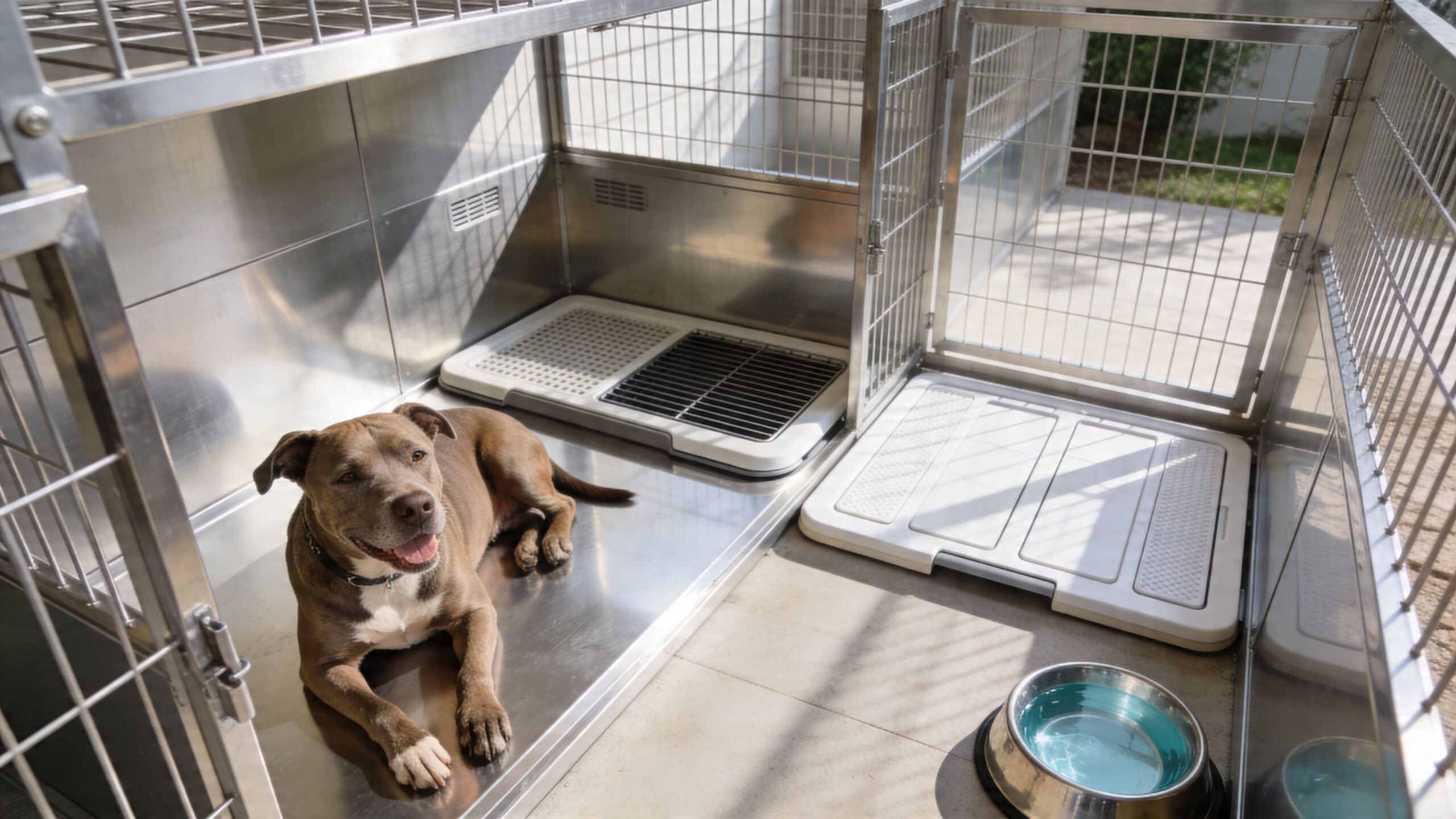
Daily cleaning prevents buildup. Weekly cleaning gets into seams, corners, trays, and hardware. Monthly inspection catches rust, loosened fasteners, rough edges, and worn finishes before they become safety issues.
A practical schedule looks like this:
- Daily reset: Remove loose hair, wipe surfaces, air out bedding, and check for moisture.
- Weekly deep clean: Wash tray or floor surface, scrub bars and door edges, disinfect, and fully dry.
- Monthly inspection: Check latch function, hinge movement, rust spots, cracks, coating wear, and floor stability.
Product choice matters
Use pet-safe cleaners that rinse clean and don’t leave harsh residue where the dog rests, licks, or rubs skin. Avoid over-scented household products that smell “clean” to people but overwhelm a dog’s nose.
If parasites are part of the problem, bathing protocol and kennel sanitation need to work together. This guide to the best flea bath for dogs helps owners think about that grooming side with more precision.
What owners miss most often
The dirtiest part of the kennel usually isn’t the obvious middle area. It’s the edges.
Door tracks, latch housings, lower corners, tray lips, and the underside of removable floors collect grime first. That buildup holds odor and keeps moisture where metal or coatings break down over time.
A few habits keep the kennel in fighting shape:
- Dry before reassembly: Moisture trapped under bedding or trays invites odor fast.
- Rotate bedding: One in use, one in wash works better than one bed used nonstop.
- Check chew points: Dogs often target the same corner or edge repeatedly.
- Inspect nails and paws: Sharp nails speed up wear on floors and bedding.
Clean equipment handles better. That’s true in grooming, training, and kennel care.
Dog kennels for pitbulls should look and smell controlled. If the kennel is stale, damp, greasy, or rough to the touch, standards have slipped.
A Lifetime of Loyalty and Leadership
A dog tests your standards when nobody is watching.
With Pitbulls, that matters. They are strong, people-focused, and quick to read inconsistency. A weak kennel setup, sloppy handling, or a loose daily routine creates problems that owners often blame on the dog. In practice, the issue is usually leadership, structure, and follow-through.
The right kennel supports that structure every day. It gives the dog a clear place to settle, gives the owner control during guests, deliveries, feeding, recovery, and travel prep, and supports the kind of calm routine that keeps powerful dogs manageable in a family home. That is not about making a Pitbull smaller. It is about giving the breed fair, disciplined care.
Those same standards carry into grooming and boarding. At Glo More Grooming, the expectation is controlled handling, clean equipment, limited volume, and one-on-one attention that respects the dog in front of us. That matters for Pitbulls, especially the ones who do poorly in loud, rushed, high-traffic chain environments and do better with steady hands and clear process.
Good owners usually care about the full picture. Kennel choice. Coat care. Skin condition. Nail length. Behavior in confinement. Recovery after stress. None of those categories live in isolation, and I have seen that firsthand. A dog with overgrown nails slips more, braces harder, and wears kennel surfaces faster. A dog with irritated skin rests poorly and starts associating the kennel with discomfort. Standards connect.
For families watching costs without wanting to lower the bar, the monthly affordable grooming promo called Snip & Style Saturday offers a practical way to keep up with maintenance while sticking to clear care standards.
Loyalty in this breed deserves leadership in return. Choose equipment that holds. Keep routines consistent. Handle grooming with the same discipline you expect from the dog. That is how good ownership looks.
Frequently Asked Questions About Pitbull Kennels
Are home kennels the same as travel crates
No. A heavy-duty home kennel is built for containment and daily structure in the house or yard. A flight or airline travel crate has its own compliance requirements and is designed for transport conditions. Don’t assume your home setup automatically works for air travel just because it feels sturdy.
Can a kennel help in areas with breed-specific restrictions
Yes, in practical terms. A secure kennel supports responsible containment, visitor management, service access, and safer daily handling. It won’t replace knowing your local rules, but it does show that you take control and public safety seriously.
My Pitbull has separation anxiety. Should I still use a kennel
Sometimes yes, but the introduction has to be careful. A kennel can help an anxious dog if the dog learns that the space predicts calm, routine, and safety. If the dog is already in panic, forcing long kennel sessions usually makes the problem worse.
Start with open-door work, food reinforcement, short absences, and calm returns. Watch for signs the dog is escalating instead of settling, such as frantic pawing, nonstop vocalizing, or repeated self-injury attempts. If you see that level of distress, bring in a qualified trainer or veterinary behavior professional.
What’s the best flooring inside a pitbull kennel
The best flooring is stable, easy to clean, and not abrasive. It should support traction without holding moisture. Avoid setups that slide, trap dampness, or create pressure points where elbows and hips rest.
Should I cover the kennel
Some dogs settle better with partial visual blocking. Others run hotter or get more aroused when visibility changes. Test the dog, not the trend. If you cover any part of the kennel, keep airflow as the priority.
If you want disciplined, one-on-one care that matches the same standards described in this guide, book with Glo More Grooming. From El Paso dog grooming to premium pet grooming, veteran-owned grooming, concierge-level handling, and the monthly affordable grooming promo through Snip & Style Saturday, the focus stays where it belongs: clean work, calm dogs, and consistent standards. Reserve your appointment now and secure your spot before the schedule fills.