
You hear it on the tile before you see it. Click. Click. Click.
Then your dog pauses at the doorway, shifts weight off one paw, and you notice a nail that looks rough at the edge. Maybe it’s flaking. Maybe it’s split. Maybe it looks thicker, duller, or more curved than the others. That’s the moment most owners in El Paso realize nail care isn’t cosmetic. It’s part of health.
Brittle dog nails can start as a nuisance and turn into pain fast. A cracked nail catches on a blanket. A weak dewclaw tears on a couch corner. A dog that used to sprint to the leash suddenly hesitates on hard floors. Those are small warnings, but they matter.
At a disciplined grooming studio, nails aren’t treated like a quick add-on at the end of a rushed appointment. They’re checked like a health marker. Texture, shape, wear pattern, sensitivity, and the dog’s response all tell a story. Sometimes the story is simple. The nails are overgrown and dry. Sometimes it points to nutrition, age, or a condition that needs a veterinarian.
That mindset reflects the standards behind veteran-owned grooming. Greatness means details matter. Loyalty means consistency, not shortcuts. Ownership means taking responsibility before a small problem becomes a painful one. In practical terms, that looks like calm handling, clean tool control, one-on-one attention, and a workflow that respects the dog in front of you instead of pushing them through like a number.
For El Paso families looking for El Paso dog grooming with more precision than a big-box chain usually delivers, brittle nails are one of those issues that separates routine service from real care. If you know what to look for, what causes it, and when to escalate, you can protect your dog’s comfort and mobility for the long run.
The Unmistakable "Click" of Concern
A lot of brittle nail cases start the same way. The owner doesn’t come in saying, “My dog has a structural nail problem.” They say, “I heard the nails on the floor,” or “one nail keeps snagging,” or “he’s licking that paw again.”
That’s a useful instinct. Healthy nails rarely draw attention to themselves.
In practice, the first visible sign may be minor. One edge looks shredded. A nail tip chips instead of wearing smoothly. The surface loses that dense, solid look and starts looking chalky or layered. If it keeps happening, the problem isn’t just bad luck.
What owners usually notice first
It's common to spot brittle dog nails in everyday moments:
- On hard flooring: The click gets louder because the nails are too long, uneven, or both.
- During paw wiping: A rough edge catches on the towel.
- After play: The dog favors one foot or licks a toe longer than usual.
- At bedtime: You see flakes or a small split on the blanket.
In El Paso, where dogs move between indoor flooring, concrete, gravel, and dry air, those small weaknesses get tested constantly. A nail that’s already compromised won’t hold up well under that kind of routine friction.
Why the details matter
A cracked nail isn’t always a crisis. Repeated cracking is different.
When a groomer works with discipline, the goal isn’t just to shorten the nail. It’s to read the paw. Is the damage isolated or repeated? Is one foot affected or several? Is the dog guarding the paw because of length, tenderness, or something deeper?
Practical rule: If a nail problem keeps returning, stop treating it like a one-time trim issue.
That’s where premium standards matter. A rushed environment often focuses on finishing the appointment. A careful environment focuses on what the nails are telling you.
Identifying the Red Flags of Brittle Nails
Brittle dog nails aren’t limited to obvious breaks. The earlier signs are usually quieter, and owners miss them because they don’t know what “normal” should look like.
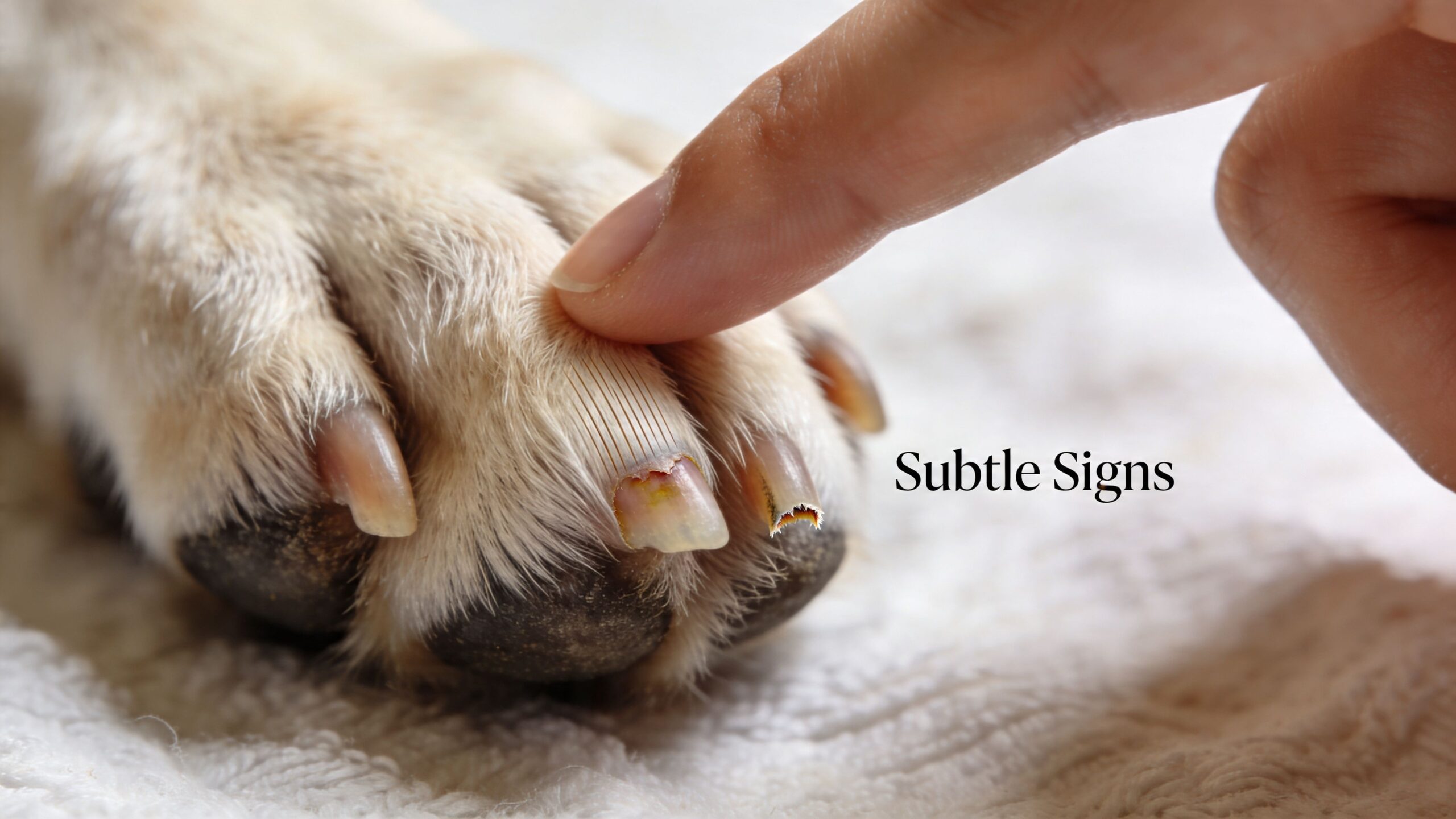
A large UK study of 31,605 dogs found a 1-year prevalence of nail clipping events of 5.64%, closely matching the 5.52% prevalence of overgrown nails, with Chihuahuas showing the highest annual prevalence at 13.29% according to this veterinary study on nail disorders in dogs. That tells you two things. Nail problems are common, and some dogs are more vulnerable than others.
Visual signs you shouldn't ignore
Start with a hands-on inspection under good light. Look at all four feet, not just the one your dog is favoring.
Watch for:
- Splitting at the tip: The nail separates into layers instead of staying dense and smooth.
- Flaking or peeling: Small shards come off when the nail touches fabric or flooring.
- Chipping: Pieces break away from the edge after normal activity.
- Abnormal curvature: The nail twists, hooks, or grows unevenly.
- Thickening or deformity: The nail looks blunt, misshapen, or heavier than the others.
- Discoloration: A nail that suddenly looks different from the rest deserves attention.
- Breakage across multiple nails: That’s a stronger warning than one injured claw.
Healthy nails vary by breed and foot shape, but they should still look structurally sound. They shouldn’t crumble under normal pressure.
Behavioral clues matter too
Dogs often signal nail discomfort before the nail looks dramatic.
Common behavior changes include:
- Paw licking or chewing
- Reluctance on tile or concrete
- Pulling the paw away during handling
- Shortened stride or subtle limping
- Resistance during nail trimming when they were previously tolerant
Some owners assume this is stubbornness. It often isn’t. It’s pain, pressure, or irritation.
Here’s a quick visual overview of what to watch for in everyday grooming checks.
A simple home check
Run this check once a week:
- Look straight at the nail tips for fraying or uneven edges.
- Check the side profile for curling or odd angle changes.
- Press gently around the toe and note any sensitivity.
- Watch your dog walk away from you on a hard surface.
If your dog keeps licking one paw and the nail looks even slightly off, treat that as useful information, not overreaction.
Understanding the Root Causes of Nail Deterioration
When brittle dog nails keep returning, the nail itself usually isn’t the whole problem. It’s the symptom. The question is what’s weakening the structure in the first place.
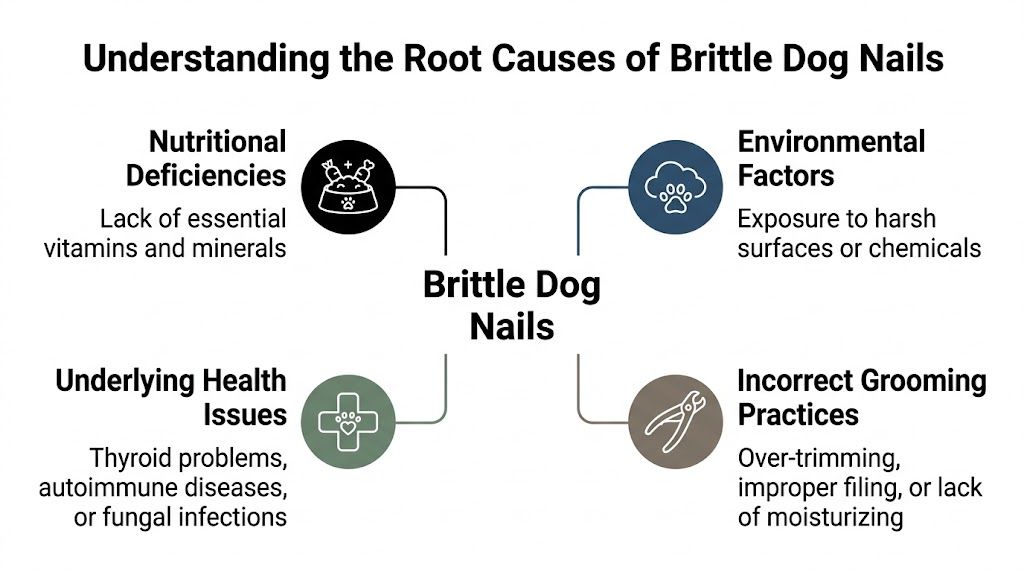
Dog nails are over 90% keratin protein, and brittleness often tracks back to nutritional issues involving biotin, zinc, and collagen. Age-related collagen decline in dogs over 7 also correlates with increased nail brittleness, as described in this review on brittle dog nails and nail structure.
Nutrition builds the nail you see later
Nails grow slowly. That means weak nails often reflect what’s been happening internally for months, not days.
If a dog lacks the building blocks needed for strong keratin structure, the nail plate gets fragile. It may look normal at first, then start splitting under routine pressure. That’s why changing trim technique alone doesn’t solve every case.
Some dogs also eat well on paper but still don’t absorb nutrients properly. When brittleness persists despite decent food, it can point to a broader health issue rather than a grooming mistake.
Environment in El Paso adds friction
Local conditions matter.
El Paso dogs deal with dry air, hot walking surfaces, concrete, gravel, and backyard wear that can challenge already weakened nails. Dryness doesn’t create every brittle nail case, but it can make marginal nails fail faster. A nail with weak structure is more likely to crack when it repeatedly hits hard ground or catches on abrasive surfaces.
A practical example is the active dog who seems fine at rest but keeps coming home with rough nail edges after outdoor play. That dog may not need less activity. The dog may need better trim control, smoother finishing, paw conditioning, and a closer look at diet.
Health problems can mimic simple overgrowth
Some nail issues start as what owners assume is basic neglect. Then the pattern changes.
Pay attention when you see:
- Several nails affected at once
- Repeated breakage despite regular care
- Thickened or deformed regrowth
- Pain that seems out of proportion to a small split
- Signs of infection around the nail bed
Those patterns can suggest infection, immune-related disease, or another systemic problem. That’s why a careful grooming assessment matters. The nail may be the first visible clue.
Strong nail care starts with one honest question. Is this just wear and tear, or is the body struggling to build a healthy nail?
When to Escalate Care to a Veterinarian
Some brittle dog nails belong in a grooming schedule. Some belong in a medical chart.
If one nail cracks after rough play, a groomer may be able to help you maintain length and reduce further snagging once the area is stable. If multiple nails begin splitting, sloughing, thickening, or deforming across several feet, that’s no longer a routine maintenance conversation.
The pattern that changes everything
Lupoid onychodystrophy, often shortened to LO, is an autoimmune disorder in which the immune system attacks the nail bed. It can affect all four feet, and diagnosis requires a veterinary biopsy because it can resemble other nail problems while needing long-term immunosuppressive treatment, as explained in this article on recognizing and treating unhealthy dog nails.
That matters because owners often try to solve a medical issue with better trimming. Better trimming won’t fix LO.
Veterinary care isn't optional when you see these signs
Book a veterinary visit if you notice any of the following:
- Multiple nails breaking across different paws
- Blood, pus, swelling, or strong odor around the nail
- A dog that cries, jerks away, or won't bear weight
- Rapid nail deformity
- Nails sloughing off or regrowing in an abnormal shape
- Brittleness that keeps returning despite consistent care
If you’re trying to decide whether the issue is routine or urgent, this guide on where to get my dog's nails cut can help clarify what belongs in a grooming setting and what needs a veterinarian.
Why experienced eyes matter
An educated groomer can spot patterns early. A veterinarian confirms the cause.
That partnership protects the dog. It also saves owners from wasting time on the wrong fix. If a dog has a painful immune-mediated nail disorder, waiting it out while trying random home products only extends discomfort.
When several nails fail at once, stop thinking cosmetic and start thinking clinical.
At-Home Remedies Versus Professional Grooming Standards
Home care has a place. It just has limits.
Owners should absolutely monitor paws, keep nails on schedule, support nutrition, and avoid letting a damaged nail snag repeatedly. But brittle dog nails expose the line between maintenance and precision. Most problems don’t come from lack of effort. They come from lack of visibility, tool control, or knowing when a nail is warning you about something deeper.
What works at home
At-home care is useful for consistency:
- Routine observation: Weekly checks catch rough edges early.
- Environmental management: Limiting hard impact on already damaged nails helps.
- Diet support: Vet-guided nutrition changes can support stronger regrowth over time.
- Paw handling practice: Dogs that tolerate foot handling are easier to help safely.
What doesn’t work well at home is guesswork. Owners often clip too conservatively and leave the nail too long, or they trim too aggressively and hit the quick. Others focus on one cracked nail and miss that several more are becoming brittle.
What professional standards add
Professional work should bring more than speed. It should bring judgment.
A disciplined groomer reads nail length, angle, thickness, edge integrity, and the dog’s tolerance before making the first cut. Grinding can smooth and refine a brittle edge that clipping alone may leave sharp or vulnerable. Calm handling matters too, especially for dogs that have learned to fear paw work.
For owners comparing methods, this article on dog nail grinding vs clipping outlines the practical differences between the two approaches.
Nail Care Decision Matrix: At-Home vs. Glo More Professional
| Factor | At-Home Care | Glo More Professional Grooming |
|---|---|---|
| Observation | Limited to what the owner notices during routine handling | Structured visual and hands-on assessment during service |
| Tool control | Depends on owner skill and dog cooperation | Controlled trim and finishing workflow |
| Stress management | Can be difficult if the dog resists familiar handling | One-on-one handling designed to reduce escalation |
| Nail finishing | Often stops at clipping | Can include smoothing rough edges after trim |
| Pattern recognition | Easy to miss gradual changes across multiple nails | More likely to catch recurring texture and shape changes |
| Medical boundaries | Owners may delay escalation | Concerning signs can be flagged for veterinary follow-up |
The big-box chain trade-off
Chain salons work for some dogs. But if your dog has brittle nails, sensitivity, or a history of rough handling, an impersonal pace becomes a real drawback. The less individualized the appointment, the easier it is to miss subtle nail deterioration or push through stress signals that matter.
That’s where premium pet grooming stands apart. The dog isn’t moving through a volume system. The care can slow down enough to stay precise.
The Glo More Grooming Protocol for Perfect Paws
Disciplined nail care is a workflow, not a single cut.
For brittle dog nails, the process has to protect structure, reduce snag points, and keep the dog calm enough for accurate handling. That means no rushed restraint, no rough clipping just to get through the appointment, and no pretending a frayed nail is fine because it’s technically shorter.
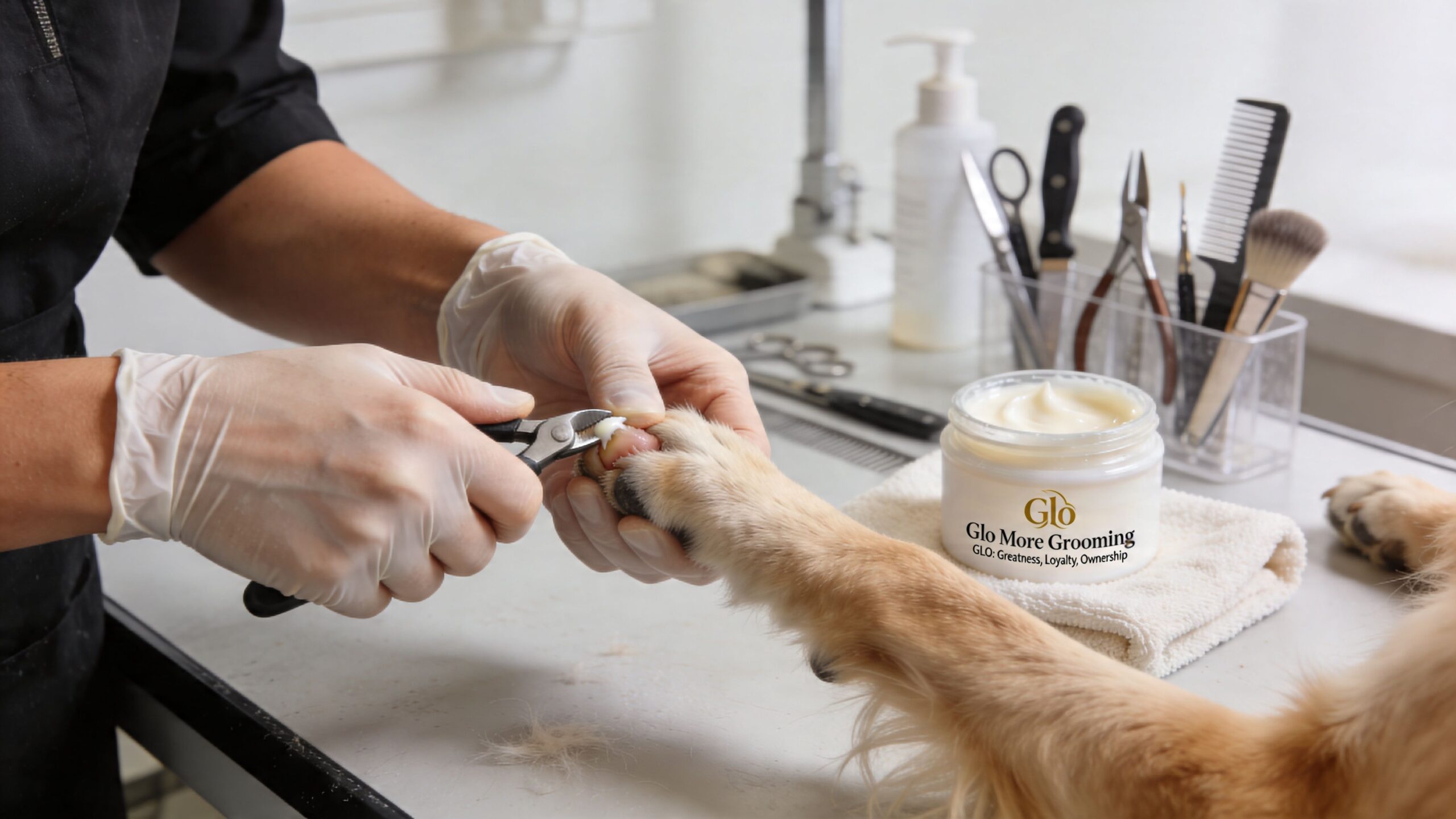
The paw-care sequence
A premium workflow usually follows a clean sequence:
Initial inspection
Each foot is checked before trimming starts. Brittle edges, uneven wear, tenderness, and visible deformity need to be recognized first.Controlled trim
Length is reduced carefully with attention to the dog’s nail shape and tolerance. The job isn’t to remove as much as possible. It’s to establish a safe, manageable length.Edge refinement
Grinding or careful finishing smooths sharp points that can catch on blankets, carpet, or upholstery. On brittle nails, this step often matters more than owners realize.Paw conditioning
Pads and surrounding skin benefit from moisture support, especially in dry regional conditions where paws and nails both take a beating.Behavior review
The dog’s response gets noted. Calm acceptance, flinching, guarding, or repeated sensitivity all help guide future care intervals.
Why one-on-one handling changes the result
Nail work gets worse when the dog feels cornered. The body tightens. The paw jerks. Precision drops.
That’s why the one-dog-at-a-time model matters for sensitive nail cases. A quieter environment makes it easier to work deliberately, and deliberate work is what brittle nails need. Glo More Grooming offers nail trims within full grooming care and uses a limited on-site workflow rather than a high-volume chain format, which suits dogs who don’t do well in a noisy rotation.
A practical local option
For owners who want regular care without overcomplicating it, Snip & Style Saturday gives the El Paso community an affordable grooming promo entry point to structured paw maintenance. It’s a practical fit for families who want consistency without sacrificing standards.
Clean nails should do three things. Support the dog’s gait, reduce snag risk, and give you a clear view of anything abnormal.
That’s the benchmark. Not just shorter nails. Better-functioning paws.
A Proactive Strategy for Lifelong Paw Health
The best way to handle brittle dog nails is to stop chasing flare-ups and build a repeatable routine. Prevention isn’t glamorous, but it’s what keeps dogs comfortable.
A veterinary dermatology source notes that nutritional deficiencies are a primary factor in over 90% of brittle nail cases in some studies, and that biotin supplementation and fish oil have been shown to resolve brittleness and restore healthy claws over several months, especially in at-risk breeds such as German Shepherds, Golden Retrievers, and Greyhounds according to this overview of dog nail problems.
The routine that holds up
A solid prevention plan looks like this:
- Check paws weekly: Don’t wait for a limp. Look at nail tips, side profile, and the skin around each nail.
- Keep a steady trim schedule: Long gaps invite overgrowth, strain, and breakage.
- Support the diet: If nails stay weak, ask your veterinarian whether biotin, fish oil, or broader nutritional review makes sense.
- Watch breed patterns: Some dogs need closer monitoring because they’re more prone to nail trouble.
- Track repeated incidents: If nail breakage becomes a pattern, stop calling it random.
Seasonal care in El Paso
Local conditions change how paws wear.
During hotter months, outdoor surfaces can increase stress on the feet. In drier periods, pads and nails may both need closer attention. Dogs that spend time on gravel, rock, or concrete often need a more disciplined trim cycle than dogs living mostly on grass and carpet.
A useful home skill is learning how to smooth minor roughness between appointments without overdoing it. This guide on how to file dog nails helps owners build safer maintenance habits.
What long-term owners do differently
They don’t wait for the dramatic break. They respond to the early signs.
That means noticing a texture change, adjusting the routine, and involving a veterinarian when the pattern stops making sense as a simple grooming issue. It’s a steady approach, not a reactive one, and it protects your dog far better over time.
Take Ownership of Your Dog’s Wellness Today
Brittle dog nails rarely improve through neglect. They improve when someone pays attention early, trims with precision, supports the dog’s overall health, and knows when the problem has moved beyond grooming.
That’s the standard responsible owners should expect from themselves and from the professionals they trust. In El Paso, that matters even more. Dry conditions, hard surfaces, and active dogs expose weak nail care fast.
The right approach is straightforward. Learn the red flags. Don’t dismiss repeated cracking or flaking. Stay disciplined with routine maintenance. Escalate to a veterinarian when the pattern points to pain, infection, or disease. Choose care that gives your dog calm handling instead of conveyor-belt treatment.
Chains can process appointments. That’s not the same as careful observation. For dogs with brittle nails, sensitive paws, or recurring nail damage, detail matters. So does environment. So does accountability.
That’s where the values behind veteran-owned grooming carry real weight. Greatness is in the details. Loyalty is in showing up consistently. Ownership is acting before your dog has to suffer for your delay.
If your dog’s nails are clicking harder, splitting more often, or not looking right, don’t wait for the next snag, tear, or painful step. Get in front of it with a routine built on discipline and real care.
If you’re ready for El Paso dog grooming that treats paw health like it matters, book with Glo More Grooming. Reserve your next appointment, ask about Snip & Style Saturday, or reach out for concierge-level support if your dog needs a more customized care plan.